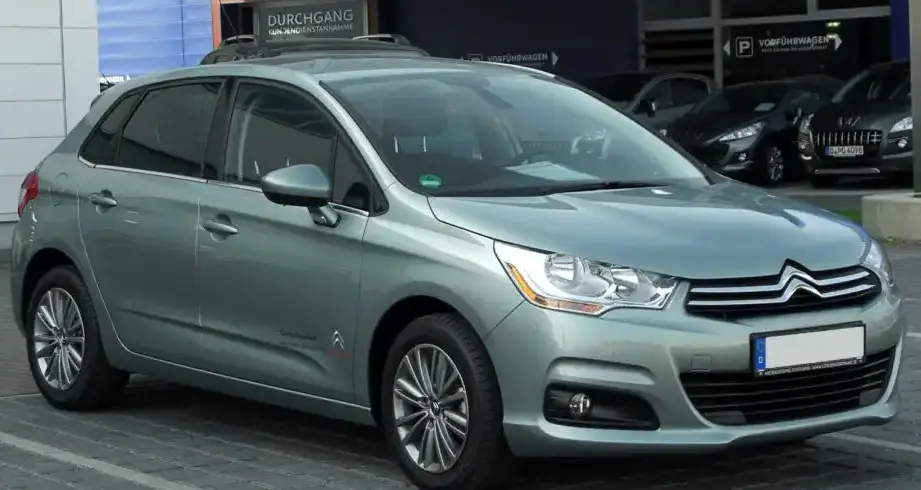
The Citroen C4 II Hatchback, specifically the 1.6 THP (156 hp) variant equipped with the electronically controlled gearbox (EGS), was a significant offering in the European compact car market from 2011 to 2015. Positioned as a mid-range trim level within the C4 II lineup, it aimed to bridge the gap between more economical engine options and the higher-performance versions. This model represented Citroen’s attempt to offer a blend of efficiency, performance, and modern technology in a practical five-door hatchback package, built on the PSA Group’s Platform 2 (EMP2) architecture, also known as the 1HX0/A3 platform.
Technical Specifications
| Brand | Citroen |
| Model | C4 |
| Generation | C4 II Hatchback (Phase I, 2010) |
| Type (Engine) | 1.6 THP (156 Hp) EGS |
| Start of production | 2011 |
| End of production | 2015 |
| Powertrain Architecture | Internal Combustion engine |
| Body type | Hatchback |
| Seats | 5 |
| Doors | 5 |
| Fuel consumption (urban) | 8.6 l/100 km (27.4 US mpg, 32.8 UK mpg, 11.6 km/l) |
| Fuel consumption (extra urban) | 5.1 l/100 km (46.1 US mpg, 55.4 UK mpg, 19.6 km/l) |
| Fuel consumption (combined) | 6.4 l/100 km (36.8 US mpg, 44.1 UK mpg, 15.6 km/l) |
| CO2 emissions | 148 g/km |
| Fuel Type | Petrol (Gasoline) |
| Acceleration 0 – 100 km/h | 8.7 sec |
| Acceleration 0 – 62 mph | 8.7 sec |
| Acceleration 0 – 60 mph | 8.3 sec |
| Maximum speed | 214 km/h (132.97 mph) |
| Emission standard | Euro 5 |
| Weight-to-power ratio | 8.2 kg/Hp, 122.4 Hp/tonne |
| Weight-to-torque ratio | 5.3 kg/Nm, 188.2 Nm/tonne |
| Power | 156 Hp @ 6000 rpm |
| Power per litre | 97.6 Hp/l |
| Torque | 240 Nm @ 1400 rpm (177.01 lb.-ft. @ 1400 rpm) |
| Engine layout | Front, Transverse |
| Engine Model/Code | 5FV EP6CDT |
| Engine displacement | 1598 cm3 (97.52 cu. in.) |
| Number of cylinders | 4 |
| Engine configuration | Inline |
| Cylinder Bore | 77 mm (3.03 in.) |
| Piston Stroke | 85.8 mm (3.38 in.) |
| Compression ratio | 11:1 |
| Number of valves per cylinder | 4 |
| Fuel injection system | Direct injection |
| Engine aspiration | Turbocharger, Intercooler |
| Valvetrain | DOHC |
| Engine oil capacity | 4.25 l (4.49 US qt | 3.74 UK qt) |
| Kerb Weight | 1275 kg (2810.89 lbs.) |
| Max. weight | 1805 kg (3979.34 lbs.) |
| Max load | 530 kg (1168.45 lbs.) |
| Trunk (boot) space – minimum | 380 l (13.42 cu. ft.) |
| Trunk (boot) space – maximum | 1183 l (41.78 cu. ft.) |
| Fuel tank capacity | 60 l (15.85 US gal | 13.2 UK gal) |
| Permitted trailer load with brakes (8%) | 1560 kg (3439.21 lbs.) |
| Permitted trailer load with brakes (12%) | 1400 kg (3086.47 lbs.) |
| Permitted trailer load without brakes | 675 kg (1488.12 lbs.) |
| Permitted towbar download | 75 kg (165.35 lbs.) |
| Length | 4329 mm (170.43 in.) |
| Width | 1789 mm (70.43 in.) |
| Width including mirrors | 2050 mm (80.71 in.) |
| Height | 1489-1502 mm (58.62 – 59.13 in.) |
| Wheelbase | 2608 mm (102.68 in.) |
| Front track | 1522-1536 mm (59.92 – 60.47 in.) |
| Rear (Back) track | 1515-1529 mm (59.65 – 60.2 in.) |
| Front overhang | 935 mm (36.81 in.) |
| Rear overhang | 786 mm (30.94 in.) |
| Drag coefficient (Cd) | 0.30 |
| Minimum turning circle (turning diameter) | 10.7 m (35.1 ft.) |
| Drivetrain Architecture | The Internal combustion engine (ICE) drives the front wheels of the vehicle. |
| Drive wheel | Front wheel drive |
| Number of gears and type of gearbox | 6 gears, automatic transmission EGS |
| Front suspension | Independent, type McPherson with coil spring and anti-roll bar |
| Rear suspension | Semi-independent, coil spring |
| Front brakes | Ventilated discs |
| Rear brakes | Disc |
| Assisting systems | ABS (Anti-lock braking system) |
| Steering type | Steering rack and pinion |
| Tires size | 205/55 R16; 225/45 R17 |
| Wheel rims size | 16; 17 |
Powertrain & Engine Architecture
The heart of this C4 variant is the 1.6-liter, four-cylinder 5FV EP6CDT engine. This engine is part of the Prince engine family, a collaborative development between PSA Group (Peugeot Citroen) and BMW. It features direct fuel injection, a turbocharger with an intercooler, and a double overhead camshaft (DOHC) valvetrain. The direct injection system, coupled with the turbocharging, allows for a good balance of power and fuel efficiency. The engine produces 156 horsepower at 6000 rpm and 240 Nm (177 lb-ft) of torque at a relatively low 1400 rpm. This torque curve contributes to good responsiveness in everyday driving situations.
The EGS (Electronically Controlled Gearbox) transmission is a six-speed automated manual transmission. Unlike a traditional automatic with a torque converter, the EGS uses actuators to shift gears, offering quicker shifts and potentially better fuel economy. However, it can sometimes exhibit less smoothness compared to conventional automatics, particularly at lower speeds. The EGS transmission was often criticized for its sometimes jerky shifts and lack of refinement compared to more sophisticated automatic gearboxes.
Driving Characteristics
The 1.6 THP EGS C4 offers a reasonably engaging driving experience. The 156 hp output provides adequate acceleration, with a 0-60 mph time of around 8.3 seconds. The readily available torque from 1400 rpm makes it feel responsive in most driving scenarios. However, the EGS transmission can detract from the overall experience, with noticeable shifts and occasional hesitation. Compared to the more economical 1.6 VTi (naturally aspirated) versions, the THP offers significantly more power. Against the diesel options, like the 1.6 HDi, the THP provides a more spirited driving experience but sacrifices some fuel economy. The gear ratios are tuned for a balance between acceleration and fuel efficiency, but the EGS transmission doesn’t always exploit the engine’s potential as effectively as a manual gearbox.
Equipment & Trim Levels
The 1.6 THP EGS trim typically included features such as air conditioning, power windows, power mirrors, a CD/MP3 stereo system, and alloy wheels. Higher trim levels offered options like automatic headlights and rain-sensing wipers, a navigation system, and leather upholstery. Interior upholstery was generally cloth, with the option of partial leather on some models. The dashboard layout was typical of Citroen at the time, with a focus on ergonomics and functionality. Optional extras included parking sensors, a panoramic sunroof, and upgraded audio systems.
Chassis & Braking
The C4 II utilized an independent McPherson strut suspension at the front and a semi-independent coil spring suspension at the rear. This setup provided a comfortable ride quality, absorbing bumps and imperfections in the road reasonably well. The front brakes were ventilated discs, while the rear brakes were solid discs. ABS (Anti-lock Braking System) was standard. Stabilizer bars were fitted to both the front and rear axles to reduce body roll during cornering. The suspension tuning was geared towards comfort rather than outright sportiness.
Market Reception & Comparison
The 1.6 THP EGS C4 received mixed reviews. Critics praised the engine’s performance and fuel efficiency but often criticized the EGS transmission for its lack of smoothness and occasional jerkiness. Compared to the diesel models, the THP offered a more engaging driving experience but was less fuel-efficient. Against competitors like the Ford Focus, Volkswagen Golf, and Opel Astra, the C4 offered a distinctive design and a comfortable ride, but the EGS transmission was often seen as a disadvantage. Fuel economy figures averaged around 36.8 US mpg (combined), which was competitive but not class-leading.
Legacy
The 1.6 THP engine proved to be relatively reliable, although some owners have reported issues with the carbon buildup on the intake valves, a common problem with direct injection engines. The EGS transmission, however, has a reputation for being less durable than traditional automatic transmissions, with some units experiencing failures. Today, the 1.6 THP EGS C4 can be found on the used car market at relatively affordable prices. It represents a decent value for buyers looking for a stylish and reasonably well-equipped compact hatchback, but potential buyers should be aware of the potential issues with the EGS transmission and the need for regular maintenance to prevent carbon buildup in the engine.