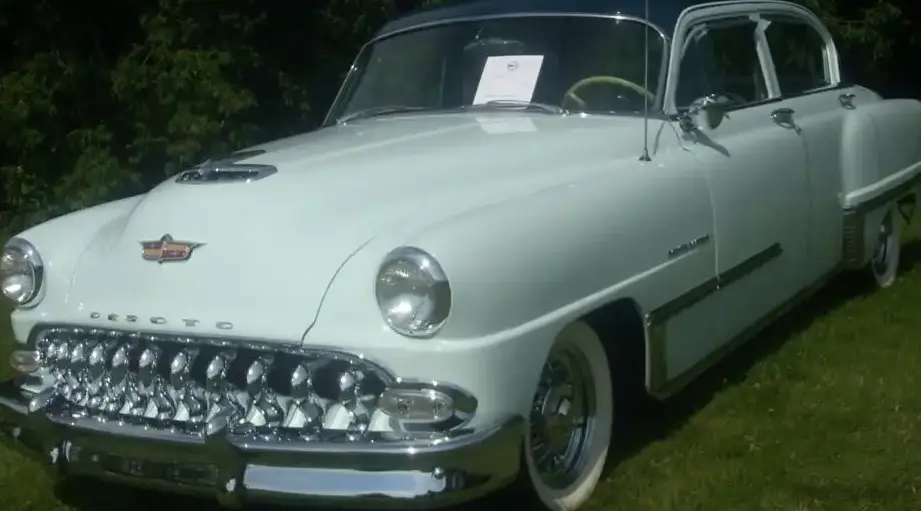
The DeSoto Powermaster Six Sportsman Coupe with the 4.1-liter (250.56 cu. in.) engine and “Tip-Toe Shift” automatic transmission represents a significant, though often overlooked, entry in the early 1950s American automotive landscape. Produced for the 1952 and 1953 model years, this variant occupied a middle ground within the Powermaster Six lineup, offering a blend of style, comfort, and relatively economical operation compared to DeSoto’s higher-performance offerings. It was built upon the foundation of the post-war redesign of the DeSoto line, aiming to attract buyers seeking a full-size car with modern features and a touch of luxury.
Technical Specifications
| Brand | DeSoto |
| Model | Powermaster Six |
| Generation | Powermaster Six Sportsman Coupe |
| Type (Engine) | 4.1 (116 Hp) Tip-Toe Shift |
| Start of production | 1952 |
| End of production | 1953 |
| Powertrain Architecture | Internal Combustion engine |
| Body type | Coupe |
| Seats | 6 |
| Doors | 2 |
| Fuel Type | Petrol (Gasoline) |
| Power | 116 Hp @ 3600 rpm |
| Power per litre | 28.3 Hp/l |
| Torque | 282 Nm @ 1600 rpm / 207.99 lb.-ft. @ 1600 rpm |
| Engine displacement | 4106 cm3 / 250.56 cu. in. |
| Number of cylinders | 6 |
| Engine configuration | Inline |
| Cylinder Bore | 87.31 mm / 3.44 in. |
| Piston Stroke | 114.3 mm / 4.5 in. |
| Compression ratio | 7:1 |
| Number of valves per cylinder | 2 |
| Fuel injection system | Carburettor |
| Engine aspiration | Naturally aspirated engine |
| Engine oil capacity | 4.7 l / 4.97 US qt | 4.14 UK qt |
| Coolant | 15.1 l / 15.96 US qt | 13.29 UK qt |
| Fuel tank capacity | 64 l / 16.91 US gal | 14.08 UK gal |
| Length | 5420 mm / 213.39 in. |
| Width | 1963 mm / 77.28 in. |
| Height | 1588 mm / 62.52 in. |
| Wheelbase | 3188 mm / 125.51 in. |
| Front track | 1430 mm / 56.3 in. |
| Rear (Back) track | 1513 mm / 59.57 in. |
| Drag coefficient (Cd) | 0.60 |
| Minimum turning circle (turning diameter) | 13 m / 42.65 ft. |
| Drivetrain Architecture | The Internal combustion engine (ICE) drives the rear wheels of the vehicle. |
| Drive wheel | Rear wheel drive |
| Number of gears and type of gearbox | 4 gears, automatic transmission Tip-Toe Shift |
| Front suspension | Independent coil spring |
| Rear suspension | Leaf spring |
| Front brakes | Drum, 305 mm |
| Rear brakes | Drum, 305 mm |
Powertrain & Engine Architecture
The heart of the Powermaster Six Sportsman Coupe was DeSoto’s 4.1-liter inline-six cylinder engine. This engine, designated within the Chrysler corporation as part of the “Hemi-Head” family (though not a true hemispherical head), featured a combustion chamber design intended to balance power and efficiency. It utilized a single Carter carburetor, providing fuel delivery to the engine. The 7:1 compression ratio was typical for the era, balancing performance with the availability of regular gasoline. The engine produced 116 horsepower at 3600 rpm and 282 Nm (207.99 lb-ft) of torque at 1600 rpm. The “Tip-Toe Shift” automatic transmission was a Fluid Drive unit, a semi-automatic transmission that used a fluid coupling instead of a traditional clutch. This system provided smooth, but not particularly quick, gear changes. It featured four forward speeds and one reverse.
Driving Characteristics
The 116 horsepower and automatic transmission combination resulted in a driving experience geared towards comfortable cruising rather than spirited performance. Acceleration was adequate for highway merging and passing, but the car was not designed for rapid acceleration. The Tip-Toe Shift transmission, while smooth, lacked the responsiveness of a manual transmission or more modern automatics. The gear ratios were optimized for relaxed cruising, with a focus on fuel economy (relative to the standards of the time). Compared to the more powerful Powermaster V8 models, the six-cylinder version felt noticeably less energetic. However, it offered a smoother and quieter ride, and was generally considered more economical to operate.
Equipment & Trim Levels
The Sportsman Coupe, even in its 1.8L configuration, was reasonably well-equipped for the early 1950s. Standard features included a spacious interior with seating for six passengers, a heater, and a basic instrument panel. Upholstery was typically cloth, available in a range of period-appropriate colors and patterns. Optional extras included a radio, whitewall tires, and a two-tone paint scheme. The trim level of the Sportsman Coupe was considered mid-range within the Powermaster Six lineup. It offered more features than the base models but lacked the luxurious appointments of the higher-end DeLuxe models.
Chassis & Braking
The Powermaster Six Sportsman Coupe utilized a body-on-frame construction, typical of American cars of the era. The front suspension was independent, employing coil springs, while the rear suspension used a traditional leaf spring setup. This configuration provided a comfortable ride, but handling was not particularly precise. Braking was accomplished via drum brakes on all four wheels, measuring 305 mm in diameter. While adequate for the car’s weight and performance, the drum brakes lacked the stopping power of modern disc brakes. Steering was of the recirculating ball type, offering relatively light effort but limited feedback.
Market Reception & Comparison
The DeSoto Powermaster Six Sportsman Coupe was generally well-received by automotive critics of the time. It was praised for its stylish design, comfortable ride, and spacious interior. However, the six-cylinder engine and Tip-Toe Shift transmission were often criticized for their lack of performance. Compared to competitors like the Ford Custom Deluxe and Chevrolet Bel Air, the DeSoto offered a similar level of comfort and features, but with a slightly more upscale image. Fuel economy was comparable to other full-size cars of the era, averaging around 16-18 miles per gallon. Reliability was generally good, although the Tip-Toe Shift transmission could be prone to occasional issues.
Legacy
Today, the DeSoto Powermaster Six Sportsman Coupe is a relatively rare and collectible classic car. While not as highly sought after as some of its V8-powered siblings, the six-cylinder version offers a unique and affordable entry into the world of vintage American automobiles. The 4.1-liter engine and Tip-Toe Shift transmission are generally considered reliable, although parts availability can be a challenge. The car’s simple mechanical design makes it relatively easy to maintain and repair for experienced mechanics. The Powermaster Six Sportsman Coupe represents a fascinating snapshot of early 1950s American automotive design and engineering, offering a glimpse into a bygone era of style, comfort, and relatively uncomplicated motoring.