
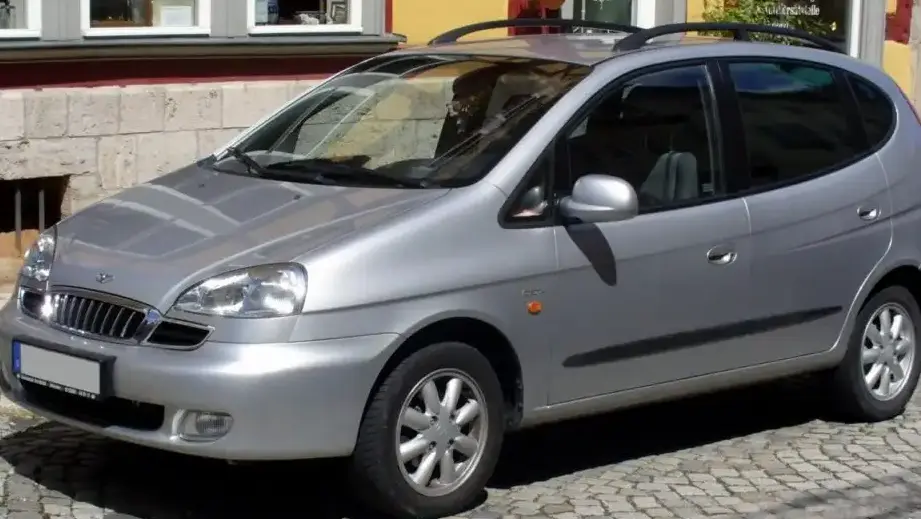
The Daewoo Rezzo, known as the Daewoo Tacuma in some European markets, was a compact minivan produced by the South Korean automaker Daewoo from 2000 to 2008. The Rezzo (KLAU) 2.0 16V, equipped with a 2.0-liter inline-four engine producing 136 horsepower, represented a mid-range offering within the Rezzo lineup. It aimed to provide a practical and affordable family vehicle, particularly in markets where multi-purpose vehicles (MPVs) were gaining popularity. The Rezzo was based on the GM Delta platform, shared with other vehicles like the Opel/Vauxhall Astra and Zafira, reflecting Daewoo’s close ties with General Motors prior to its acquisition.
Technical Specifications
| Brand | Daewoo |
| Model | Rezzo |
| Generation | Rezzo (KLAU) |
| Type (Engine) | 2.0 16V (136 Hp) |
| Start of production | 2000 year |
| End of production | 2008 year |
| Powertrain Architecture | Internal Combustion engine |
| Body type | Minivan |
| Seats | 5 |
| Doors | 5 |
| Fuel consumption (urban) | 12 l/100 km (19.6 US mpg) |
| Fuel consumption (extra urban) | 8 l/100 km (29.4 US mpg) |
| Fuel Type | Petrol (Gasoline) |
| Acceleration 0 – 100 km/h | 13.4 sec |
| Acceleration 0 – 62 mph | 13.4 sec |
| Acceleration 0 – 60 mph | 12.7 sec |
| Maximum speed | 200 km/h (124.27 mph) |
| Weight-to-power ratio | 9.3 kg/Hp |
| Weight-to-torque ratio | 6.9 kg/Nm |
| Power | 136 Hp @ 5600 rpm |
| Power per litre | 68.1 Hp/l |
| Torque | 184 Nm @ 4000 rpm (135.71 lb.-ft. @ 4000 rpm) |
| Engine layout | Front, Transverse |
| Engine displacement | 1998 cm3 (121.93 cu. in.) |
| Number of cylinders | 4 |
| Engine configuration | Inline |
| Cylinder Bore | 86 mm (3.39 in.) |
| Piston Stroke | 86 mm (3.39 in.) |
| Compression ratio | 9.5:1 |
| Number of valves per cylinder | 4 |
| Fuel injection system | Multi-port manifold injection |
| Engine aspiration | Naturally aspirated engine |
| Valvetrain | DOHC |
| Kerb Weight | 1270 kg (2799.87 lbs.) |
| Max. weight | 1745 kg (3847.07 lbs.) |
| Max load | 475 kg (1047.2 lbs.) |
| Trunk (boot) space – minimum | 455 l (16.07 cu. ft.) |
| Trunk (boot) space – maximum | 1165 l (41.14 cu. ft.) |
| Fuel tank capacity | 60 l (15.85 US gal | 13.2 UK gal) |
| Length | 4350 mm (171.26 in.) |
| Width | 1750 mm (68.9 in.) |
| Height | 1580 mm (62.2 in.) |
| Wheelbase | 2600 mm (102.36 in.) |
| Front track | 1474 mm (58.03 in.) |
| Rear (Back) track | 1480 mm (58.27 in.) |
| Drivetrain Architecture | The Internal combustion engine (ICE) drives the front wheels of the vehicle. |
| Drive wheel | Front wheel drive |
| Number of gears and type of gearbox | 5 gears, manual transmission |
| Front suspension | Spring Strut |
| Rear suspension | Coil spring |
| Front brakes | Ventilated discs |
| Rear brakes | Drum |
| Assisting systems | ABS (Anti-lock braking system) |
| Steering type | Steering rack and pinion |
| Tires size | 195/60 R15 |
| Wheel rims size | 6.5J X 15 |
Powertrain & Engine Architecture
The Rezzo 2.0 16V was powered by the GM Family II engine, specifically the X20SED variant. This 1998cc inline-four engine featured a cast iron block and an aluminum cylinder head with dual overhead camshafts (DOHC) and four valves per cylinder. The multi-port fuel injection system delivered fuel to each cylinder individually, optimizing combustion. The engine produced 136 horsepower at 5600 rpm and 184 Nm (135.71 lb-ft) of torque at 4000 rpm. The engine’s 9.5:1 compression ratio was a compromise between performance and fuel efficiency. The five-speed manual transmission was the standard gearbox for this variant, providing a relatively direct connection between the engine and the front wheels. While an automatic transmission was offered in some markets, it wasn’t as common with the 2.0L engine.
Driving Characteristics
The Rezzo 2.0 16V offered adequate performance for everyday driving. Acceleration to 60 mph took approximately 12.7 seconds, and the top speed was around 124 mph. The 2.0-liter engine provided sufficient power for highway cruising and overtaking, although it wasn’t particularly sporty. The five-speed manual transmission allowed drivers to keep the engine in its optimal power band. Compared to the lower-powered 1.6-liter versions, the 2.0L offered a noticeable improvement in responsiveness. However, it lacked the punch of larger engines found in some competing MPVs. The gear ratios were tuned for fuel economy and drivability rather than outright performance.
Equipment & Trim Levels
The Rezzo 2.0 16V typically came with a reasonable level of standard equipment. This included power steering, central locking, electric front windows, and an adjustable steering column. Air conditioning was often standard, but could be optional depending on the market. Interior upholstery was typically cloth, with a relatively simple dashboard layout. Optional extras included alloy wheels, a sunroof, and an upgraded audio system. The Rezzo aimed for practicality over luxury, offering a functional and comfortable interior.
Chassis & Braking
The Rezzo utilized a front-wheel-drive layout with a MacPherson strut suspension in the front and a coil spring suspension in the rear. The front brakes were ventilated discs, providing good stopping power, while the rear brakes were drums. ABS (Anti-lock Braking System) was standard, enhancing safety. The suspension was tuned for comfort, providing a relatively smooth ride, but it wasn’t particularly sporty. The chassis was designed to maximize interior space and provide a stable platform for carrying passengers and cargo.
Market Reception & Comparison
The Daewoo Rezzo 2.0 16V was generally well-received as an affordable and practical family vehicle. Critics praised its spacious interior and reasonable fuel economy. However, some reviewers noted its somewhat bland styling and lack of refinement compared to more established European MPVs. Compared to the 1.6-liter Rezzo, the 2.0L offered a significant performance boost, making it a more suitable choice for drivers who frequently carried passengers or cargo. Fuel economy was comparable to other compact MPVs of the time, averaging around 29.4 US mpg on the highway. Reliability was generally good, although some owners reported minor issues with the electrical system.
Legacy
The Daewoo Rezzo, while not a groundbreaking vehicle, served as a valuable entry for Daewoo (and later Chevrolet) into the competitive compact MPV segment. The 2.0-liter engine proved to be relatively durable and reliable, and many examples are still on the road today. In the used car market, the Rezzo 2.0 16V represents an affordable and practical option for those seeking a spacious and economical family vehicle. Its simple mechanical design makes it relatively easy to maintain, and parts availability is generally good. While it may lack the prestige of some other MPVs, the Rezzo offers a compelling combination of practicality, affordability, and reliability.
