
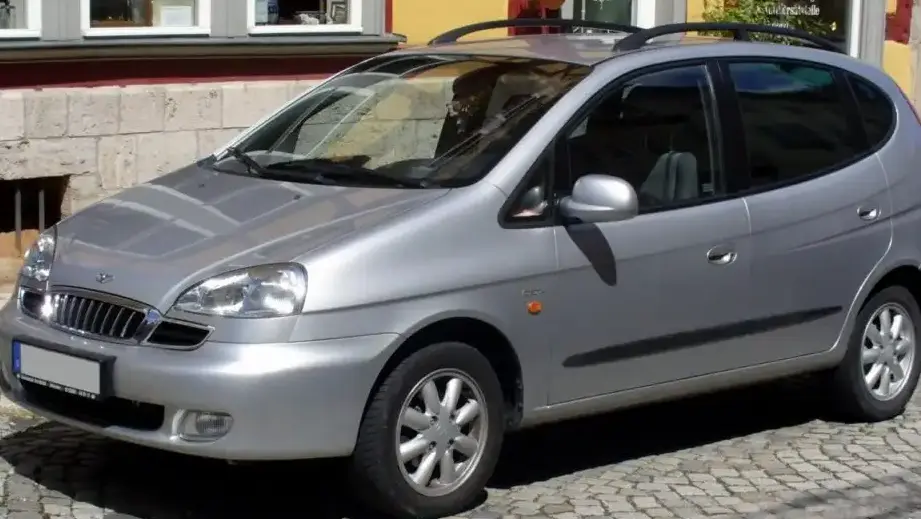
The Daewoo Rezzo, known as the Daewoo Tacuma in some European markets, was a compact minivan produced by the South Korean automaker Daewoo from 2001 to 2008. The Rezzo (KLAU) 2.0 i, powered by a 2.0-liter inline-four engine producing 105 horsepower, represented a mid-range offering within the Rezzo lineup. It aimed to provide a practical and affordable family vehicle, particularly in markets where multi-purpose vehicles (MPVs) were gaining popularity. The Rezzo was based on the GM Delta platform, shared with other vehicles like the Opel/Vauxhall Astra and Zafira, reflecting Daewoo’s partnership with General Motors.
Technical Specifications
| Brand | Daewoo |
| Model | Rezzo |
| Generation | Rezzo (KLAU) |
| Type (Engine) | 2.0 i (105 Hp) |
| Start of production | 2001 |
| End of production | 2008 |
| Powertrain Architecture | Internal Combustion engine |
| Body type | Minivan |
| Seats | 5 |
| Doors | 5 |
| Fuel Type | Petrol (Gasoline) |
| Acceleration 0 – 100 km/h | 10.5 sec |
| Acceleration 0 – 62 mph | 10.5 sec |
| Acceleration 0 – 60 mph | 10 sec |
| Maximum speed | 180 km/h (111.85 mph) |
| Weight-to-power ratio | 12 kg/Hp, 83.3 Hp/tonne |
| Weight-to-torque ratio | 7.5 kg/Nm, 134.1 Nm/tonne |
| Power | 105 Hp @ 5000 rpm |
| Power per litre | 52.6 Hp/l |
| Torque | 169 Nm @ 2800 rpm (124.65 lb.-ft. @ 2800 rpm) |
| Engine layout | Front, Transverse |
| Engine displacement | 1998 cm3 (121.93 cu. in.) |
| Number of cylinders | 4 |
| Engine configuration | Inline |
| Cylinder Bore | 86 mm (3.39 in.) |
| Piston Stroke | 86 mm (3.39 in.) |
| Compression ratio | 8.8:1 |
| Number of valves per cylinder | 2 |
| Fuel injection system | Multi-port manifold injection |
| Engine aspiration | Naturally aspirated engine |
| Valvetrain | OHC |
| Kerb Weight | 1260 kg (2777.82 lbs.) |
| Trunk (boot) space – minimum | 347 l (12.25 cu. ft.) |
| Trunk (boot) space – maximum | 1425 l (50.32 cu. ft.) |
| Fuel tank capacity | 60 l (15.85 US gal | 13.2 UK gal) |
| Length | 4350 mm (171.26 in.) |
| Width | 1755 mm (69.09 in.) |
| Height | 1580 mm (62.2 in.) |
| Wheelbase | 2600 mm (102.36 in.) |
| Front track | 1476 mm (58.11 in.) |
| Rear (Back) track | 1480 mm (58.27 in.) |
| Drivetrain Architecture | The Internal combustion engine (ICE) drives the front wheels of the vehicle. |
| Drive wheel | Front wheel drive |
| Number of gears and type of gearbox | 5 gears, manual transmission |
| Front suspension | Spring Strut |
| Rear suspension | Coil spring |
| Front brakes | Ventilated discs |
| Rear brakes | Drum |
| Assisting systems | ABS (Anti-lock braking system) |
| Steering type | Steering rack and pinion |
| Power steering | Hydraulic Steering |
| Tires size | 185/70 R14 |
Powertrain & Engine Architecture
The heart of the Rezzo 2.0 i was the X20SED engine, a 1.998-liter inline-four cylinder gasoline engine. This engine utilized a single overhead camshaft (SOHC) valvetrain with two valves per cylinder. Fuel delivery was managed by a multi-point fuel injection system, providing adequate, though not exceptional, fuel atomization. The engine’s 8.8:1 compression ratio was a compromise between performance and fuel efficiency. The 105 horsepower output at 5000 rpm and 169 Nm (124.65 lb-ft) of torque at 2800 rpm were typical figures for a naturally aspirated 2.0-liter engine of that era. The engine was transversely mounted in the front of the vehicle, driving the front wheels. The Rezzo 2.0 i was exclusively offered with a five-speed manual transmission, providing drivers with direct control over gear selection.
Driving Characteristics
The Rezzo 2.0 i offered a reasonably comfortable and practical driving experience. Acceleration from 0 to 60 mph took approximately 10 seconds, which was adequate for everyday driving but didn’t offer particularly sporty performance. The five-speed manual transmission allowed for efficient cruising at highway speeds, though engine noise could become noticeable at higher RPMs. The gear ratios were tuned for fuel economy and drivability rather than outright performance. Compared to potential higher-output variants (which were not widely available), the 2.0 i prioritized fuel efficiency and affordability over brisk acceleration. The relatively low horsepower meant that fully loaded with passengers and cargo, the engine could feel strained on inclines.
Equipment & Trim Levels
The Rezzo 2.0 i typically came equipped with a basic level of standard features. These generally included power steering, central locking, electric front windows, and an AM/FM radio. Air conditioning was often an optional extra. Interior upholstery was typically cloth, with a relatively simple dashboard layout. Higher trim levels, when available, might have added features like alloy wheels, upgraded audio systems, and additional safety equipment. The Rezzo was designed as a value-oriented vehicle, so luxury features were generally limited.
Chassis & Braking
The Rezzo utilized a front-wheel-drive layout with a MacPherson strut suspension in the front and a coil spring suspension in the rear. This setup provided a comfortable ride, though handling was not particularly sharp. The front brakes were ventilated discs, offering adequate stopping power, while the rear brakes were drums, a cost-saving measure common in vehicles of this class. An anti-lock braking system (ABS) was included as a standard safety feature. The chassis was designed to maximize interior space, resulting in a relatively high center of gravity, which contributed to some body roll during cornering.
Market Reception & Comparison
The Daewoo Rezzo, and particularly the 2.0 i variant, was generally well-received as an affordable and practical family vehicle. Critics praised its spacious interior and versatile seating configuration. However, the engine’s performance was often cited as a weakness, with some reviewers noting its lack of power, especially when fully loaded. Compared to other MPVs available at the time, such as the Renault Scenic or Opel Zafira, the Rezzo offered a lower price point but lacked some of the refinement and features of its European competitors. Fuel economy was considered average for its class. Reliability was generally good, though parts availability could be an issue in some markets after General Motors acquired Daewoo.
Legacy
The Daewoo Rezzo, while not a groundbreaking vehicle, served as a practical and affordable option for families in the early 2000s. The 2.0-liter engine proved to be reasonably durable, and well-maintained examples can still be found on the used car market today. However, due to the brand’s eventual disappearance, parts support has become increasingly limited. The Rezzo’s legacy lies in its role as a precursor to the Chevrolet Tacuma, which continued production in some markets after the Daewoo brand was phased out. The Rezzo demonstrated Daewoo’s ability to produce a functional and reasonably well-engineered MPV, even if it didn’t achieve widespread recognition or lasting success.
