
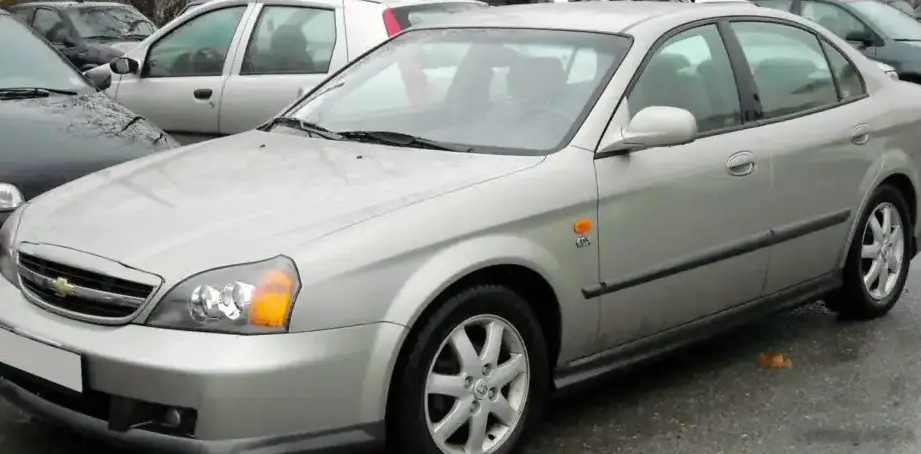
The Chevrolet Evanda 2.0 i 16V, produced between 2004 and 2006, represented Chevrolet’s entry into the mid-size sedan segment, primarily targeted towards markets outside of North America. Built in South Korea by Daewoo (later GM Daewoo), and rebadged as a Chevrolet, the Evanda aimed to offer a comfortable and spacious alternative to established Japanese and European competitors. This particular 2.0-liter, 16-valve variant with a manual transmission occupied a middle ground in the Evanda lineup, offering a balance between performance and fuel efficiency. It sat below the higher-output engines, but provided more power than the base models.
Technical Specifications
| Brand | Chevrolet |
| Model | Evanda |
| Generation | Evanda |
| Type (Engine) | 2.0 i 16V (131 Hp) |
| Start of production | 2004 |
| End of production | 2006 |
| Powertrain Architecture | Internal Combustion engine |
| Body type | Sedan |
| Seats | 5 |
| Doors | 4 |
| Fuel consumption (urban) | 12.3 l/100 km (19.1 US mpg) |
| Fuel consumption (extra urban) | 6.8 l/100 km (34.6 US mpg) |
| Fuel consumption (combined) | 8.8 l/100 km (26.7 US mpg) |
| Fuel Type | Petrol (Gasoline) |
| Acceleration 0 – 100 km/h | 9.8 sec |
| Acceleration 0 – 62 mph | 9.8 sec |
| Acceleration 0 – 60 mph | 9.3 sec |
| Maximum speed | 200 km/h (124.27 mph) |
| Weight-to-power ratio | 10.9 kg/Hp |
| Weight-to-torque ratio | 7.9 kg/Nm |
| Power | 131 Hp @ 5400 rpm |
| Torque | 181 Nm @ 4200 rpm (133.5 lb.-ft. @ 4200 rpm) |
| Engine layout | Front, Transverse |
| Engine Model/Code | L88 |
| Engine displacement | 1998 cm3 (121.93 cu. in.) |
| Number of cylinders | 4 |
| Engine configuration | Inline |
| Cylinder Bore | 86 mm (3.39 in.) |
| Piston Stroke | 86 mm (3.39 in.) |
| Compression ratio | 9.6:1 |
| Number of valves per cylinder | 4 |
| Fuel injection system | Multi-port manifold injection |
| Engine aspiration | Naturally aspirated engine |
| Valvetrain | DOHC |
| Engine oil capacity | 4 l (4.23 US qt | 3.52 UK qt) |
| Coolant capacity | 7.5 l (7.93 US qt | 6.6 UK qt) |
| Kerb Weight | 1422 kg (3134.97 lbs.) |
| Max. weight | 1912 kg (4215.24 lbs.) |
| Max load | 490 kg (1080.27 lbs.) |
| Trunk (boot) space – minimum | 435 l (15.36 cu. ft.) |
| Fuel tank capacity | 65 l (17.17 US gal | 14.3 UK gal) |
| Length | 4770 mm (187.8 in.) |
| Width | 1815 mm (71.46 in.) |
| Height | 1440 mm (56.69 in.) |
| Wheelbase | 2700 mm (106.3 in.) |
| Front track | 1550 mm (61.02 in.) |
| Rear track | 1535 mm (60.43 in.) |
| Drivetrain Architecture | Front wheel drive |
| Number of gears | 5 gears, manual transmission |
| Front suspension | Spring Strut |
| Rear suspension | Coil spring |
| Front brakes | Ventilated discs |
| Rear brakes | Disc |
| Assisting systems | ABS (Anti-lock braking system) |
| Steering type | Steering rack and pinion |
| Tires size | 205/65 R16 |
INTRODUCTION
The Chevrolet Evanda, launched in 2004, was a mid-size sedan designed to provide a comfortable and practical transportation solution. Produced by GM Daewoo in South Korea and marketed under the Chevrolet brand in various international markets, it aimed to compete with established players like the Toyota Camry and Honda Accord. The 2.0 i 16V variant, equipped with a 131 horsepower engine and a five-speed manual transmission, represented a balanced offering within the Evanda range. It was positioned as a step up from the base models, providing improved performance without the added cost of the larger engine options.
Powertrain & Engine Architecture
The heart of the Evanda 2.0 i 16V is the L88 engine, a 1.998-liter inline-four cylinder powerplant. This engine utilizes a multi-port fuel injection system, delivering fuel directly into the intake ports for efficient combustion. The 16-valve configuration, achieved through a double overhead camshaft (DOHC) valvetrain, enhances breathing and contributes to the engine’s power output. The engine’s 9.6:1 compression ratio strikes a balance between performance and fuel efficiency. The five-speed manual transmission provides drivers with direct control over gear selection, allowing for a more engaging driving experience compared to the available automatic option. The transmission’s gear ratios are tuned for a blend of acceleration and highway cruising, with a relatively tall fifth gear designed to improve fuel economy at higher speeds.
Driving Characteristics
The Evanda 2.0 i 16V offered a comfortable and predictable driving experience. While not a performance-oriented vehicle, the 131 horsepower engine provided adequate power for everyday driving situations. Acceleration from 0 to 60 mph took approximately 9.3 seconds, and the car could reach a top speed of 200 km/h (124 mph). The manual transmission allowed drivers to maximize the engine’s output, providing better control during overtaking maneuvers and on winding roads. Compared to the automatic transmission version, the manual offered a more responsive feel and slightly improved fuel economy. The suspension, tuned for comfort, absorbed bumps and irregularities in the road surface effectively, providing a smooth ride for passengers. However, this comfort came at the expense of sharp handling, with noticeable body roll during cornering.
Equipment & Trim Levels
The Evanda 2.0 i 16V typically came equipped with a reasonable level of standard features. Interior appointments included cloth upholstery, power windows and locks, and a basic audio system. Air conditioning was standard, a necessity for many of the markets where the Evanda was sold. Optional extras included alloy wheels, a sunroof, and an upgraded audio system with a CD changer. The dashboard layout was functional and straightforward, prioritizing ease of use over stylistic flair. Safety features included dual front airbags and an Anti-lock Braking System (ABS), although side airbags and electronic stability control were not typically offered on this trim level.
Chassis & Braking
The Evanda’s chassis featured a front strut suspension and a rear coil spring suspension, a common configuration for front-wheel-drive sedans. This setup prioritized ride comfort and space efficiency. The front brakes were ventilated discs, providing adequate stopping power, while the rear brakes were solid discs. The ABS system helped to prevent wheel lockup during hard braking, enhancing stability and control. The steering system utilized a rack and pinion setup, offering reasonably precise steering feel. The Evanda’s tires were typically 205/65 R16, providing a good balance between grip and ride comfort.
Market Reception & Comparison
The Chevrolet Evanda 2.0 i 16V received mixed reviews from automotive critics. It was generally praised for its spacious interior, comfortable ride, and reasonable price point. However, it was often criticized for its bland styling, uninspired handling, and relatively low power output compared to some of its competitors. Compared to the higher-output Evanda variants, the 2.0 i 16V offered better fuel economy but lacked the same level of performance. The automatic transmission version of this trim was often criticized for feeling sluggish and reducing fuel efficiency. In terms of reliability, the Evanda generally proved to be a dependable vehicle, although some owners reported issues with the electrical system and certain engine components.
Legacy
The Chevrolet Evanda, while not a groundbreaking vehicle, served as a solid and dependable mid-size sedan for those seeking a practical and affordable transportation option. The 2.0 i 16V variant, with its manual transmission, remains a relatively common sight in the used car market. The L88 engine, while not known for exceptional performance, has proven to be reasonably durable and relatively easy to maintain. Today, the Evanda is often viewed as a budget-friendly option for those seeking a reliable and spacious sedan, although its age and lack of modern features may limit its appeal to some buyers. Parts availability can be a concern in some regions, but generally, components are still obtainable through aftermarket suppliers.
