
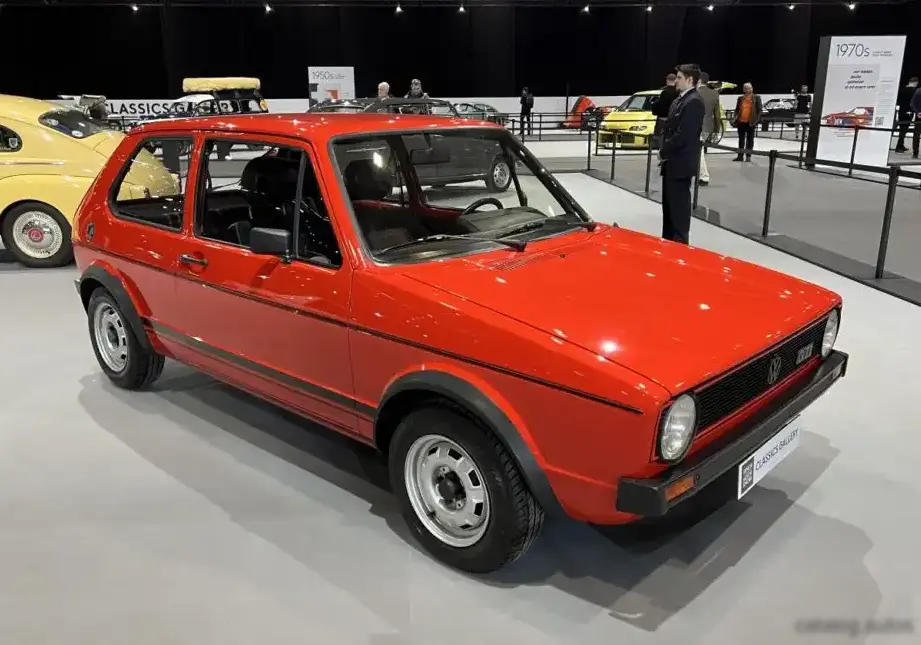
Technical Specifications
| Brand | Volkswagen |
| Model | Golf |
| Generation | Golf I (3-door) |
| Type (Engine) | 1.5 (70 Hp) |
| Start of production | 1974 |
| End of production | 1975 |
| Powertrain Architecture | Internal Combustion engine |
| Body type | Hatchback |
| Seats | 5 |
| Doors | 3 |
| Fuel Type | Petrol (Gasoline) |
| Acceleration 0 – 100 km/h | 12.5 sec |
| Acceleration 0 – 62 mph | 12.5 sec |
| Acceleration 0 – 60 mph | 11.9 sec |
| Maximum speed | 160 km/h (99.42 mph) |
| Weight-to-power ratio | 10.7 kg/Hp, 93.3 Hp/tonne |
| Weight-to-torque ratio | 6.6 kg/Nm, 152 Nm/tonne |
| Power | 70 Hp @ 5200 rpm |
| Power per litre | 47.6 Hp/l |
| Torque | 114 Nm @ 3000 rpm (84.08 lb.-ft. @ 3000 rpm) |
| Engine layout | Front, Transverse |
| Engine Model/Code | FH, FD |
| Engine displacement | 1471 cm3 (89.77 cu. in.) |
| Number of cylinders | 4 |
| Engine configuration | Inline |
| Cylinder Bore | 76.5 mm (3.01 in.) |
| Piston Stroke | 80 mm (3.15 in.) |
| Compression ratio | 8.2:1 |
| Number of valves per cylinder | 2 |
| Fuel injection system | Carburettor |
| Engine aspiration | Naturally aspirated engine |
| Valvetrain | SOHC |
| Engine oil capacity | 3.5 l (3.7 US qt | 3.08 UK qt) |
| Coolant | 4.5 l (4.76 US qt | 3.96 UK qt) |
| Kerb Weight | 750 kg (1653.47 lbs) |
| Max. weight | 1170 kg (2579.41 lbs) |
| Max load | 420 kg (925.94 lbs) |
| Trunk (boot) space – minimum | 368 l (13 cu. ft.) |
| Trunk (boot) space – maximum | 1102 l (38.92 cu. ft.) |
| Fuel tank capacity | 40 l (10.57 US gal | 8.8 UK gal) |
| Length | 3723 mm (146.57 in.) |
| Width | 1610 mm (63.39 in.) |
| Height | 1410 mm (55.51 in.) |
| Wheelbase | 2400 mm (94.49 in.) |
| Front track | 1390 mm (54.72 in.) |
| Rear (Back) track | 1350 mm (53.15 in.) |
| Ride height (ground clearance) | 125 mm (4.92 in.) |
| Minimum turning circle | 10.5 m (34.45 ft.) |
| Drivetrain Architecture | The Internal combustion engine (ICE) drives the front wheels of the vehicle. |
| Drive wheel | Front wheel drive |
| Number of gears and type of gearbox | 4 gears, manual transmission |
| Front suspension | Independent, type McPherson with coil spring and anti-roll bar |
| Rear suspension | Coil spring, Torsion |
| Front brakes | Disc |
| Rear brakes | Drum |
| Steering type | Steering rack and pinion |
| Tires size | 175/50 R13 |
| Wheel rims size | 5J x 13 |
The Volkswagen Golf Mk1, produced from 1974 to 1983, marked a significant departure for Volkswagen, moving away from the iconic rear-engined, air-cooled Beetle and embracing a modern, front-wheel-drive platform. The 3-door 1.5-liter (70 hp) variant, primarily available during the 1974 and 1975 model years, served as the entry point into the Golf range, offering affordable transportation and a first taste of this new automotive direction. Designated internally as the 1H-series, this model was instrumental in establishing the Golf’s reputation for practicality, reliability, and accessible performance. It was the bedrock upon which the Golf’s enduring success was built.
Powertrain & Engine Architecture
The heart of the Golf 1.5 was the FH or FD engine code, a 1471cc inline-four cylinder engine. This engine featured a single overhead camshaft (SOHC) valvetrain with two valves per cylinder. Fuel delivery was handled by a single carburetor, a common and cost-effective solution for the time. The engine produced 70 horsepower at 5200 rpm and 84 lb-ft of torque at 3000 rpm. Crucially, the engine was transversely mounted, a key element of the Golf’s front-wheel-drive layout, maximizing interior space. A 4-speed manual transmission was standard, providing a direct connection between the engine and the front wheels. While not a powerhouse, this configuration was known for its durability and relatively straightforward maintenance.
Driving Characteristics
The 1.5-liter Golf delivered modest performance. Acceleration to 60 mph took approximately 11.9 seconds, with a top speed around 99 mph. Compared to later Golf variants, like those with the 1.6-liter engine or the GTI’s fuel-injected 1.8-liter, the 1.5 felt noticeably slower. The 4-speed manual transmission had relatively wide gear spacing, requiring frequent shifting to keep the engine in its optimal power band. Handling was competent for the era, but lacked the sharpness of more performance-focused models. However, its lighter weight compared to some later Golfs contributed to a more nimble feel in everyday driving. The emphasis was on providing economical and dependable transportation, not outright speed.
Equipment & Trim Levels
The 1.5-liter Golf was typically offered in a fairly basic trim level. Standard features included cloth upholstery, vinyl floor covering, and a simple dashboard layout. Options were available, such as a radio, heated rear window, and upgraded interior trim. The interior was functional and durable, prioritizing practicality over luxury. The exterior featured steel wheels, chrome bumpers, and relatively understated body styling. The 3-door configuration was a deliberate choice to keep the price point accessible, targeting buyers who didn’t need the convenience of rear doors.
Chassis & Braking
The Golf Mk1 utilized an independent McPherson strut suspension at the front, providing a comfortable ride and reasonable handling. The rear suspension employed a torsion beam setup, a cost-effective and space-efficient design. Braking was provided by disc brakes at the front and drum brakes at the rear. While adequate for the car’s weight and performance, the braking system wasn’t particularly powerful by modern standards. The steering was a rack-and-pinion system, offering precise and responsive control. The relatively small 13-inch wheels and 175/50 R13 tires prioritized ride comfort but limited grip during cornering.
Market Reception & Comparison
The 1.5-liter Golf was well-received as an affordable and practical hatchback. Critics praised its fuel efficiency, reliability, and surprisingly spacious interior. However, its modest performance was often noted. Compared to the more powerful Golf variants, such as the GL or GTI, the 1.5 was seen as a sensible choice for budget-conscious buyers. It struck a good balance between practicality and affordability, making it a popular choice for first-time car buyers and those seeking a reliable daily driver. Fuel economy was a significant advantage, particularly during the fuel crises of the 1970s.
Legacy
The 1.5-liter Golf, while not the most exciting variant, played a crucial role in establishing the Golf as a benchmark in the compact hatchback segment. Its simple, durable powertrain proved remarkably reliable, and many examples are still on the road today. In the used car market, these early Golfs are increasingly sought after by enthusiasts and collectors, particularly those interested in a classic Volkswagen with significant historical value. The 1.5-liter engine, while basic by today’s standards, is known for its longevity and ease of maintenance, making it a relatively affordable and enjoyable classic car to own. The Golf Mk1, in all its iterations, laid the groundwork for one of the most successful automotive nameplates in history.
