
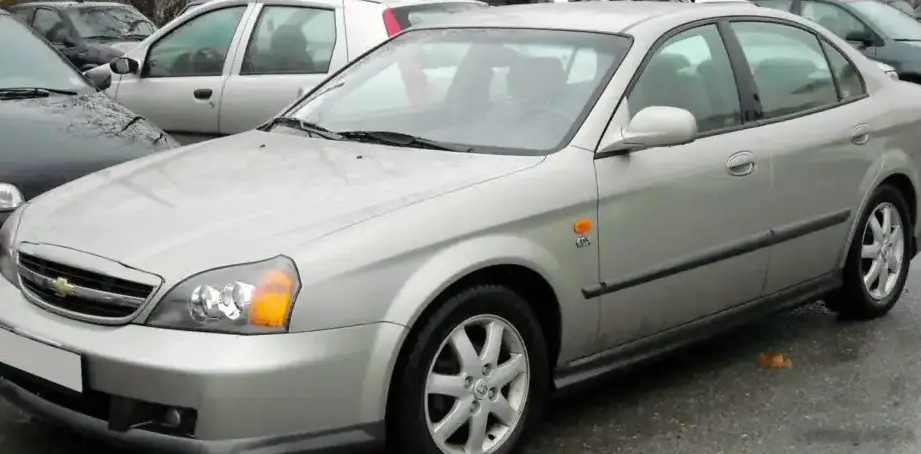
The Chevrolet Evanda 2.0 i 16V Automatic, produced between 2004 and 2006, represented a mid-range offering within the Evanda lineup. The Evanda itself was a D-segment sedan designed primarily for markets outside of North America, particularly South Korea where it was initially sold as the Daewoo Evanda before the General Motors acquisition and rebranding. Positioned as a comfortable and relatively affordable family car, the 2.0L automatic variant aimed to balance performance with ease of use and fuel efficiency. It sat between the base 1.8L engine and potentially higher-trim levels with more features, though specific trim availability varied by region.
Technical Specifications
| Brand | Chevrolet |
| Model | Evanda |
| Generation | Evanda |
| Type (Engine) | 2.0 i 16V (131 Hp) Automatic |
| Start of production | 2004 |
| End of production | 2006 |
| Powertrain Architecture | Internal Combustion engine |
| Body type | Sedan |
| Seats | 5 |
| Doors | 4 |
| Fuel consumption (urban) | 13.4 l/100 km (17.6 US mpg, 21.1 UK mpg, 7.5 km/l) |
| Fuel consumption (extra urban) | 7.3 l/100 km (32.2 US mpg, 38.7 UK mpg, 13.7 km/l) |
| Fuel consumption (combined) | 9.6 l/100 km (24.5 US mpg, 29.4 UK mpg, 10.4 km/l) |
| Fuel Type | Petrol (Gasoline) |
| Acceleration 0 – 100 km/h | 11.8 sec |
| Acceleration 0 – 62 mph | 11.8 sec |
| Acceleration 0 – 60 mph | 11.2 sec |
| Maximum speed | 190 km/h (118.06 mph) |
| Weight-to-power ratio | 10.9 kg/Hp, 92.1 Hp/tonne |
| Weight-to-torque ratio | 7.9 kg/Nm, 127.3 Nm/tonne |
| Power | 131 Hp @ 5400 rpm |
| Power per litre | 65.6 Hp/l |
| Torque | 181 Nm @ 4200 rpm (133.5 lb.-ft. @ 4200 rpm) |
| Engine layout | Front, Transverse |
| Engine Model/Code | L88 |
| Engine displacement | 1998 cm3 (121.93 cu. in.) |
| Number of cylinders | 4 |
| Engine configuration | Inline |
| Cylinder Bore | 86 mm (3.39 in.) |
| Piston Stroke | 86 mm (3.39 in.) |
| Compression ratio | 9.6:1 |
| Number of valves per cylinder | 4 |
| Fuel injection system | Multi-port manifold injection |
| Engine aspiration | Naturally aspirated engine |
| Valvetrain | DOHC |
| Engine oil capacity | 4 l (4.23 US qt | 3.52 UK qt) |
| Coolant capacity | 7.5 l (7.93 US qt | 6.6 UK qt) |
| Kerb Weight | 1422 kg (3134.97 lbs.) |
| Max. weight | 1912 kg (4215.24 lbs.) |
| Max load | 490 kg (1080.27 lbs.) |
| Trunk (boot) space – minimum | 435 l (15.36 cu. ft.) |
| Fuel tank capacity | 65 l (17.17 US gal | 14.3 UK gal) |
| Length | 4770 mm (187.8 in.) |
| Width | 1815 mm (71.46 in.) |
| Height | 1440 mm (56.69 in.) |
| Wheelbase | 2700 mm (106.3 in.) |
| Front track | 1550 mm (61.02 in.) |
| Rear (Back) track | 1535 mm (60.43 in.) |
| Drivetrain Architecture | Front wheel drive |
| Number of gears and type of gearbox | 4 gears, automatic transmission |
| Front suspension | Spring Strut |
| Rear suspension | Coil spring |
| Front brakes | Ventilated discs |
| Rear brakes | Disc |
| Assisting systems | ABS (Anti-lock braking system) |
| Steering type | Steering rack and pinion |
| Tires size | 205/65 R16 |
| Wheel rims size | 16 |
INTRODUCTION
The Chevrolet Evanda, launched in 2004, was a significant model for GM’s operations in emerging markets. Built upon the GM Delta platform (internally known as the 1HX0/A3 platform, shared with models like the Opel/Vauxhall Astra), the Evanda aimed to provide a comfortable and spacious sedan experience. The 2.0 i 16V Automatic variant was a key part of the range, offering a balance between performance and convenience. It was designed to appeal to buyers seeking a smooth, easy-to-drive vehicle for daily commuting and family transportation. The Evanda was primarily sold in markets like South Korea, parts of Europe, and the Middle East, where it competed with other mid-size sedans like the Toyota Corolla and Honda Civic.
Powertrain & Engine Architecture
The heart of the Evanda 2.0 i 16V Automatic is the L88 engine, a 1.998-liter inline-four cylinder gasoline engine. This engine utilizes a multi-port fuel injection system, delivering fuel directly to each intake port for improved combustion efficiency. The engine features a double overhead camshaft (DOHC) valvetrain, operating 16 valves (four per cylinder) to optimize airflow and enhance power output. The compression ratio is set at 9.6:1. Paired with this engine is a four-speed automatic transmission, designed for smooth gear changes and ease of operation. While not a particularly advanced transmission by modern standards, it provided a comfortable driving experience for the target audience. The transmission’s gear ratios were tuned for a balance of acceleration and fuel economy, prioritizing drivability over outright performance.
Driving Characteristics
The Evanda 2.0 i 16V Automatic offered a comfortable and predictable driving experience. With 131 horsepower and 181 Nm (133.5 lb-ft) of torque, acceleration was adequate for everyday driving, with a 0-60 mph time of around 11.2 seconds. However, it wasn’t a particularly sporty vehicle. Compared to a manual transmission version (if available in certain markets) or a potential higher-output engine option, the automatic transmission resulted in some power loss and a slightly less engaging driving experience. The four-speed automatic, while smooth, lacked the responsiveness and efficiency of more modern transmissions with more gears. The suspension was tuned for comfort, providing a relatively soft ride, but this also meant that handling was not particularly sharp. The car felt stable and predictable, but not particularly nimble in corners.
Equipment & Trim Levels
The standard equipment level for the Evanda 2.0 i 16V Automatic typically included features such as air conditioning, power windows, power door locks, and a basic audio system. Interior upholstery was generally cloth, though higher trim levels might have offered leather options. Dashboard configuration was functional and straightforward, prioritizing usability over stylistic flair. Optional extras could include alloy wheels, a sunroof, upgraded audio systems, and potentially features like cruise control. Specific trim levels and available options varied depending on the region where the vehicle was sold.
Chassis & Braking
The Evanda’s chassis utilized a front strut suspension and a rear coil spring suspension, providing a comfortable ride quality. The front brakes were ventilated discs, offering good stopping power, while the rear brakes were solid discs. An Anti-lock Braking System (ABS) was standard, enhancing safety by preventing wheel lockup during hard braking. The steering system was a rack and pinion setup, providing reasonably precise steering feel. Tire size was typically 205/65 R16, mounted on 16-inch wheels.
Market Reception & Comparison
The Chevrolet Evanda 2.0 i 16V Automatic was generally well-received as a comfortable and practical family sedan. Critics praised its spacious interior and comfortable ride, but noted that its performance was not particularly exciting. Compared to other trims in the Evanda lineup, the 2.0L automatic offered a good balance between performance and fuel economy. The 1.8L engine was more fuel-efficient but lacked power, while higher-output engine options (if available) offered more performance but at a higher price point. Fuel economy figures of around 24.5 US mpg combined were respectable for its class, but not class-leading.
Legacy
The Chevrolet Evanda, while not a groundbreaking vehicle, served as a solid and reliable family sedan for those in its target markets. The L88 engine, while not known for exceptional durability, proved to be reasonably reliable with proper maintenance. Today, the Evanda 2.0 i 16V Automatic can be found on the used car market, often at very affordable prices. Its simplicity and relatively low running costs make it an attractive option for budget-conscious buyers. However, potential buyers should be aware that parts availability may be limited in some regions, and the car’s age means that maintenance and repairs are likely to be required.
