
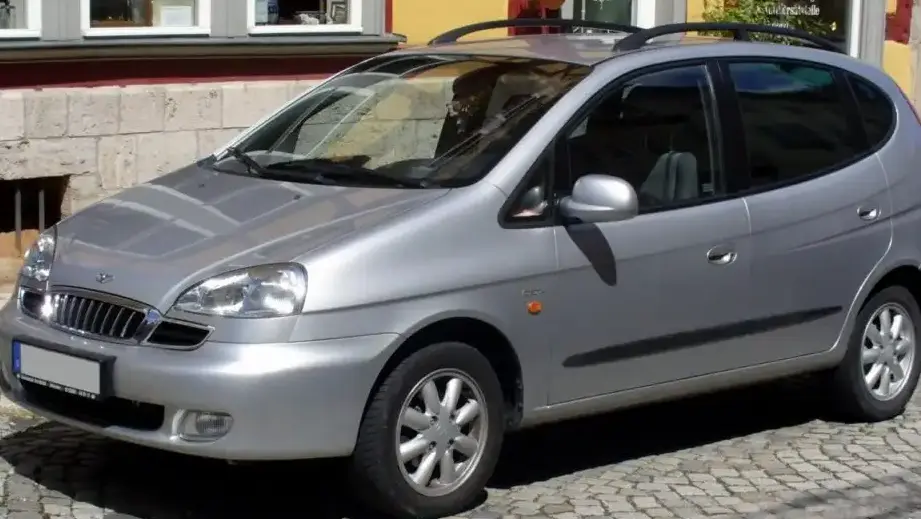
The Daewoo Rezzo 2.0i, designated as the KLAU, was a five-door minivan produced by the South Korean automaker Daewoo from 2000 to 2008. Positioned as a practical and affordable family vehicle, the Rezzo aimed to provide spaciousness and versatility in a compact package. It was primarily marketed in South Korea and select export markets, including parts of Europe and Latin America. The 2.0i variant, equipped with a 121 horsepower engine, represented a mid-range offering within the Rezzo lineup, slotting above the base 1.6L engine and below any potential higher-performance trims. The Rezzo was based on the GM Delta platform, shared with other compact vehicles of the era.
Technical Specifications
| Brand | Daewoo |
| Model | Rezzo |
| Generation | Rezzo (KLAU) |
| Type (Engine) | 2.0 i (121 Hp) |
| Start of production | 2000 year |
| End of production | 2008 year |
| Powertrain Architecture | Internal Combustion engine |
| Body type | Minivan |
| Seats | 5 |
| Doors | 5 |
| Fuel consumption (urban) | 12 l/100 km (19.6 US mpg, 23.5 UK mpg, 8.3 km/l) |
| Fuel consumption (extra urban) | 7.2 l/100 km (32.7 US mpg, 39.2 UK mpg, 13.9 km/l) |
| Fuel consumption (combined) | 9 l/100 km (26.1 US mpg, 31.4 UK mpg, 11.1 km/l) |
| Fuel Type | Petrol (Gasoline) |
| Acceleration 0 – 100 km/h | 10.8 sec |
| Acceleration 0 – 62 mph | 10.8 sec |
| Acceleration 0 – 60 mph | 10.3 sec |
| Maximum speed | 111 km/h (68.97 mph) |
| Weight-to-power ratio | 11.5 kg/Hp, 86.9 Hp/tonne |
| Weight-to-torque ratio | 7.9 kg/Nm, 126.4 Nm/tonne |
| Power | 121 Hp @ 5600 rpm |
| Power per litre | 60.6 Hp/l |
| Torque | 176 Nm @ 4000 rpm (129.81 lb.-ft. @ 4000 rpm) |
| Engine layout | Front, Transverse |
| Engine Model/Code | T20SED |
| Engine displacement | 1998 cm3 (121.93 cu. in.) |
| Number of cylinders | 4 |
| Engine configuration | Inline |
| Cylinder Bore | 86 mm (3.39 in.) |
| Piston Stroke | 86 mm (3.39 in.) |
| Compression ratio | 9.6:1 |
| Number of valves per cylinder | 2 |
| Fuel injection system | Multi-port manifold injection |
| Engine aspiration | Naturally aspirated engine |
| Valvetrain | DOHC |
| Engine oil capacity | 4 l (4.23 US qt | 3.52 UK qt) |
| Coolant capacity | 7.5 l (7.93 US qt | 6.6 UK qt) |
| Kerb Weight | 1392 kg (3068.83 lbs.) |
| Max. weight | 1862 kg (4105.01 lbs.) |
| Max load | 470 kg (1036.17 lbs.) |
| Trunk (boot) space – minimum | 690 l (24.37 cu. ft.) |
| Trunk (boot) space – maximum | 1500 l (52.97 cu. ft.) |
| Fuel tank capacity | 60 l (15.85 US gal | 13.2 UK gal) |
| Length | 4350 mm (171.26 in.) |
| Width | 1750 mm (68.9 in.) |
| Height | 1580 mm (62.2 in.) |
| Wheelbase | 2600 mm (102.36 in.) |
| Front track | 1476 mm (58.11 in.) |
| Rear (Back) track | 1480 mm (58.27 in.) |
| Drivetrain Architecture | The Internal combustion engine (ICE) drives the front wheels of the vehicle. |
| Drive wheel | Front wheel drive |
| Number of gears and type of gearbox | 5 gears, manual transmission |
| Front suspension | Spring Strut |
| Rear suspension | Coil spring |
| Front brakes | Ventilated discs |
| Rear brakes | Drum |
| Assisting systems | ABS (Anti-lock braking system) |
| Steering type | Steering rack and pinion |
| Power steering | Hydraulic Steering |
| Tires size | 195/60 R15 |
| Wheel rims size | 6J x 15 |
Powertrain & Engine Architecture
The Rezzo 2.0i was powered by the T20SED engine, a 1.998-liter inline-four cylinder gasoline engine. This engine featured a double overhead camshaft (DOHC) valvetrain with two valves per cylinder. Fuel delivery was handled by a multi-port fuel injection system, providing a balance between efficiency and performance. The engine produced 121 horsepower at 5600 rpm and 176 Nm (129.81 lb-ft) of torque at 4000 rpm. The engine’s 9.6:1 compression ratio was typical for naturally aspirated engines of the time. The Rezzo 2.0i was equipped with a five-speed manual transmission as standard. This transmission was chosen for its simplicity and reliability, contributing to the vehicle’s overall affordability. The engine’s transverse mounting and front-wheel-drive configuration were common for compact minivans, maximizing interior space and improving fuel efficiency.
Driving Characteristics
The Rezzo 2.0i offered adequate, though not particularly sporty, performance. The 121 horsepower engine provided sufficient power for everyday driving, including highway cruising and moderate acceleration. The 0-60 mph time was around 10.3 seconds, and the top speed was approximately 111 km/h (68.97 mph). The five-speed manual transmission allowed drivers to optimize engine performance based on driving conditions. Compared to the base 1.6L engine, the 2.0i offered noticeably improved acceleration and passing power. However, it didn’t match the performance of larger or more powerful minivans available in other markets. The suspension, tuned for comfort, provided a relatively smooth ride, but handling was not particularly sharp. The front-wheel-drive layout contributed to predictable handling characteristics, but also limited traction in slippery conditions.
Equipment & Trim Levels
The Rezzo 2.0i typically came with a modest level of standard equipment. Features generally included power steering, air conditioning, and basic audio system. Interior upholstery was typically cloth, with a functional and durable design. Higher trim levels, if available in specific markets, might have added features such as power windows, central locking, and upgraded audio systems. Optional extras could include alloy wheels, a sunroof, and improved interior trim. The dashboard layout was straightforward and focused on practicality, with easy-to-read gauges and conveniently placed controls. Safety features were relatively basic, typically including ABS (Anti-lock Braking System) as standard, but lacking advanced safety technologies like airbags in some markets.
Chassis & Braking
The Rezzo’s chassis featured a front strut suspension and a rear coil spring suspension, providing a comfortable ride quality. The front brakes were ventilated discs, offering good stopping power, while the rear brakes were drums, a cost-saving measure common in vehicles of this class. The steering system was a rack and pinion setup with hydraulic power assistance, providing responsive and relatively light steering feel. Tire size was typically 195/60 R15. The vehicle’s weight of approximately 1392 kg (3068.83 lbs) contributed to its moderate handling characteristics. The suspension was tuned to prioritize ride comfort over sporty handling, making it well-suited for everyday driving and family transportation.
Market Reception & Comparison
The Daewoo Rezzo 2.0i was generally well-received as an affordable and practical family vehicle. Critics praised its spacious interior and versatile seating configuration. However, some reviewers noted its relatively basic features and unremarkable performance. Compared to other minivans available at the time, the Rezzo offered a competitive price point but lacked the refinement and advanced features of more expensive models. Fuel economy was reasonable, with combined fuel consumption around 9 l/100 km (26.1 US mpg). Reliability was generally considered average, with some reports of minor mechanical issues. The Rezzo’s main competitors included other compact minivans and multi-purpose vehicles (MPVs) from brands like Renault, Opel, and Citroën.
Legacy
The Daewoo Rezzo, while not a groundbreaking vehicle, served as a practical and affordable transportation option for families in its target markets. The T20SED engine proved to be reasonably reliable, and parts availability remains adequate in regions where the Rezzo was sold. Today, the Rezzo 2.0i can be found on the used car market at very affordable prices. While it may not offer the latest technology or performance, it remains a viable option for those seeking a spacious and economical vehicle for basic transportation. Its simple mechanical design makes it relatively easy to maintain and repair, appealing to budget-conscious buyers and DIY mechanics.
