
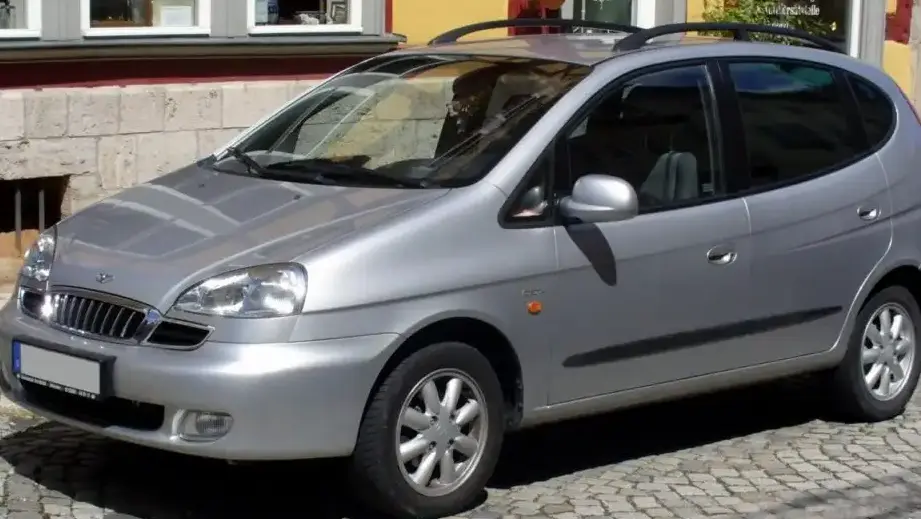
Technical Specifications
| Brand | Daewoo |
| Model | Rezzo |
| Generation | Rezzo (KLAU) |
| Type (Engine) | 2.0 i (128 Hp) Automatic |
| Start of production | 2000 year |
| End of production | 2008 year |
| Powertrain Architecture | Internal Combustion engine |
| Body type | Minivan |
| Seats | 5 |
| Doors | 5 |
| Fuel consumption (urban) | 15.1 l/100 km (15.6 US mpg, 18.7 UK mpg, 6.6 km/l) |
| Fuel consumption (extra urban) | 8.2 l/100 km (28.7 US mpg, 34.4 UK mpg, 12.2 km/l) |
| Fuel consumption (combined) | 10.8 l/100 km (21.8 US mpg, 26.2 UK mpg, 9.3 km/l) |
| Fuel Type | Petrol (Gasoline) |
| Acceleration 0 – 100 km/h | 12.4 sec |
| Acceleration 0 – 62 mph | 12.4 sec |
| Acceleration 0 – 60 mph | 11.8 sec |
| Maximum speed | 104 km/h (64.62 mph) |
| Weight-to-power ratio | 10.9 kg/Hp, 92 Hp/tonne |
| Weight-to-torque ratio | 7.9 kg/Nm, 126.4 Nm/tonne |
| Power | 128 Hp @ 5600 rpm |
| Power per litre | 64.1 Hp/l |
| Torque | 176 Nm @ 4000 rpm (129.81 lb.-ft. @ 4000 rpm) |
| Engine layout | Front, Transverse |
| Engine Model/Code | T20SED |
| Engine displacement | 1998 cm3 (121.93 cu. in.) |
| Number of cylinders | 4 |
| Engine configuration | Inline |
| Cylinder Bore | 86 mm (3.39 in.) |
| Piston Stroke | 86 mm (3.39 in.) |
| Compression ratio | 9.6:1 |
| Number of valves per cylinder | 2 |
| Fuel injection system | Multi-port manifold injection |
| Engine aspiration | Naturally aspirated engine |
| Valvetrain | DOHC |
| Engine oil capacity | 4 l (4.23 US qt | 3.52 UK qt) |
| Coolant | 7.5 l (7.93 US qt | 6.6 UK qt) |
| Kerb Weight | 1392 kg (3068.83 lbs.) |
| Max. weight | 1862 kg (4105.01 lbs.) |
| Max load | 470 kg (1036.17 lbs.) |
| Trunk (boot) space – minimum | 690 l (24.37 cu. ft.) |
| Trunk (boot) space – maximum | 1500 l (52.97 cu. ft.) |
| Fuel tank capacity | 60 l (15.85 US gal | 13.2 UK gal) |
| Length | 4350 mm (171.26 in.) |
| Width | 1750 mm (68.9 in.) |
| Height | 1580 mm (62.2 in.) |
| Wheelbase | 2600 mm (102.36 in.) |
| Front track | 1476 mm (58.11 in.) |
| Rear (Back) track | 1480 mm (58.27 in.) |
| Drivetrain Architecture | The Internal combustion engine (ICE) drives the front wheels of the vehicle. |
| Drive wheel | Front wheel drive |
| Number of gears and type of gearbox | 4 gears, automatic transmission |
| Front suspension | Spring Strut |
| Rear suspension | Coil spring |
| Front brakes | Ventilated discs |
| Rear brakes | Drum |
| Assisting systems | ABS (Anti-lock braking system) |
| Steering type | Steering rack and pinion |
| Power steering | Hydraulic Steering |
| Tires size | 195/60 R15 |
| Wheel rims size | 6J x 15 |
The Daewoo Rezzo 2.0i Automatic, produced from 2000 to 2008, was a five-door minivan designed to provide affordable family transportation. Sold primarily in Europe and Asia (often marketed as the Tacuma in certain regions), the Rezzo represented Daewoo’s entry into the increasingly popular compact MPV segment. This particular variant, equipped with the 2.0-liter inline-four engine and a four-speed automatic transmission, occupied a mid-range position within the Rezzo lineup, offering a balance between performance and convenience. It was positioned above the base 1.6L models and served as an alternative to diesel-powered options available in some markets. The Rezzo was built on the GM Delta platform, a versatile architecture also used for vehicles like the Opel/Vauxhall Astra and Zafira.
Powertrain & Engine Architecture
The Rezzo 2.0i Automatic’s powertrain centers around the T20SED engine, a 1.998-liter (121.93 cubic inches) inline-four cylinder gasoline engine. This engine employs a multi-port fuel injection system, delivering fuel directly into the intake ports for optimized combustion, and a double overhead camshaft (DOHC) valvetrain to enhance airflow and overall efficiency. The compression ratio is set at 9.6:1. The engine generates 128 horsepower at 5600 rpm and 176 Nm (129.81 lb-ft) of torque at 4000 rpm. This power is transferred to the front wheels through a four-speed automatic transmission, chosen for its ease of use and convenience. While not a technologically advanced transmission by today’s standards, it provided smooth, if not particularly rapid, gear changes for everyday driving. The engine’s transverse mounting and front-wheel-drive configuration were common for vehicles in this class, contributing to efficient packaging and space utilization.
Driving Characteristics
The Rezzo 2.0i Automatic delivered a comfortable, though not particularly exhilarating, driving experience. Acceleration from 0 to 60 mph required approximately 11.8 seconds, and the vehicle’s top speed was limited to around 64.62 mph (104 km/h). The four-speed automatic transmission, while user-friendly, exhibited noticeable gear changes and lacked the responsiveness of a manual transmission. The gear ratios were optimized for fuel economy and relaxed cruising rather than aggressive acceleration. Compared to the base 1.6L engine, the 2.0L offered a substantial improvement in power and torque, making it better suited for carrying passengers and cargo, particularly on inclines or when merging onto highways. However, it didn’t possess the briskness of higher-output engines potentially offered in other markets. The suspension prioritized ride comfort over sporty handling, resulting in a generally smooth and forgiving ride quality.
Equipment & Trim Levels
The Rezzo 2.0i Automatic typically included features considered standard for a family minivan of its era. These generally encompassed power windows and locks, air conditioning, and a basic audio system. Interior upholstery was typically cloth, and the dashboard layout was relatively straightforward. Optional extras could include alloy wheels, upgraded audio systems, and potentially a sunroof. The specific trim level varied depending on the market, but the 2.0i Automatic generally represented a step up from the base models, offering increased comfort and convenience features.
Chassis & Braking
The Rezzo’s chassis utilized a front suspension system featuring spring struts and a rear suspension with coil springs. The front brakes were ventilated discs, providing adequate stopping power, while the rear brakes were drums. An Anti-lock Braking System (ABS) was included as a standard safety feature. Steering was rack and pinion with hydraulic power assistance. The suspension was tuned to prioritize ride comfort, offering a smooth and compliant ride. The vehicle typically rode on 195/60 R15 tires mounted on 6J x 15 inch wheel rims.
Market Reception & Comparison
The Daewoo Rezzo, and specifically the 2.0i Automatic variant, received mixed reviews from automotive critics. While its spacious interior and affordability were generally praised, its unremarkable performance and somewhat basic interior materials were often noted. Fuel economy was considered average for its class, with combined consumption around 21.8 US mpg (10.8 l/100 km). Compared to other compact MPVs available at the time, such as the Renault Scenic or Opel Zafira, the Rezzo offered a more competitive price point but lacked the refinement and driving dynamics of its European rivals. The 1.6L Rezzo models offered better fuel efficiency but suffered from significantly slower performance, making the 2.0L a more practical choice for drivers needing additional power.
Legacy
The Daewoo Rezzo, while not a revolutionary vehicle, provided a functional and affordable transportation solution for families. The 2.0-liter engine and four-speed automatic transmission proved to be reasonably reliable, although sourcing parts can be challenging in some regions today. The Rezzo is now a relatively uncommon sight on the roads, but it has garnered a small following among enthusiasts who appreciate its unique styling and practicality. Its legacy lies in offering a budget-friendly MPV option during a period of growing popularity for this vehicle segment.
