
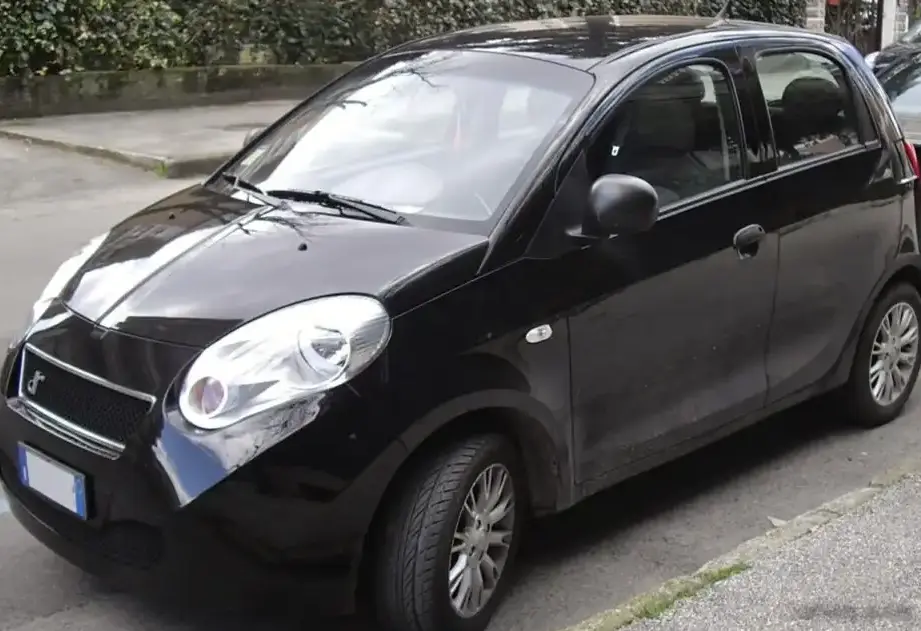
The DR 1 1.1 Ecopower, produced between 2011 and 2013, was an entry-level hatchback marketed primarily in Europe by the Italian manufacturer DR Motor Company. Positioned as an affordable and economical city car, the 1.1 Ecopower represented the base trim level of the DR 1 range. It was built upon a platform originally developed by Chery Automobile of China, reflecting DR Motor’s strategy of rebadging and adapting existing designs for the European market. The DR 1 aimed to provide basic transportation with a focus on fuel efficiency, targeting budget-conscious buyers and those seeking a small, maneuverable vehicle for urban environments.
Technical Specifications
| Brand | DR |
| Model | 1 |
| Generation | 1 |
| Type (Engine) | 1.1 Ecopower (68 Hp) |
| Start of production | 2011 |
| End of production | 2013 |
| Powertrain Architecture | Internal Combustion engine |
| Body type | Hatchback |
| Seats | 4 |
| Doors | 5 |
| Fuel consumption (urban) | 6.1 l/100 km (38.6 US mpg, 46.3 UK mpg, 16.4 km/l) |
| Fuel consumption (extra urban) | 4.3 l/100 km (54.7 US mpg, 65.7 UK mpg, 23.3 km/l) |
| Fuel consumption (combined) | 4.9 l/100 km (48 US mpg, 57.6 UK mpg, 20.4 km/l) |
| CO2 emissions | 114 g/km |
| Fuel Type | Petrol (Gasoline) |
| Acceleration 0 – 100 km/h | 13.5 sec |
| Acceleration 0 – 62 mph | 13.5 sec |
| Acceleration 0 – 60 mph | 12.8 sec |
| Maximum speed | 145 km/h (90.1 mph) |
| Emission standard | Euro 5 |
| Weight-to-power ratio | 13.9 kg/Hp |
| Weight-to-torque ratio | 10.5 kg/Nm |
| Power | 68 Hp @ 6000 rpm |
| Power per litre | 62.8 Hp/l |
| Torque | 90 Nm @ 3500-4000 rpm (66.38 lb.-ft. @ 3500-4000 rpm) |
| Engine layout | Front, Transverse |
| Engine displacement | 1083 cm3 (66.09 cu. in.) |
| Number of cylinders | 4 |
| Engine configuration | Inline |
| Compression ratio | 9.5:1 |
| Number of valves per cylinder | 4 |
| Fuel injection system | Multi-port manifold injection |
| Engine aspiration | Naturally aspirated |
| Kerb Weight | 945 kg (2083.37 lbs.) |
| Max. weight | 1350 kg (2976.24 lbs.) |
| Max load | 405 kg (892.87 lbs.) |
| Trunk (boot) space – minimum | 180 l (6.36 cu. ft.) |
| Trunk (boot) space – maximum | 430 l (15.19 cu. ft.) |
| Fuel tank capacity | 42 l (11.1 US gal, 9.24 UK gal) |
| Length | 3620 mm (142.52 in.) |
| Width | 1630 mm (64.17 in.) |
| Height | 1530 mm (60.24 in.) |
| Wheelbase | 2340 mm (92.13 in.) |
| Front track | 1380 mm (54.33 in.) |
| Rear track | 1365 mm (53.74 in.) |
| Minimum turning circle | 9.6 m (31.5 ft.) |
| Drivetrain | Front wheel drive |
| Number of gears | 5 gears, manual transmission |
| Front suspension | Independent, McPherson with coil spring and anti-roll bar |
| Rear suspension | Spring Strut, Rigid axle suspension, Coil spring |
| Front brakes | Disc |
| Rear brakes | Drum |
| Assisting systems | ABS (Anti-lock braking system) |
| Steering type | Steering rack and pinion |
| Power steering | Electric |
| Tires size | 175/60 R14; 175/55 R15 |
| Wheel rims size | 14; 15 |
Powertrain & Engine Architecture
The DR 1 1.1 Ecopower was powered by a 1.1-liter, inline-four cylinder gasoline engine. This engine, sourced from Chery and designated as the SQR311, was a relatively simple design featuring a single overhead camshaft (SOHC) and four valves per cylinder. The engine utilized a multi-point fuel injection system, providing adequate fuel delivery for its modest power output. The compression ratio was set at 9.5:1, a common figure for naturally aspirated engines of this era. The engine produced 68 horsepower at 6000 rpm and 90 Nm (66.38 lb-ft) of torque between 3500 and 4000 rpm. This power was transmitted to the front wheels through a five-speed manual transmission. The engine’s architecture prioritized fuel economy over outright performance, making it suitable for city driving.
Driving Characteristics
The DR 1 1.1 Ecopower’s driving experience was characterized by its lack of urgency. With only 68 horsepower propelling a vehicle weighing around 945 kg (2083 lbs), acceleration was slow, taking 13.5 seconds to reach 62 mph. The five-speed manual transmission helped to maximize the engine’s limited power, but frequent downshifts were often necessary, particularly when encountering hills or overtaking. The gear ratios were tuned for economy rather than spirited driving. Steering was light and easy, making it maneuverable in tight urban spaces. The suspension, while basic, provided a reasonably comfortable ride on smooth roads, although it could become unsettled on rough surfaces. Compared to potential higher-trim versions (had they been offered with larger engines), the 1.1 Ecopower was significantly slower and less refined, but it offered a lower purchase price and better fuel economy.
Equipment & Trim Levels
As the base trim level, the DR 1 1.1 Ecopower was equipped with a fairly basic set of features. Standard equipment typically included power steering, central locking, electric front windows, and an ABS anti-lock braking system. The interior was functional but spartan, with cloth upholstery and a simple dashboard layout. Optional extras were limited, but could include air conditioning and a basic audio system. The focus was on providing essential features at an affordable price point. The interior plastics were of relatively low quality, reflecting the car’s budget positioning.
Chassis & Braking
The DR 1 1.1 Ecopower utilized a front-engine, front-wheel-drive layout. The front suspension consisted of independent McPherson struts with coil springs and an anti-roll bar, while the rear suspension employed a simpler rigid axle setup with coil springs. The braking system featured disc brakes on the front wheels and drum brakes on the rear wheels. ABS was standard, providing enhanced braking control in emergency situations. The chassis was designed for affordability and simplicity, prioritizing cost-effectiveness over sophisticated handling characteristics. The relatively narrow tires (typically 175/60 R14 or 175/55 R15) contributed to the car’s modest grip levels.
Market Reception & Comparison
The DR 1 1.1 Ecopower received mixed reviews from automotive critics. It was generally praised for its low price and fuel efficiency, but criticized for its lack of performance and refinement. Compared to other city cars available in Europe at the time, such as the Fiat Panda or the Renault Twingo, the DR 1 offered a lower price point but lacked the established brand recognition and overall quality of its competitors. Fuel economy was competitive, with combined fuel consumption figures around 4.9 l/100 km (48 US mpg). Reliability was considered average, with some reports of minor mechanical issues. The DR 1 1.1 Ecopower appealed to buyers seeking the most affordable transportation option, but those prioritizing performance or refinement were likely to look elsewhere.
Legacy
The DR 1 1.1 Ecopower, while not a groundbreaking vehicle, served as an entry point into the European market for DR Motor Company. Its simple, reliable powertrain and low running costs made it a popular choice for budget-conscious buyers. On the used car market today, the DR 1 1.1 Ecopower is typically found at very low prices. The 1.1-liter engine is known for its durability, but maintenance should be performed regularly to ensure long-term reliability. Parts availability can be a challenge, as DR Motor Company is a relatively small manufacturer. However, many components are sourced from Chery, which can simplify sourcing replacement parts. The DR 1 1.1 Ecopower represents a unique chapter in the history of affordable European motoring.
