
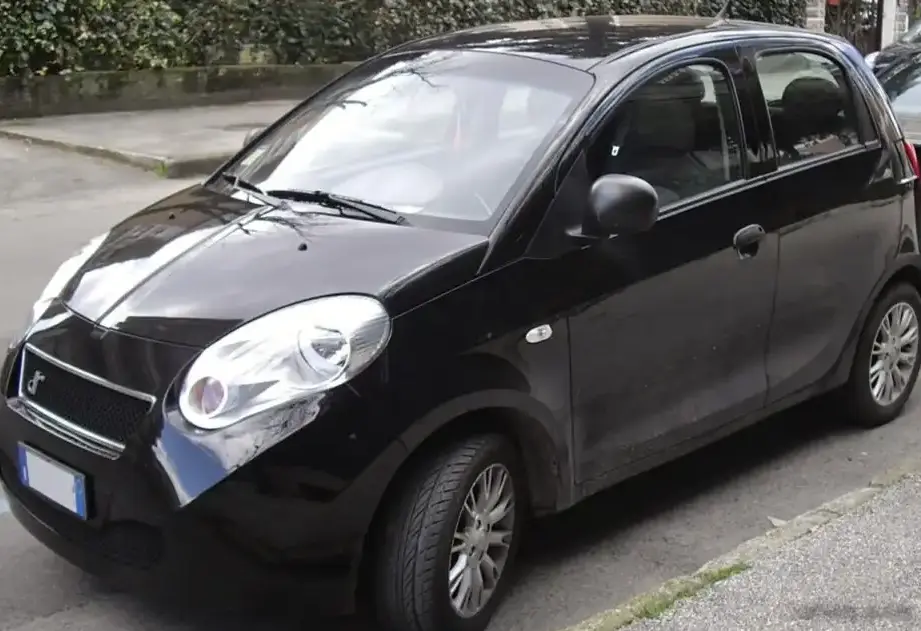
The DR 1 1.3 Ecopower Automatic, produced between 2009 and 2011, was an entry-level hatchback offered by the Italian automotive manufacturer DR Motor Company. Positioned as an affordable and economical option within the DR 1 range, this variant utilized a 1.3-liter gasoline engine paired with a five-speed automatic transmission. The DR 1 itself was based heavily on the Chery Riich G5, a Chinese-designed hatchback, reflecting DR Motor’s strategy of rebadging and adapting vehicles from other manufacturers for the European market. This particular model aimed to provide a convenient, automatic driving experience for urban commuters and first-time car buyers.
Technical Specifications
| Brand | DR |
| Model | 1 |
| Generation | 1 |
| Type (Engine) | 1.3 Ecopower (83 Hp) Automatic |
| Start of production | 2009 |
| End of production | 2011 |
| Powertrain Architecture | Internal Combustion engine |
| Body type | Hatchback |
| Seats | 4 |
| Doors | 5 |
| Fuel consumption (urban) | 7.4 l/100 km (31.8 US mpg) |
| Fuel consumption (extra urban) | 4.4 l/100 km (53.5 US mpg) |
| Fuel consumption (combined) | 5.5 l/100 km (42.8 US mpg) |
| CO2 emissions | 128 g/km |
| Fuel Type | Petrol (Gasoline) |
| Acceleration 0 – 100 km/h | 12 sec |
| Acceleration 0 – 62 mph | 12 sec |
| Acceleration 0 – 60 mph | 11.4 sec |
| Maximum speed | 156 km/h (96.93 mph) |
| Emission standard | Euro 5 |
| Weight-to-power ratio | 11.5 kg/Hp |
| Weight-to-torque ratio | 8.3 kg/Nm |
| Power | 83 Hp @ 5500 rpm |
| Torque | 115 Nm @ 4500 rpm (84.82 lb.-ft. @ 4500 rpm) |
| Engine layout | Front, Transverse |
| Engine displacement | 1297 cm3 (79.15 cu. in.) |
| Number of cylinders | 4 |
| Engine configuration | Inline |
| Compression ratio | 10.8:1 |
| Number of valves per cylinder | 4 |
| Fuel injection system | Multi-port manifold injection |
| Engine aspiration | Naturally aspirated |
| Kerb Weight | 955 kg (2105.41 lbs.) |
| Max. weight | 1350 kg (2976.24 lbs.) |
| Max load | 395 kg (870.83 lbs.) |
| Trunk (boot) space – minimum | 180 l (6.36 cu. ft.) |
| Trunk (boot) space – maximum | 430 l (15.19 cu. ft.) |
| Fuel tank capacity | 42 l (11.1 US gal | 9.24 UK gal) |
| Length | 3620 mm (142.52 in.) |
| Width | 1630 mm (64.17 in.) |
| Height | 1530 mm (60.24 in.) |
| Wheelbase | 2340 mm (92.13 in.) |
| Front track | 1380 mm (54.33 in.) |
| Rear track | 1365 mm (53.74 in.) |
| Minimum turning circle | 9.6 m (31.5 ft.) |
| Drivetrain | Front wheel drive |
| Number of gears | 5 gears, automatic transmission |
| Front suspension | Independent, McPherson with coil spring and anti-roll bar |
| Rear suspension | Spring Strut, Rigid axle suspension, Coil spring |
| Front brakes | Disc |
| Rear brakes | Drum |
| Assisting systems | ABS (Anti-lock braking system) |
| Steering type | Steering rack and pinion |
| Power steering | Electric |
| Tires size | 175/55 R15 |
| Wheel rims size | 15 |
Powertrain & Engine Architecture
The DR 1 1.3 Ecopower Automatic was powered by a 1.3-liter inline-four cylinder gasoline engine. This engine, derived from a design originally developed by Chery, featured a multi-point fuel injection system and a compression ratio of 10.8:1. While specific engine codes aren’t widely documented for DR Motor vehicles, the engine architecture is consistent with those found in early 2000s Chery models. The engine produced 83 horsepower at 5500 rpm and 115 Nm (84.82 lb-ft) of torque at 4500 rpm. The five-speed automatic transmission was a conventional hydraulic automatic, chosen for its ease of use and affordability. It wasn’t known for particularly quick shifts or sporty performance, but it provided smooth operation for everyday driving.
Driving Characteristics
The 1.3-liter engine and automatic transmission combination resulted in modest performance. Acceleration from 0 to 100 km/h (0-62 mph) took approximately 12 seconds. The automatic transmission, while convenient, contributed to a noticeable delay in response compared to a manual transmission. Gear ratios were optimized for fuel economy rather than outright acceleration. In real-world driving, the DR 1 1.3 Automatic felt adequate for city driving and light highway use, but struggled with steep inclines or when fully loaded. Compared to potential higher-output variants (had they been offered), this version prioritized fuel efficiency and ease of driving over performance.
Equipment & Trim Levels
The DR 1 1.3 Ecopower Automatic was typically equipped with a basic level of standard features. These generally included power steering, central locking, electric front windows, and an ABS anti-lock braking system. Interior upholstery was typically cloth, and the dashboard featured a functional but simple design. Optional extras, depending on the market and dealer, could include air conditioning, a radio/CD player, and alloy wheels. The trim level was generally considered the base trim, focusing on providing essential features at a low price point.
Chassis & Braking
The DR 1 featured a front-engine, front-wheel-drive layout. The front suspension utilized an independent McPherson strut setup with a coil spring and anti-roll bar, while the rear suspension employed a simpler rigid axle configuration with coil springs. Braking consisted of disc brakes on the front wheels and drum brakes on the rear. The braking system was adequate for the vehicle’s weight and performance, but lacked the stopping power of more advanced systems found in higher-end vehicles. The relatively lightweight construction (955 kg / 2105 lbs) helped to mitigate the limitations of the braking system.
Market Reception & Comparison
The DR 1 1.3 Ecopower Automatic was primarily marketed towards budget-conscious buyers seeking a practical and affordable hatchback. Critics generally acknowledged its low price point but noted its lack of refinement and modest performance. Fuel economy was a strong point, with combined fuel consumption figures around 5.5 l/100 km (42.8 US mpg). Compared to other entry-level hatchbacks available in Europe at the time, such as the Fiat Panda or Renault Twingo, the DR 1 offered a larger interior space but lacked the brand recognition and established reputation of its competitors. Reliability reports were limited, but the engine and transmission were generally considered to be reasonably durable.
Legacy
The DR 1 1.3 Ecopower Automatic, while not a groundbreaking vehicle, served as an affordable transportation option for a specific segment of the market. Its long-term reliability has been mixed, with some owners reporting issues with the engine and transmission, while others have experienced relatively trouble-free ownership. On the used car market, these vehicles are now quite rare and typically command very low prices. The DR 1 represents a unique chapter in the history of DR Motor Company, showcasing their early strategy of rebadging and adapting vehicles from other manufacturers to compete in the European automotive landscape. The simplicity of the powertrain makes it relatively easy to maintain for those with basic mechanical skills, but sourcing parts can sometimes be challenging due to the limited production numbers and the vehicle’s origins.
