
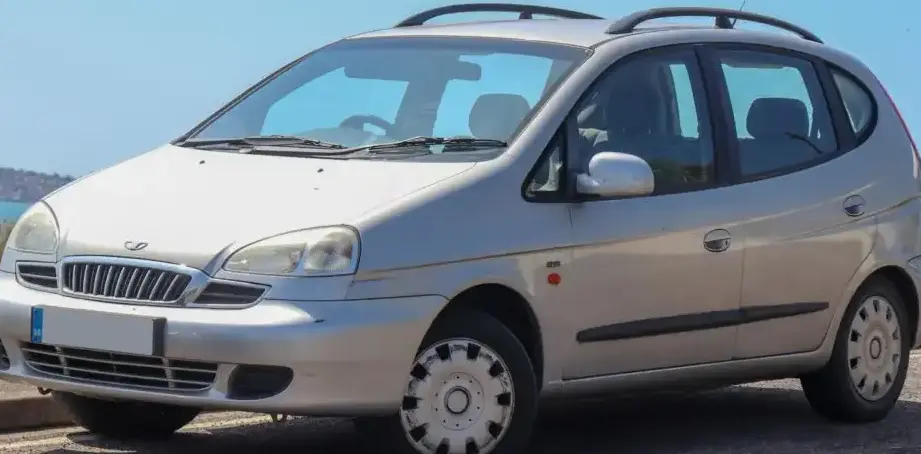
Technical Specifications
| Brand | Daewoo |
| Model | Tacuma |
| Generation | Tacuma |
| Type (Engine) | 2.0 i 16V (121 Hp) |
| Start of production | 2001 |
| End of production | 2008 |
| Powertrain Architecture | Internal Combustion engine |
| Body type | Minivan |
| Seats | 5 |
| Doors | 5 |
| Fuel consumption (urban) | 12.9 l/100 km (18.2 US mpg, 21.9 UK mpg, 7.8 km/l) |
| Fuel consumption (extra urban) | 7.9 l/100 km (29.8 US mpg, 35.8 UK mpg, 12.7 km/l) |
| Fuel consumption (combined) | 9.7 l/100 km (24.2 US mpg, 29.1 UK mpg, 10.3 km/l) |
| Fuel Type | Petrol (Gasoline) |
| Acceleration 0 – 100 km/h | 10.5 sec |
| Acceleration 0 – 62 mph | 10.5 sec |
| Acceleration 0 – 60 mph | 10 sec |
| Maximum speed | 188 km/h (116.82 mph) |
| Weight-to-power ratio | 11.4 kg/Hp, 87.6 Hp/tonne |
| Weight-to-torque ratio | 7.8 kg/Nm, 127.4 Nm/tonne |
| Power | 121 Hp @ 5600 rpm |
| Power per litre | 60.6 Hp/l |
| Torque | 176 Nm @ 4000 rpm (129.81 lb.-ft. @ 4000 rpm) |
| Engine layout | Front, Transverse |
| Engine Model/Code | T20SED |
| Engine displacement | 1998 cm3 (121.93 cu. in.) |
| Number of cylinders | 4 |
| Engine configuration | Inline |
| Cylinder Bore | 86 mm (3.39 in.) |
| Piston Stroke | 86 mm (3.39 in.) |
| Compression ratio | 9.6:1 |
| Number of valves per cylinder | 4 |
| Fuel injection system | Multi-port manifold injection |
| Engine aspiration | Naturally aspirated engine |
| Valvetrain | DOHC |
| Engine oil capacity | 4 l (4.23 US qt | 3.52 UK qt) |
| Coolant capacity | 7.5 l (7.93 US qt | 6.6 UK qt) |
| Kerb Weight | 1381 kg (3044.58 lbs.) |
| Max. weight | 1862 kg (4105.01 lbs.) |
| Max load | 481 kg (1060.42 lbs.) |
| Trunk (boot) space – minimum | 347 l (12.25 cu. ft.) |
| Trunk (boot) space – maximum | 1425 l (50.32 cu. ft.) |
| Fuel tank capacity | 60 l (15.85 US gal | 13.2 UK gal) |
| Length | 4350 mm (171.26 in.) |
| Width | 1755 mm (69.09 in.) |
| Height | 1580 mm (62.2 in.) |
| Wheelbase | 2600 mm (102.36 in.) |
| Front track | 1476 mm (58.11 in.) |
| Rear track | 1480 mm (58.27 in.) |
| Drivetrain Architecture | Front wheel drive |
| Number of gears | 5 |
| Gearbox type | Manual transmission |
| Front suspension | Spring Strut |
| Rear suspension | Coil spring |
| Front brakes | Ventilated discs |
| Rear brakes | Disc |
| Assisting systems | ABS (Anti-lock braking system) |
| Steering type | Steering rack and pinion |
| Power steering | Hydraulic Steering |
| Tires size | 195/60 R15 H |
The Daewoo Tacuma 2.0 i 16V, produced between 2001 and 2008, was a compact minivan primarily aimed at the European market. It represented Daewoo’s, and later Chevrolet’s following the General Motors acquisition, entry into the affordable multi-purpose vehicle (MPV) segment. This 2.0-liter, 121 horsepower variant occupied a mid-range position within the Tacuma lineup, offering a compromise between performance, fuel economy, and price. The Tacuma was built on the GM Delta platform, a shared architecture with vehicles like the Opel/Vauxhall Astra and Zafira, demonstrating the influence of GM’s engineering and manufacturing practices after taking control of Daewoo Motors.
Powertrain & Engine Architecture
The Tacuma 2.0 i 16V was powered by the T20SED engine, a 1.998-liter inline-four cylinder gasoline engine. This engine employed a dual overhead camshaft (DOHC) valvetrain with four valves per cylinder, enhancing its volumetric efficiency. Fuel delivery was handled by a multi-port fuel injection system, providing precise fuel metering for optimal combustion. The engine generated 121 horsepower at 5600 rpm and 176 Nm (129.81 lb-ft) of torque at 4000 rpm. The engine’s 9.6:1 compression ratio was typical for naturally aspirated engines of the period. A five-speed manual transmission was standard for this variant, offering a balance between responsiveness and fuel efficiency. The transmission’s gear ratios were calibrated for everyday driving conditions, prioritizing usability over outright performance.
Driving Characteristics
The combination of the 2.0-liter engine and the five-speed manual transmission delivered adequate, though not particularly sporty, performance. Acceleration from 0 to 60 mph took around 10 seconds, with a top speed of approximately 117 mph. Compared to the base 1.6-liter engine, the 2.0-liter provided a noticeable increase in power, especially during overtaking and when the vehicle was fully loaded. However, it didn’t offer the same level of responsiveness as some of its competitors. The gear ratios were designed to favor fuel economy and comfortable cruising, rather than aggressive acceleration. The steering was light and easy to use, making it well-suited for urban environments, but lacked the feedback preferred by drivers seeking a more engaging driving experience.
Equipment & Trim Levels
The Tacuma 2.0 i 16V generally included features expected in a family vehicle of its era. Standard equipment typically consisted of power steering, central locking, electric front windows, and an adjustable steering column. Air conditioning was often included, though sometimes offered as an optional upgrade. Interior upholstery was usually cloth, with a relatively straightforward dashboard layout. Optional extras could include alloy wheels, a CD player, and enhanced interior trim packages. Safety features included ABS brakes and driver and passenger airbags.
Chassis & Braking
The Tacuma utilized a front-wheel-drive layout with a MacPherson strut suspension at the front and a coil spring suspension at the rear. The front brakes were ventilated discs, providing sufficient stopping power, while the rear brakes were solid discs. The suspension was tuned for ride comfort, prioritizing a smooth and compliant ride over sporty handling characteristics. The vehicle’s relatively modest weight (around 3045 lbs) helped to offset the limitations of the engine’s power output.
Market Reception & Comparison
The Daewoo Tacuma 2.0 i 16V was generally regarded as a practical and affordable family vehicle. Reviewers praised its spacious interior, versatile cargo capacity, and reasonable fuel economy. However, it was often criticized for its somewhat uninspired styling and a perceived lack of refinement compared to more established European rivals. Compared to the base 1.6-liter Tacuma, the 2.0-liter offered a significant performance boost, making it a more suitable choice for drivers who frequently transported passengers or cargo, or who regularly drove on highways. Fuel economy was comparable between the two engines, with the 2.0-liter exhibiting slightly lower figures due to its increased power.
Legacy
The Daewoo Tacuma, and specifically the 2.0 i 16V variant, has earned a reputation for being a reliable and relatively inexpensive vehicle to maintain. The T20SED engine is known for its durability, and parts availability remains reasonable. In the used car market, Tacumas are typically available at very affordable prices, making them an attractive option for budget-conscious buyers. While not a particularly exciting vehicle, the Tacuma provided dependable family transportation for many owners, and its inherent simplicity contributes to its continued viability as a used car.
