
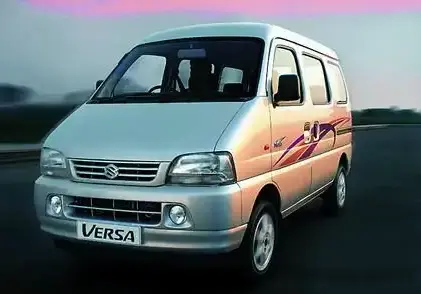
The Maruti Versa 1.3 i 16V DX (82 Hp) was a five-door, eight-seater minivan produced by Maruti Suzuki, the leading automobile manufacturer in India, between 2002 and 2009. Positioned as an affordable and practical family vehicle, the Versa aimed to fill a niche in the Indian market for a multi-purpose vehicle (MPV) capable of carrying large families and cargo. It was based on a modified platform derived from the Esteem sedan, offering a more spacious and versatile alternative to traditional hatchbacks and sedans. The ‘DX’ trim represented the base model within the Versa lineup, focusing on value and essential features.
Technical Specifications
| Brand | Maruti |
| Model | Versa |
| Generation | Versa |
| Type | 1.3 i 16V DX (82 Hp) |
| Start of production | 2002 |
| End of production | 2009 |
| Powertrain Architecture | Internal Combustion engine |
| Body type | Minivan |
| Seats | 8 |
| Doors | 5 |
| Fuel Type | Petrol (Gasoline) |
| Weight-to-power ratio | 11.9 kg/Hp, 84.1 Hp/tonne |
| Weight-to-torque ratio | 9.6 kg/Nm, 104.6 Nm/tonne |
| Power | 82 Hp @ 6000 rpm |
| Power per litre | 63.2 Hp/l |
| Torque | 102 Nm @ 3000 rpm (75.23 lb.-ft. @ 3000 rpm) |
| Engine layout | Front, Transverse |
| Engine displacement | 1298 cm3 (79.21 cu. in.) |
| Number of cylinders | 4 |
| Engine configuration | Inline |
| Cylinder Bore | 74 mm (2.91 in.) |
| Piston Stroke | 75.5 mm (2.97 in.) |
| Compression ratio | 9.2:1 |
| Number of valves per cylinder | 4 |
| Fuel injection system | Multi-port manifold injection |
| Engine aspiration | Naturally aspirated engine |
| Valvetrain | OHC |
| Kerb Weight | 975 kg (2149.51 lbs.) |
| Max. weight | 1585 kg (3494.33 lbs.) |
| Max load | 610 kg (1344.82 lbs.) |
| Fuel tank capacity | 40 l (10.57 US gal | 8.8 UK gal) |
| Length | 3675 mm (144.69 in.) |
| Width | 1475 mm (58.07 in.) |
| Height | 1905 mm (75 in.) |
| Wheelbase | 2350 mm (92.52 in.) |
| Front track | 1280 mm (50.39 in.) |
| Rear track | 1290 mm (50.79 in.) |
| Drivetrain Architecture | The Internal combustion engine (ICE) drives the front wheels of the vehicle. |
| Drive wheel | Front wheel drive |
| Number of gears and type of gearbox | 5 gears, manual transmission |
| Front suspension | Coil spring |
| Rear suspension | Coil spring |
| Front brakes | Disc |
| Rear brakes | Drum |
| Assisting systems | ABS (Anti-lock braking system) |
| Steering type | Steering rack and pinion |
| Tires size | 155/80 R13 |
| Wheel rims size | 13 |
Powertrain & Engine Architecture
The Versa 1.3 i 16V DX was powered by the G13BB engine, a 1.3-liter, inline-four cylinder petrol engine. This engine was a mainstay in Maruti Suzuki’s lineup, known for its relative simplicity and reliability. The ‘16V’ designation indicates the engine featured four valves per cylinder, enhancing breathing and contributing to improved power output compared to older two-valve designs. The engine utilized a multi-point fuel injection system, delivering fuel directly to each intake port for precise fuel metering and efficient combustion. The overhead camshaft (OHC) valvetrain further optimized engine performance. The 5-speed manual transmission was the sole gearbox option for this variant, prioritizing fuel efficiency and affordability over outright performance. The engine’s relatively modest output of 82 horsepower and 102 Nm (75.23 lb-ft) of torque was typical for vehicles in this segment during the early 2000s.
Driving Characteristics
The Versa 1.3 i 16V DX offered a practical, if not particularly exciting, driving experience. With 82 horsepower propelling a vehicle weighing approximately 975 kg (2149.51 lbs), acceleration was adequate for city driving and highway cruising, but overtaking maneuvers required careful planning. The 5-speed manual transmission allowed drivers to keep the engine in its optimal power band, but the gear ratios were geared towards fuel economy rather than spirited performance. Compared to potential higher-spec variants (had they existed), the 1.3L engine would have felt noticeably less powerful. The suspension, tuned for comfort, provided a reasonably smooth ride on typical Indian road conditions, but body roll was evident during cornering. The steering, a rack and pinion system, offered acceptable precision, though it lacked the feedback found in more sophisticated setups.
Equipment & Trim Levels
The ‘DX’ trim level of the Versa represented the entry point to the model range. As such, it was equipped with essential features focused on functionality and affordability. Standard equipment typically included basic cloth upholstery, a simple dashboard layout with analog gauges, and manual windows and door locks. Air conditioning was often an optional extra. Safety features were limited, typically consisting of only the ABS (Anti-lock braking system) as a key safety feature. The interior was designed with practicality in mind, offering ample space for passengers and luggage, reflecting the Versa’s role as a family vehicle. Optional extras could include power steering, a better audio system, and upgraded interior trim.
Chassis & Braking
The Versa’s chassis was a modified version of the Esteem sedan’s platform, adapted to accommodate the larger body and increased seating capacity. The suspension utilized a coil spring setup for both the front and rear axles, prioritizing ride comfort over sporty handling. The front brakes were disc brakes, providing adequate stopping power, while the rear brakes were drum brakes, a cost-saving measure common in vehicles of this price range. The ABS system, while a welcome addition, was a relatively basic system compared to modern iterations. The 13-inch wheels, fitted with 155/80 R13 tires, were chosen for their affordability and durability, rather than performance characteristics.
Market Reception & Comparison
The Maruti Versa 1.3 i 16V DX was generally well-received in the Indian market as a practical and affordable MPV. Critics praised its spacious interior, comfortable ride, and fuel efficiency. However, some reviewers noted its lack of power and relatively basic features. Compared to other MPVs available at the time, such as the Tata Indica MPV, the Versa offered a more refined driving experience and a more spacious interior. Its fuel economy was competitive, making it an attractive option for budget-conscious buyers. The 1.3L engine was considered adequate for most daily driving needs, but those requiring more power or frequently carrying a full load of passengers might have preferred a larger engine (though none were offered in the Versa).
Legacy
The Maruti Versa, while discontinued in 2009, remains a recognizable vehicle on Indian roads. The G13BB engine, known for its durability, continues to be relatively reliable even in older vehicles, provided they have been properly maintained. Parts availability is generally good, thanks to the widespread use of this engine in other Maruti Suzuki models. In the used car market, the Versa 1.3 i 16V DX is often sought after by buyers looking for an affordable and practical family vehicle. While it may not offer the modern features and performance of newer MPVs, its simplicity, reliability, and spacious interior continue to appeal to a segment of the market. The Versa paved the way for Maruti Suzuki’s later successes in the MPV segment, establishing the brand as a leader in affordable family transportation.
