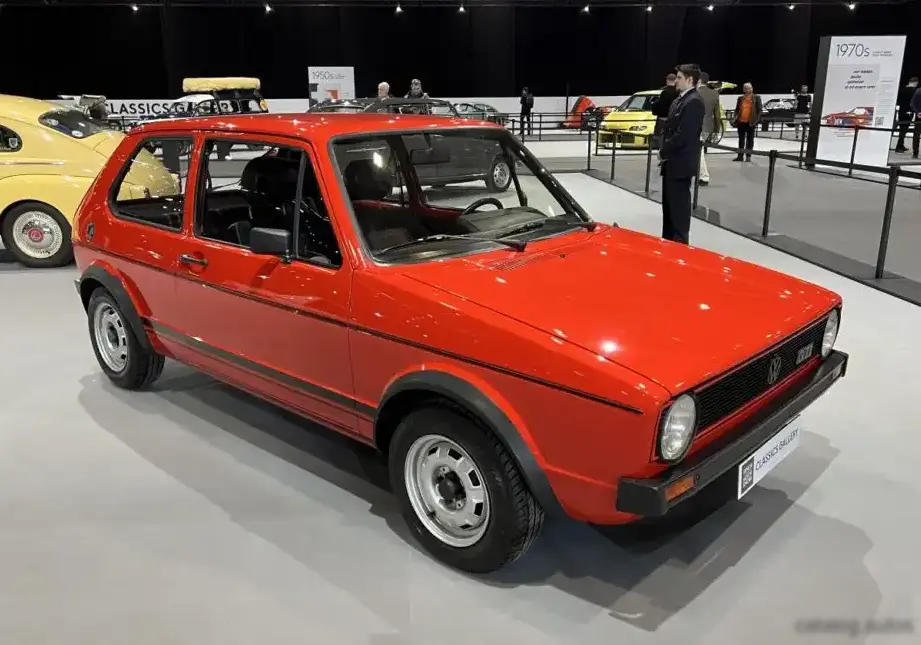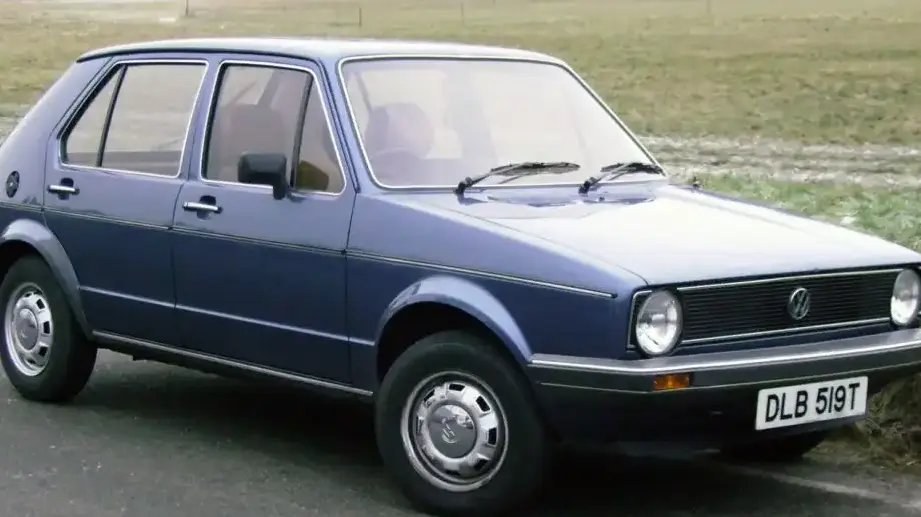
The Volkswagen Golf I (5-door) 1.5 D, produced between 1976 and 1980, represented Volkswagen’s entry into the diesel hatchback market. This variant, powered by a modest 1.5-liter diesel engine producing 50 horsepower, was positioned as the most economical option within the first-generation Golf lineup (Type 17, internally designated as the 1HX0). It catered to buyers prioritizing fuel efficiency and practicality over outright performance, particularly in European markets where diesel fuel was becoming increasingly popular and subject to favorable taxation. The five-door body style offered enhanced passenger accessibility compared to the earlier three-door models, further broadening the Golf’s appeal as a family vehicle.
Technical Specifications
| Brand | Volkswagen |
| Model | Golf |
| Generation | Golf I (5-door) |
| Type (Engine) | 1.5 D (50 Hp) |
| Start of production | 1976 |
| End of production | 1980 |
| Powertrain Architecture | Internal Combustion engine |
| Body type | Hatchback |
| Seats | 5 |
| Doors | 5 |
| Fuel Type | Diesel |
| Acceleration 0 – 100 km/h | 15.8 sec |
| Acceleration 0 – 62 mph | 15.8 sec |
| Acceleration 0 – 60 mph | 18 sec |
| Maximum speed | 140 km/h (86.99 mph) |
| Weight-to-power ratio | 16.6 kg/Hp, 60.2 Hp/tonne |
| Weight-to-torque ratio | 10.1 kg/Nm, 98.8 Nm/tonne |
| Power | 50 Hp @ 5000 rpm |
| Power per litre | 34 Hp/l |
| Torque | 82 Nm @ 3000 rpm (60.48 lb.-ft. @ 3000 rpm) |
| Engine layout | Front, Transverse |
| Engine Model/Code | CK |
| Engine displacement | 1471 cm3 (89.77 cu. in.) |
| Number of cylinders | 4 |
| Engine configuration | Inline |
| Cylinder Bore | 76.5 mm (3.01 in.) |
| Piston Stroke | 80 mm (3.15 in.) |
| Compression ratio | 23.5:1 |
| Number of valves per cylinder | 2 |
| Fuel injection system | Precombustion chamber injection |
| Engine aspiration | Naturally aspirated engine |
| Valvetrain | SOHC |
| Engine oil capacity | 3.5 l (3.7 US qt | 3.08 UK qt) |
| Coolant | 4.5 l (4.76 US qt | 3.96 UK qt) |
| Kerb Weight | 830 kg (1829.84 lbs.) |
| Max. weight | 1250 kg (2755.78 lbs.) |
| Max load | 420 kg (925.94 lbs.) |
| Trunk (boot) space – minimum | 368 l (13 cu. ft.) |
| Trunk (boot) space – maximum | 1102 l (38.92 cu. ft.) |
| Fuel tank capacity | 40 l (10.57 US gal | 8.8 UK gal) |
| Length | 3723 mm (146.57 in.) |
| Width | 1610 mm (63.39 in.) |
| Height | 1410 mm (55.51 in.) |
| Wheelbase | 2400 mm (94.49 in.) |
| Front track | 1389 mm (54.69 in.) |
| Rear (Back) track | 1356 mm (53.39 in.) |
| Ride height (ground clearance) | 125 mm (4.92 in.) |
| Minimum turning circle (turning diameter) | 10.5 m (34.45 ft.) |
| Drivetrain Architecture | The Internal combustion engine (ICE) drives the front wheels of the vehicle. |
| Drive wheel | Front wheel drive |
| Number of gears and type of gearbox | 4 gears, manual transmission |
| Front suspension | Independent, type McPherson with coil spring and anti-roll bar |
| Rear suspension | Trailing arm, Coil spring, Torsion |
| Front brakes | Disc, 238.76 mm |
| Rear brakes | Drum, 180.34 mm |
| Steering type | Steering rack and pinion |
| Tires size | 175/70 R13 |
| Wheel rims size | Front wheel rims: 4.5J x 13Rear wheel rims: 4.5J x 13 |
Powertrain & Engine Architecture
The heart of the Golf I 1.5 D was the CK engine, a naturally aspirated, inline-four cylinder diesel. This engine utilized a precombustion chamber injection system, a common design for diesel engines of the era. This system involved injecting fuel into a small precombustion chamber connected to the main cylinder, where it was partially ignited before entering the main combustion chamber. This improved cold-starting performance and reduced engine noise compared to direct injection systems. The engine featured a single overhead camshaft (SOHC) operating two valves per cylinder. The 1471cc displacement produced 50 horsepower at 5000 rpm and 82 Nm (60.48 lb-ft) of torque at 3000 rpm. The engine was transversely mounted, a layout that became a Volkswagen hallmark, contributing to efficient space utilization within the front-wheel-drive platform.
Driving Characteristics
The 1.5 D, paired with a four-speed manual transmission, offered modest performance. Acceleration was slow, taking approximately 15.8 seconds to reach 62 mph (100 km/h), and top speed was limited to around 87 mph (140 km/h). Compared to the gasoline-powered Golf variants, particularly the GTI, the 1.5 D lacked responsiveness. However, its strength lay in its fuel economy and low-end torque. The gear ratios were optimized for maximizing fuel efficiency rather than outright acceleration. The engine provided adequate power for everyday driving, especially in urban environments, but struggled on inclines or when fully loaded. The manual transmission, while not particularly sporty, was robust and reliable.
Equipment & Trim Levels
The 1.5 D typically represented the base trim level in the Golf I range. Standard equipment included basic cloth upholstery, vinyl floor coverings, and a simple dashboard layout. Features like a radio, heated rear window, and upgraded interior trim were often optional extras. The five-door configuration was a significant advantage for families, providing easier access to the rear seats. The overall interior design prioritized functionality and durability over luxury.
Chassis & Braking
The Golf I 1.5 D utilized an independent McPherson strut front suspension with coil springs and an anti-roll bar, providing reasonable handling characteristics. The rear suspension employed a trailing arm setup with coil springs and a torsion beam. Braking was accomplished via disc brakes on the front wheels and drum brakes on the rear. The braking system was adequate for the vehicle’s weight and performance, but lacked the stopping power of more advanced systems found on higher-performance Golf models. The relatively light weight of the 1.5 D (approximately 830 kg or 1829.84 lbs) helped to offset the limitations of the braking system.
Market Reception & Comparison
The Golf I 1.5 D was well-received in European markets, particularly in countries with high diesel fuel taxes and a growing demand for fuel-efficient vehicles. Critics praised its economy and practicality, but noted its lack of performance. Compared to the gasoline-powered Golf models, the 1.5 D offered significantly better fuel economy but considerably slower acceleration. The 1.5 D was often seen as a sensible and economical choice for those prioritizing cost-effectiveness over driving excitement. It provided a viable alternative to other small, fuel-efficient hatchbacks of the era.
Legacy
The Volkswagen Golf I 1.5 D, while not a performance icon, played a crucial role in establishing the Golf as a versatile and practical family car. The CK diesel engine proved to be relatively durable and reliable, and many examples remain on the road today. In the used car market, these early Golf diesels are sought after by enthusiasts and collectors, particularly those interested in preserving a piece of automotive history. The 1.5 D’s success paved the way for subsequent generations of Golf diesel models, which have become increasingly sophisticated and technologically advanced. The engine, while simple by modern standards, represents a significant step in the development of automotive diesel technology.