
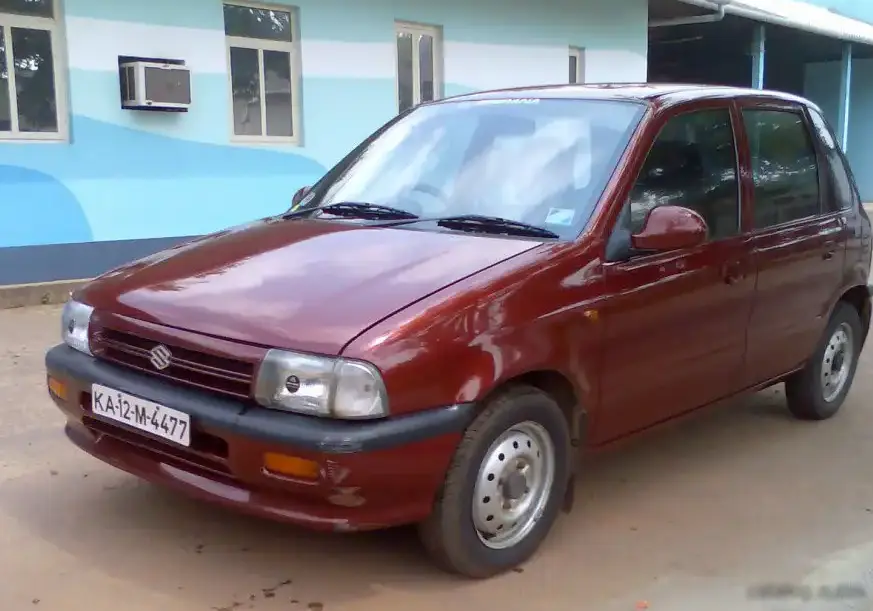
Technical Specifications
| Brand | Maruti |
| Model | Zen |
| Generation | ZEN (EF) |
| Type (Engine) | 1.0 i (54 Hp) |
| Start of production | 1999 |
| End of production | 2002 |
| Powertrain Architecture | Internal Combustion engine |
| Body type | Hatchback |
| Seats | 5 |
| Doors | 5 |
| Fuel Type | Petrol (Gasoline) |
| Acceleration 0 – 100 km/h | 15.5 sec |
| Acceleration 0 – 62 mph | 15.5 sec |
| Acceleration 0 – 60 mph | 14.7 sec |
| Maximum speed | 150 km/h (93.21 mph) |
| Power | 54 Hp @ 6500 rpm |
| Power per litre | 54.4 Hp/l |
| Torque | 73 Nm @ 4500 rpm (53.84 lb.-ft. @ 4500 rpm) |
| Engine layout | Front, Transverse |
| Engine displacement | 993 cm3 (60.6 cu. in.) |
| Number of cylinders | 4 |
| Engine configuration | Inline |
| Cylinder Bore | 72 mm (2.83 in.) |
| Piston Stroke | 61 mm (2.4 in.) |
| Compression ratio | 9.4:1 |
| Number of valves per cylinder | 2 |
| Fuel injection system | Single-point injection |
| Engine aspiration | Naturally aspirated engine |
| Trunk (boot) space – minimum | 175 l (6.18 cu. ft.) |
| Trunk (boot) space – maximum | 850 l (30.02 cu. ft.) |
| Fuel tank capacity | 35 l (9.25 US gal | 7.7 UK gal) |
| Length | 3495 mm (137.6 in.) |
| Width | 1495 mm (58.86 in.) |
| Height | 1410 mm (55.51 in.) |
| Wheelbase | 2335 mm (91.93 in.) |
| Front track | 1335 mm (52.56 in.) |
| Rear (Back) track | 1305 mm (51.38 in.) |
| Minimum turning circle | 9.8 m (32.15 ft.) |
| Drivetrain Architecture | The Internal combustion engine (ICE) drives the front wheels of the vehicle. |
| Drive wheel | Front wheel drive |
| Number of gears and type of gearbox | 5 gears, manual transmission |
| Front suspension | Spring Strut |
| Rear suspension | Coil spring |
| Front brakes | Disc |
| Rear brakes | Drum |
| Assisting systems | ABS (Anti-lock braking system) |
| Steering type | Steering rack and pinion |
| Tires size | 145/70 R13 |
| Wheel rims size | 13 |
The Maruti Zen, specifically the EF series produced between 1999 and 2002, holds a significant place in the history of the Indian automotive industry. This compact, five-door hatchback was instrumental in making car ownership more accessible to the Indian middle class, offering a relatively affordable and practical transportation solution. The 1.0 i variant, equipped with a 993cc engine producing 54 horsepower, served as the entry point to the Zen lineup, primarily targeting first-time car buyers and those prioritizing fuel efficiency for city commuting. Built on a unibody chassis, it directly competed with other small cars available in the Indian market at the time, such as the Hyundai Santro and the Daewoo Matiz.
Powertrain & Engine Architecture
At the heart of the Zen 1.0 i lay the F10D engine, a 993cc inline-four cylinder petrol engine. This engine employed a single-point fuel injection system, a cost-effective and relatively simple technology for the era. The engine featured a single overhead camshaft (SOHC) operating two valves per cylinder. The F10D was renowned for its simplicity and inherent reliability, although it wasn’t designed for high performance. Its 54 horsepower output at 6500 rpm and 73 Nm (53.84 lb.-ft.) of torque at 4500 rpm were sufficient for urban driving but limited its capabilities on open highways or when carrying a full passenger load. The engine’s design philosophy centered around maximizing fuel economy rather than achieving exhilarating performance. The engine was mounted transversely, powering the front wheels.
Driving Characteristics
The Zen 1.0 i, with its modest power output, delivered a predictable and unchallenging driving experience. Acceleration was decidedly leisurely, requiring approximately 15.5 seconds to reach 100 km/h (62 mph). The five-speed manual transmission was well-suited to the engine’s characteristics, allowing drivers to maintain the engine within its optimal power band. Compared to later Zen models equipped with larger engines, the 1.0 i felt noticeably slower, particularly during overtaking maneuvers. However, its lightweight construction and nimble handling made it enjoyable to drive within urban environments. The gear ratios were optimized for fuel efficiency, resulting in a relatively high final drive ratio. The steering, while not particularly sporty, was light and easy to use in city traffic.
Equipment & Trim Levels
The Zen 1.0 i was typically offered with a basic level of standard equipment, reflecting its position as the entry-level model in the Zen range. Standard features generally included power steering, a basic audio system, and cloth upholstery. Air conditioning was frequently offered as an optional extra. Interior plastics were durable and practical, though not luxurious. The dashboard layout was functional and straightforward, prioritizing ease of use over aesthetic appeal. Higher trim levels, while uncommon on the 1.0 i, might have included features such as power windows and central locking. The overall focus was on providing essential features at an affordable price point, making it accessible to a wider range of buyers.
Chassis & Braking
The Zen EF utilized a relatively simple chassis design. The front suspension consisted of MacPherson strut coil springs, while the rear employed a coil spring setup. The front brakes were disc brakes, providing adequate stopping power for the vehicle’s weight and performance characteristics. However, the rear brakes were drum brakes, which offered less stopping power and fade resistance compared to disc brakes. An Anti-lock Braking System (ABS) was not standard on the base 1.0 i model, but was occasionally available as an optional upgrade. The steering system was a rack and pinion setup, providing reasonably precise steering feel and responsiveness.
Market Reception & Comparison
The Maruti Zen 1.0 i was well-received in the Indian market due to its affordability, fuel efficiency, and practicality. Automotive critics praised its ease of driving and maneuverability in congested urban conditions. However, its limited power output was a frequent point of criticism. Compared to the higher-specification Zen variants with larger engines, the 1.0 i offered significantly less performance. The 1.0 i was also perceived as less refined than some of its competitors, such as the Hyundai Santro. Despite these drawbacks, the Zen 1.0 i remained a popular choice among budget-conscious buyers seeking reliable and economical transportation.
Legacy
The Maruti Zen, and particularly the 1.0 i variant, played a pivotal role in shaping the Indian automotive landscape. It helped introduce a new generation of Indian consumers to the benefits of personal transportation. Although the Zen has been discontinued for many years, it remains a fondly remembered vehicle among many Indian car enthusiasts. The F10D engine, while not known for exceptional longevity, proved to be relatively reliable with consistent maintenance. Today, well-maintained examples of the Zen 1.0 i are becoming increasingly collectible, serving as a nostalgic reminder of a simpler era in Indian motoring. While parts availability can be challenging, the engine’s straightforward design makes it relatively easy to repair for experienced mechanics.
