
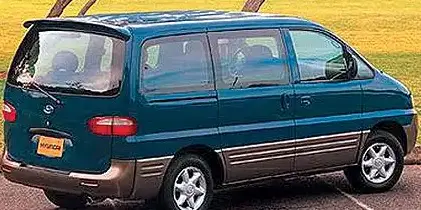
The Hyundai H-1, marketed as the Starex in some regions, is a multipurpose vehicle (MPV) produced by the South Korean manufacturer Hyundai. The first generation, known as the H-1 I Starex, was produced from 1997 to 2007. The 2.4-liter (112 hp) automatic variant, produced between 1998 and 2007, occupied a mid-range position within the H-1 lineup, offering a balance between affordability and convenience. It was primarily aimed at families and businesses requiring a spacious and practical vehicle, particularly in markets where large MPVs were popular. This model was a key player in Hyundai’s expansion into international markets, offering a competitively priced alternative to established European and Japanese MPVs.
Technical Specifications
| Brand | Hyundai |
| Model | H-1 |
| Generation | H-1 I Starex |
| Type (Engine) | 2.4 (112 Hp) Automatic |
| Start of production | 1998 |
| End of production | 2007 |
| Powertrain Architecture | Internal Combustion engine |
| Body type | Minivan |
| Seats | 7 |
| Doors | 4 |
| Fuel consumption (urban) | 17.6 l/100 km (13.4 US mpg, 16.1 UK mpg, 5.7 km/l) |
| Fuel consumption (extra urban) | 10.6 l/100 km (22.2 US mpg, 26.6 UK mpg, 9.4 km/l) |
| Fuel Type | Petrol (Gasoline) |
| Acceleration 0 – 100 km/h | 22.3 sec |
| Acceleration 0 – 62 mph | 22.3 sec |
| Acceleration 0 – 60 mph | 21.2 sec |
| Maximum speed | 142 km/h (88.23 mph) |
| Weight-to-power ratio | 16 kg/Hp, 62.6 Hp/tonne |
| Weight-to-torque ratio | 9.9 kg/Nm, 101.1 Nm/tonne |
| Power | 112 Hp @ 4500 rpm |
| Power per litre | 47.6 Hp/l |
| Torque | 181 Nm @ 2300 rpm (133.5 lb.-ft. @ 2300 rpm) |
| Engine layout | Front, Longitudinal |
| Engine displacement | 2351 cm3 (143.47 cu. in.) |
| Number of cylinders | 4 |
| Engine configuration | Inline |
| Cylinder Bore | 86.5 mm (3.41 in.) |
| Piston Stroke | 100 mm (3.94 in.) |
| Compression ratio | 8.6:1 |
| Number of valves per cylinder | 2 |
| Fuel injection system | Multi-port manifold injection |
| Engine aspiration | Naturally aspirated engine |
| Valvetrain | OHC |
| Kerb Weight | 1790 kg (3946.27 lbs.) |
| Max. weight | 2550 kg (5621.79 lbs.) |
| Max load | 760 kg (1675.51 lbs.) |
| Trunk (boot) space – minimum | 364 l (12.85 cu. ft.) |
| Trunk (boot) space – maximum | 3295 l (116.36 cu. ft.) |
| Fuel tank capacity | 65 l (17.17 US gal, 14.3 UK gal) |
| Length | 4695 mm (184.84 in.) |
| Width | 1820 mm (71.65 in.) |
| Height | 1885 mm (74.21 in.) |
| Wheelbase | 2810 mm (110.63 in.) |
| Front track | 1570 mm (61.81 in.) |
| Rear (Back) track | 1545 mm (60.83 in.) |
| Drivetrain Architecture | Rear wheel drive |
| Number of gears and type of gearbox | 4 gears, automatic transmission |
| Front suspension | Double wishbone |
| Rear suspension | Coil spring |
| Front brakes | Ventilated discs |
| Rear brakes | Drum |
| Assisting systems | ABS (Anti-lock braking system) |
| Steering type | Steering rack and pinion |
| Power steering | Hydraulic Steering |
| Tires size | 195/80 R14 |
| Wheel rims size | 14 |
Introduction
The Hyundai H-1 I Starex 2.4 Automatic, produced between 1998 and 2007, was a rear-wheel-drive minivan designed to cater to the growing demand for spacious and versatile vehicles. Built on the 1HX0 platform, it offered seating for up to seven passengers and a substantial cargo capacity. The 2.4-liter engine with an automatic transmission was positioned as a comfortable and convenient option, appealing to buyers who prioritized ease of driving over outright performance. It was a significant model for Hyundai, helping to establish the brand as a credible competitor in the global MPV market.
Powertrain & Engine Architecture
The heart of the H-1 2.4 Automatic is the 2.4-liter inline-four cylinder gasoline engine, designated with engine codes like G4CS. This engine features a naturally aspirated configuration and utilizes a multi-port fuel injection system for efficient fuel delivery. The engine’s overhead camshaft (OHC) valvetrain operates two valves per cylinder. The 8.6:1 compression ratio was a compromise between performance and the fuel quality available in various markets. Paired with this engine is a four-speed automatic transmission, designed for smooth and effortless gear changes. This transmission, while not offering the efficiency of more modern gearboxes, provided a comfortable driving experience, particularly in urban environments. The longitudinal engine placement and rear-wheel-drive configuration were common for larger vehicles in many markets during this period.
Driving Characteristics
The 2.4-liter engine, producing 112 horsepower and 181 Nm (133.5 lb-ft) of torque, delivered adequate, but not exhilarating, performance. Acceleration from 0 to 100 km/h (0-62 mph) took approximately 22.3 seconds. The automatic transmission, while convenient, contributed to a slightly sluggish feel compared to the available manual transmission options. The gear ratios were optimized for fuel economy and comfortable cruising rather than rapid acceleration. In real-world driving, the H-1 2.4 Automatic was best suited for relaxed journeys with a full passenger load. The rear-wheel-drive layout provided a stable feel, especially when carrying heavier loads, but it wasn’t particularly sporty in handling.
Equipment & Trim Levels
The H-1 2.4 Automatic typically came equipped with features considered standard for a family-oriented MPV of its time. These included power steering, air conditioning, and an AM/FM radio. Higher trim levels offered options such as power windows, central locking, and upgraded interior upholstery. The interior generally featured durable, though not luxurious, materials. The dashboard layout was functional and straightforward, prioritizing practicality over aesthetics. Optional extras included a sunroof, alloy wheels, and a more advanced audio system. The seating configuration was flexible, with options for different arrangements to maximize passenger or cargo space.
Chassis & Braking
The H-1 I Starex utilized a body-on-frame construction, providing a robust and durable chassis. The front suspension employed a double wishbone setup, while the rear suspension featured a coil spring arrangement. This suspension configuration aimed to balance ride comfort with load-carrying capability. Braking duties were handled by ventilated discs at the front and drum brakes at the rear. An Anti-lock Braking System (ABS) was included as a standard safety feature. The steering system was a rack and pinion type with hydraulic power assistance, providing relatively light and easy steering.
Market Reception & Comparison
The Hyundai H-1 2.4 Automatic received mixed reviews. Critics generally praised its spacious interior, practicality, and competitive price point. However, the engine was often criticized for being underpowered, especially when fully loaded. Compared to the more powerful engine options available in the H-1 lineup (such as diesel variants), the 2.4-liter automatic offered lower performance but better fuel economy in some driving conditions. Against competitors like the Toyota Previa and Mitsubishi Space Wagon, the H-1 offered a more affordable alternative, though often with a less refined driving experience. Reliability was generally considered good, but maintenance costs could be higher than some Japanese rivals.
Legacy
The Hyundai H-1 I Starex 2.4 Automatic has proven to be a relatively durable and reliable vehicle, with many examples still on the road today. The 2.4-liter engine, while not known for its exceptional performance, has a reputation for longevity when properly maintained. In the used car market, these models are often sought after for their affordability and spaciousness. However, potential buyers should be aware of potential issues such as rust, wear and tear on the automatic transmission, and the availability of spare parts. The H-1 I Starex laid the foundation for Hyundai’s continued success in the MPV segment, paving the way for subsequent generations of the Starex and other Hyundai people carriers.
