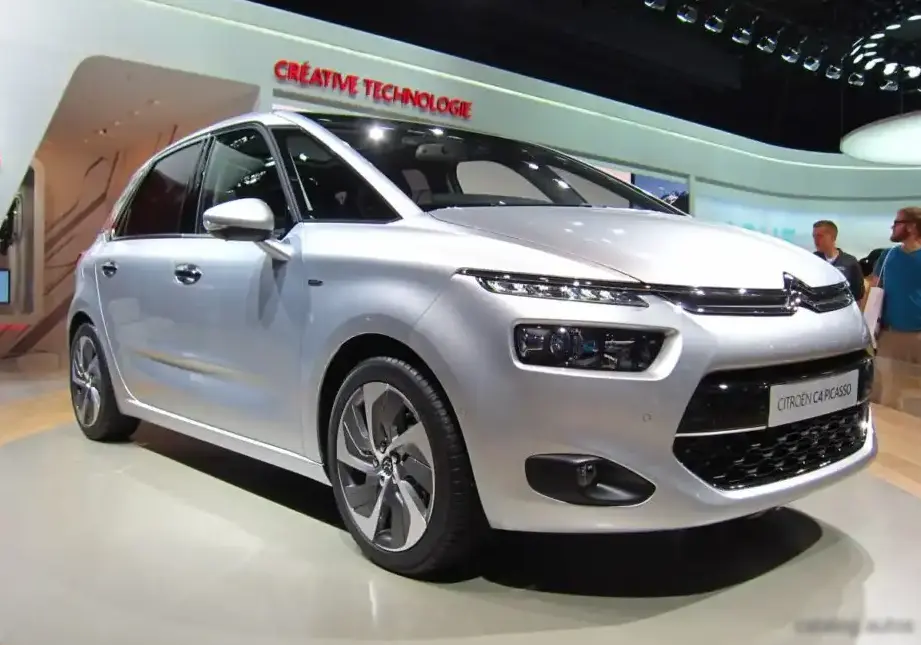
The Citroen C4 II Picasso 1.6 VTi, produced between 2013 and 2014, represented a mid-range offering within the second generation of Citroen’s popular compact MPV. Positioned as a practical and relatively affordable option, it aimed to balance fuel efficiency with adequate performance for family transport. This variant, part of the Phase I refresh of the C4 Picasso, was primarily sold in European markets, capitalizing on the demand for versatile, space-efficient vehicles. It sat within the C4 II Picasso range, offering a step up from the base diesel models but remaining below the more powerful and feature-rich petrol options.
Technical Specifications
| Brand | Citroen |
| Model | C4 |
| Generation | C4 II Picasso (Phase I, 2013) |
| Type (Engine) | 1.6 VTi (120 Hp) |
| Start of production | 2013 |
| End of production | 2014 |
| Powertrain Architecture | Internal Combustion engine |
| Body type | Minivan, MPV |
| Seats | 5 |
| Doors | 5 |
| Fuel consumption (urban) | 8.5 l/100 km (27.7 US mpg, 33.2 UK mpg, 11.8 km/l) |
| Fuel consumption (extra urban) | 4.9 l/100 km (48 US mpg, 57.6 UK mpg, 20.4 km/l) |
| Fuel consumption (combined) | 6.3 l/100 km (37.3 US mpg, 44.8 UK mpg, 15.9 km/l) |
| CO2 emissions | 145 g/km |
| Fuel Type | Petrol (Gasoline) |
| Acceleration 0 – 100 km/h | 12.3 sec |
| Acceleration 0 – 62 mph | 12.3 sec |
| Acceleration 0 – 60 mph | 11.7 sec |
| Maximum speed | 187 km/h (116.2 mph) |
| Emission standard | Euro 5 |
| Weight-to-power ratio | 10.4 kg/Hp, 95.8 Hp/tonne |
| Weight-to-torque ratio | 7.8 kg/Nm, 127.8 Nm/tonne |
| Power | 120 Hp @ 6000 rpm |
| Power per litre | 75.1 Hp/l |
| Torque | 160 Nm @ 4250 rpm (118.01 lb.-ft. @ 4250 rpm) |
| Engine layout | Front, Transverse |
| Engine Model/Code | 5FS EP6C |
| Engine displacement | 1598 cm3 (97.52 cu. in.) |
| Number of cylinders | 4 |
| Engine configuration | Inline |
| Cylinder Bore | 77 mm (3.03 in.) |
| Piston Stroke | 85.8 mm (3.38 in.) |
| Compression ratio | 11:1 |
| Number of valves per cylinder | 4 |
| Fuel injection system | Multi-port manifold injection |
| Engine aspiration | Naturally aspirated engine |
| Engine oil capacity | 4.25 l (4.49 US qt | 3.74 UK qt) |
| Coolant | 6 l (6.34 US qt | 5.28 UK qt) |
| Kerb Weight | 1252 kg (2760.19 lbs.) |
| Max. weight | 1900 kg (4188.78 lbs.) |
| Max load | 648 kg (1428.6 lbs.) |
| Trunk (boot) space – minimum | 537 l (18.96 cu. ft.) |
| Trunk (boot) space – maximum | 1710 l (60.39 cu. ft.) |
| Fuel tank capacity | 57 l (15.06 US gal | 12.54 UK gal) |
| Permitted trailer load with brakes (12%) | 1000 kg (2204.62 lbs.) |
| Permitted trailer load without brakes | 660 kg (1455.05 lbs.) |
| Permitted towbar download | 70 kg (154.32 lbs.) |
| Length | 4428 mm (174.33 in.) |
| Width | 1826 mm (71.89 in.) |
| Width with mirrors folded | 1971 mm (77.6 in.) |
| Width including mirrors | 2117 mm (83.35 in.) |
| Height | 1610-1625 mm (63.39 – 63.98 in.) |
| Wheelbase | 2785 mm (109.65 in.) |
| Front track | 1573-1587 mm (61.93 – 62.48 in.) |
| Rear (Back) track | 1576-1590 mm (62.05 – 62.6 in.) |
| Front overhang | 879 mm (34.61 in.) |
| Rear overhang | 764 mm (30.08 in.) |
| Minimum turning circle (turning diameter) | 11.1 m (36.42 ft.) |
| Drivetrain Architecture | The Internal combustion engine (ICE) drives the front wheels of the vehicle. |
| Drive wheel | Front wheel drive |
| Number of gears and type of gearbox | 5 gears, manual transmission |
| Front suspension | Independent, type McPherson with coil spring and anti-roll bar |
| Rear suspension | Semi-independent, coil spring |
| Front brakes | Ventilated discs |
| Rear brakes | Disc |
| Assisting systems | ABS (Anti-lock braking system) |
| Steering type | Steering rack and pinion |
| Power steering | Electric Steering |
| Tires size | 205/60 R16 |
| Wheel rims size | 16 |
Powertrain & Engine Architecture
The heart of this C4 Picasso variant is the PSA Group’s 1.6-liter naturally aspirated four-cylinder petrol engine, designated the 5FS EP6C. This engine is part of the Prince engine family, developed in collaboration with BMW. It features a cast iron block and aluminum cylinder head, incorporating a multi-point fuel injection system and a timing chain for durability. The engine produces 120 horsepower at 6000 rpm and 160 Nm (118 lb-ft) of torque at 4250 rpm. The engine’s relatively simple design contributes to its reliability, but also limits its overall performance. The engine is paired with a five-speed manual transmission, delivering power to the front wheels. While an automatic transmission was offered on other C4 Picasso models, the 1.6 VTi was exclusively available with a manual gearbox in this generation.
Driving Characteristics
The 1.6 VTi engine, coupled with the five-speed manual transmission, provides adequate, but not exhilarating, performance. Acceleration from 0 to 100 km/h (0-62 mph) takes around 12.3 seconds, and top speed is rated at 187 km/h (116 mph). The engine feels somewhat strained when accelerating hard, particularly when fully loaded. The gear ratios are reasonably well-spaced for everyday driving, but the lack of a sixth gear can result in higher engine speeds at highway cruising speeds. Compared to the more powerful 1.6 THP turbocharged engine or the diesel variants, the 1.6 VTi feels noticeably less responsive. However, it offers a smoother and quieter driving experience than the diesel options, and its linear power delivery makes it easy to control.
Equipment & Trim Levels
The 1.6 VTi trim typically included features such as air conditioning, electric front windows, a CD/radio player with auxiliary input, and ABS brakes. Higher trim levels, available as options, added features like alloy wheels, rear parking sensors, automatic headlights and wipers, and a panoramic sunroof. Interior upholstery was typically cloth, with a functional and durable design. The dashboard layout was typical of Citroen at the time, featuring a centrally mounted instrument cluster and a user-friendly infotainment system. Safety features included driver and passenger airbags, side airbags, and curtain airbags.
Chassis & Braking
The C4 II Picasso utilizes a McPherson strut front suspension and a semi-independent torsion beam rear suspension. This setup provides a comfortable ride quality, absorbing bumps and imperfections in the road surface effectively. The front brakes are ventilated discs, while the rear brakes are solid discs. ABS (Anti-lock Braking System) is standard, providing enhanced braking performance and stability. The steering is electrically assisted, offering light and precise control. The suspension is tuned for comfort rather than sporty handling, resulting in a slight degree of body roll during cornering.
Market Reception & Comparison
The Citroen C4 II Picasso 1.6 VTi was generally well-received by critics as a practical and affordable family car. However, its performance was often criticized as being underwhelming, particularly when compared to the turbocharged petrol and diesel alternatives. Fuel economy was considered reasonable, but not class-leading. The 1.6 VTi offered a good balance between price and features, making it an attractive option for buyers who prioritized practicality and comfort over outright performance. Compared to the 1.6 HDi diesel, the VTi offered a quieter and smoother driving experience, but at the cost of higher fuel consumption and lower torque.
Legacy
The 1.6 VTi engine, while not known for its exceptional performance, proved to be relatively reliable in the C4 II Picasso. Common issues are generally limited to routine maintenance items such as spark plugs, air filters, and oil changes. On the used car market, the 1.6 VTi variants tend to be more affordable than the more powerful or diesel-powered models. They represent a good value proposition for buyers seeking a spacious, comfortable, and reliable MPV for family use. However, potential buyers should be aware of the engine’s limitations in terms of performance and fuel economy.