
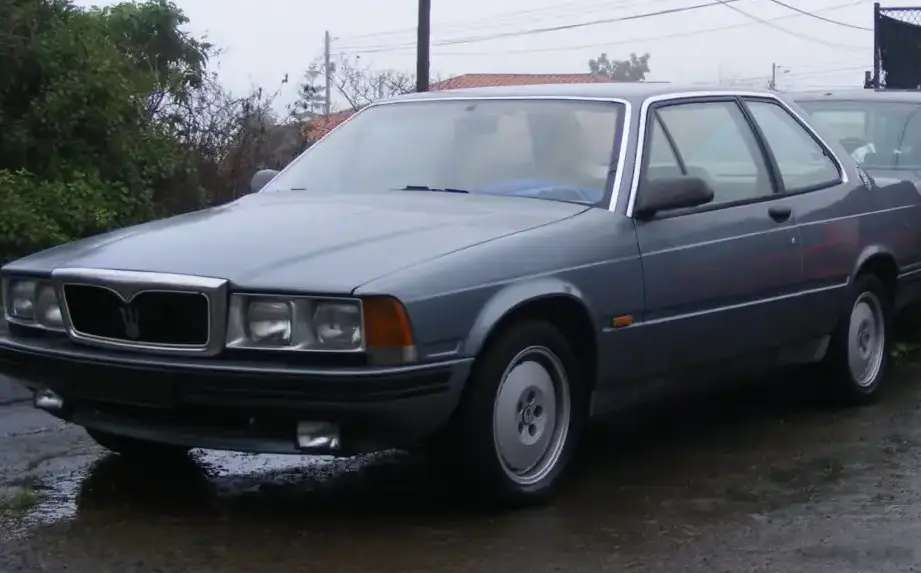
The Maserati 228, produced between 1986 and 1992, represented a significant evolution in the Italian manufacturer’s lineup. Positioned as a more accessible entry point into the Maserati grand touring experience, the 228 aimed to broaden the brand’s appeal while retaining its core values of performance and luxury. This particular variant, the 2.8 i V6 Turbo producing 250 horsepower, was a key component of that strategy. It sat within the broader 228 range, which was itself a development of the earlier Biturbo models, benefiting from refinements in design and engineering. The 228 utilized the 1HX0 chassis, shared with other Biturbo derivatives, and offered a blend of Italian styling and respectable performance for its time.
Technical Specifications
| Brand | Maserati |
| Model | 228 |
| Generation | 228 |
| Type (Engine) | 2.8 i V6 Turbo (250 Hp) |
| Start of production | 1986 |
| End of production | 1992 |
| Powertrain Architecture | Internal Combustion engine |
| Body type | Coupe |
| Seats | 5 |
| Doors | 2 |
| Fuel consumption (urban) | 18.2 l/100 km (12.9 US mpg, 15.5 UK mpg, 5.5 km/l) |
| Fuel consumption (extra urban) | 9.2 l/100 km (25.6 US mpg, 30.7 UK mpg, 10.9 km/l) |
| Fuel consumption (combined) | 11.8 l/100 km (19.9 US mpg, 23.9 UK mpg, 8.5 km/l) |
| Fuel Type | Petrol (Gasoline) |
| Acceleration 0 – 100 km/h | 5.8 sec |
| Acceleration 0 – 62 mph | 5.8 sec |
| Acceleration 0 – 60 mph | 5.5 sec |
| Maximum speed | 235 km/h (146.02 mph) |
| Weight-to-power ratio | 5 kg/Hp, 201.6 Hp/tonne |
| Weight-to-torque ratio | 3.3 kg/Nm, 300.8 Nm/tonne |
| Power | 250 Hp @ 6000 rpm |
| Power per litre | 89.6 Hp/l |
| Torque | 373 Nm @ 3500 rpm (275.11 lb.-ft. @ 3500 rpm) |
| Engine Model/Code | AM334 |
| Engine displacement | 2790 cm3 (170.26 cu. in.) |
| Number of cylinders | 6 |
| Engine configuration | V-engine |
| Cylinder Bore | 94 mm (3.7 in.) |
| Piston Stroke | 67 mm (2.64 in.) |
| Compression ratio | 7.7:1 |
| Number of valves per cylinder | 3 |
| Fuel injection system | Multi-port manifold injection |
| Engine aspiration | Turbocharger |
| Engine oil capacity | 6 l (6.34 US qt | 5.28 UK qt) |
| Coolant | 8.5 l (8.98 US qt | 7.48 UK qt) |
| Kerb Weight | 1240 kg (2733.73 lbs.) |
| Max. weight | 1800 kg (3968.32 lbs.) |
| Max load | 560 kg (1234.59 lbs.) |
| Trunk (boot) space – minimum | 530 l (18.72 cu. ft.) |
| Fuel tank capacity | 82 l (21.66 US gal | 18.04 UK gal) |
| Length | 4460 mm (175.59 in.) |
| Width | 1865 mm (73.43 in.) |
| Height | 1330 mm (52.36 in.) |
| Wheelbase | 2600 mm (102.36 in.) |
| Front track | 1540 mm (60.63 in.) |
| Rear (Back) track | 1550 mm (61.02 in.) |
| Drivetrain Architecture | The Internal combustion engine (ICE) drives the rear wheels of the vehicle. |
| Drive wheel | Rear wheel drive |
| Number of gears and type of gearbox | 5 gears, manual transmission |
| Front suspension | Coil spring |
| Rear suspension | Coil spring |
| Front brakes | Ventilated discs |
| Rear brakes | Disc |
| Power steering | Hydraulic Steering |
| Tires size | 205/55 R15 |
| Wheel rims size | 15 |
Powertrain & Engine Architecture
The heart of the 228 was the AM334 engine, a 2.8-liter V6 featuring a single turbocharger and multi-port fuel injection. This engine was a derivative of the earlier 2.0 and 2.5-liter V6s used in the Biturbo range, but with increased displacement and refinements to the turbocharging system. The engine produced 250 horsepower at 6000 rpm and 373 Nm (275 lb-ft) of torque at 3500 rpm. The turbocharger was an IHI unit, providing a noticeable boost in power across the rev range. The engine utilized a relatively low 7.7:1 compression ratio, typical for turbocharged engines of the era. The 228 was exclusively offered with a five-speed manual transmission, delivering power to the rear wheels. This transmission was chosen to complement the engine’s performance characteristics and provide a more engaging driving experience.
Driving Characteristics
The 228 2.8 i V6 Turbo offered a compelling blend of performance and handling. The turbocharger provided a surge of power, making the car feel significantly faster than its naturally aspirated siblings. Acceleration from 0 to 60 mph was achieved in around 5.5 seconds, and the car could reach a top speed of 235 km/h (146 mph). The five-speed manual transmission allowed drivers to fully exploit the engine’s powerband. While the chassis was shared with other Biturbo models, the 228’s increased power required a slightly stiffer suspension setup to manage body roll and maintain stability. The steering was direct and responsive, providing good feedback to the driver. Compared to the lower-powered 2.0-liter versions, the 228 offered a more refined and exhilarating driving experience.
Equipment & Trim Levels
The 228 was generally well-equipped for its price point. Standard features included leather upholstery, power windows, central locking, and an upgraded audio system. Air conditioning was also typically included. The interior design was typical of Italian cars of the period, with a focus on style and comfort. Optional extras included a sunroof, upgraded wheels, and a more sophisticated audio system. The dashboard layout was relatively straightforward, with clearly marked gauges and controls. The 228 aimed to provide a luxurious and comfortable interior environment, befitting a grand touring car.
Chassis & Braking
The 228 utilized a relatively conventional chassis design, with coil springs and telescopic shock absorbers at all four corners. The front suspension featured independent double wishbones, while the rear suspension employed a solid axle with coil springs. The braking system consisted of ventilated discs at the front and solid discs at the rear. Power-assisted steering was standard. The 228’s suspension was tuned to provide a balance between comfort and handling, offering a reasonably compliant ride without sacrificing too much stability. The braking system was adequate for the car’s performance, but it lacked the sophistication of more modern systems.
Market Reception & Comparison
The Maserati 228 was generally well-received by automotive critics. It was praised for its stylish design, strong performance, and relatively affordable price. However, some critics noted that the car’s build quality was not always up to the standards of its German rivals. Compared to the lower-powered 2.0-liter versions, the 2.8 i V6 Turbo offered a significant performance upgrade, making it the preferred choice for enthusiasts. Fuel economy was relatively poor, averaging around 19.9 US mpg in combined driving. Reliability was also a concern, as with many Italian cars of the period. However, the 228’s unique character and driving experience made it a popular choice among those seeking a distinctive grand touring car.
Legacy
The Maserati 228 represents an important chapter in the brand’s history. It helped to broaden Maserati’s appeal and establish it as a competitor in the luxury sports car market. While the 228’s reliability was not always stellar, the engine proved to be reasonably durable when properly maintained. Today, the 228 is a sought-after classic car, appreciated for its stylish design and engaging driving experience. Values have been steadily increasing in recent years, as collectors recognize the car’s historical significance and unique character. Finding well-maintained examples can be challenging, but the 228 remains a rewarding ownership experience for those willing to invest the time and effort.
