
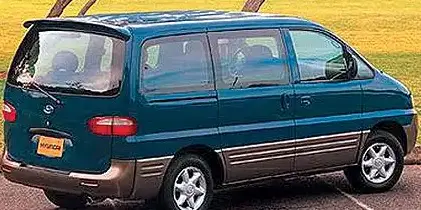
Technical Specifications
| Brand | Hyundai |
| Model | H-1 |
| Generation | H-1 I Starex |
| Type (Engine) | 2.4 i LWD (110 Hp) |
| Start of production | 1998 |
| End of production | 2007 |
| Powertrain Architecture | Internal Combustion engine |
| Body type | Minivan |
| Seats | 9 |
| Doors | 4 |
| Fuel consumption (urban) | 16.8 l/100 km (14 US mpg, 16.8 UK mpg, 6 km/l) |
| Fuel consumption (extra urban) | 9.9 l/100 km (23.8 US mpg, 28.5 UK mpg, 10.1 km/l) |
| Fuel Type | Petrol (Gasoline) |
| Acceleration 0 – 100 km/h | 20.6 sec |
| Acceleration 0 – 62 mph | 20.6 sec |
| Acceleration 0 – 60 mph | 19.6 sec |
| Maximum speed | 155 km/h (96.31 mph) |
| Weight-to-power ratio | 16.5 kg/Hp, 60.6 Hp/tonne |
| Weight-to-torque ratio | 10 kg/Nm, 99.7 Nm/tonne |
| Power | 110 Hp @ 4500 rpm |
| Power per litre | 46.8 Hp/l |
| Torque | 181 Nm @ 2300 rpm (133.5 lb.-ft. @ 2300 rpm) |
| Engine layout | Front, Longitudinal |
| Engine displacement | 2351 cm3 (143.47 cu. in.) |
| Number of cylinders | 4 |
| Engine configuration | Inline |
| Cylinder Bore | 86.5 mm (3.41 in.) |
| Piston Stroke | 100 mm (3.94 in.) |
| Compression ratio | 8.5:1 |
| Number of valves per cylinder | 2 |
| Fuel injection system | Multi-port manifold injection |
| Engine aspiration | Naturally aspirated engine |
| Kerb Weight | 1815 kg (4001.39 lbs.) |
| Max. weight | 2650 kg (5842.25 lbs.) |
| Max load | 835 kg (1840.86 lbs.) |
| Trunk (boot) space – maximum | 4400 l (155.38 cu. ft.) |
| Fuel tank capacity | 65 l (17.17 US gal | 14.3 UK gal) |
| Length | 5035 mm (198.23 in.) |
| Width | 1820 mm (71.65 in.) |
| Height | 1960 mm (77.17 in.) |
| Wheelbase | 3080 mm (121.26 in.) |
| Front track | 1570 mm (61.81 in.) |
| Rear (Back) track | 1545 mm (60.83 in.) |
| Drivetrain Architecture | The Internal combustion engine (ICE) drives the rear wheels of the vehicle. |
| Drive wheel | Rear wheel drive |
| Number of gears and type of gearbox | 5 gears, manual transmission |
| Front suspension | Double wishbone |
| Rear suspension | Coil spring |
| Front brakes | Ventilated discs |
| Rear brakes | Disc |
| Assisting systems | ABS (Anti-lock braking system) |
| Steering type | Steering rack and pinion |
| Power steering | Hydraulic Steering |
| Tires size | 195/80 R14 |
The Hyundai H-1 I Starex 2.4 i LWD (110 Hp) was a significant model within the first generation H-1 lineup, produced between 1998 and 2007. Built on a body-on-frame construction, it was designed to cater to the growing demand for versatile, multi-passenger vehicles. The “LWD” designation indicates a long-wheelbase configuration, maximizing interior space. This variant was particularly popular in regions where large families or commercial operators required a vehicle capable of carrying both passengers and substantial cargo. It served as a workhorse vehicle, often used as a family van, taxi, or light commercial transport.
Powertrain & Engine Architecture
The 2.4 i LWD variant was powered by Hyundai’s 2.4-liter inline-four cylinder gasoline engine. This engine, often referred to by its internal code, featured a naturally aspirated design with a multi-port fuel injection system. The engine produced 110 horsepower at 4500 rpm and 181 Nm (133.5 lb-ft) of torque at 2300 rpm. The 8.5:1 compression ratio was typical for the era, balancing performance and fuel efficiency. The engine’s valvetrain consisted of two valves per cylinder. The engine was mounted longitudinally in the front of the vehicle. The 5-speed manual transmission was the standard offering for this trim, providing a direct connection between the engine and the rear wheels. While an automatic transmission was available on other H-1 models, it wasn’t commonly paired with the 2.4L engine due to the engine’s relatively modest power output.
Driving Characteristics
The driving experience of the H-1 2.4 i LWD was characterized by its focus on practicality rather than performance. With 110 horsepower and a relatively high kerb weight of 1815 kg (4001.39 lbs), acceleration was modest, taking approximately 20.6 seconds to reach 100 km/h (62 mph). The 5-speed manual transmission allowed drivers to make the most of the available power, but the engine required frequent downshifting when encountering hills or carrying a full load. Compared to higher-output versions of the H-1, such as those equipped with a diesel engine, the 2.4 i LWD felt noticeably less powerful. However, the engine’s torque delivery at lower RPMs made it reasonably suitable for everyday driving and urban conditions. The rear-wheel-drive configuration provided a stable driving experience, particularly when loaded. The steering, while hydraulic assisted, lacked the precision found in more modern vehicles.
Equipment & Trim Levels
The 2.4 i LWD trim level typically included basic but functional equipment. Standard features generally included power steering, ABS (Anti-lock Braking System), and a relatively simple interior layout. Upholstery was typically cloth, and the dashboard featured basic instrumentation. Air conditioning was often an optional extra. The focus was on providing a durable and practical interior that could withstand heavy use. Optional extras could include power windows, central locking, and a basic audio system. The long-wheelbase configuration provided ample space for up to nine passengers, with flexible seating arrangements to accommodate varying cargo needs. The rear doors often featured a split configuration for easier access.
Chassis & Braking
The H-1 I Starex featured a robust chassis designed to handle the vehicle’s weight and passenger capacity. The front suspension utilized a double wishbone setup, while the rear suspension employed a coil spring arrangement. This configuration provided a reasonable balance between ride comfort and handling stability. The braking system consisted of ventilated discs on the front wheels and discs on the rear wheels, providing adequate stopping power for most driving conditions. The hydraulic power steering system offered reasonable assistance, making maneuvering easier, especially at low speeds. The vehicle’s body-on-frame construction contributed to its durability and ability to withstand heavy loads.
Market Reception & Comparison
The H-1 2.4 i LWD was generally well-received in markets where affordability and practicality were prioritized. Critics noted its spacious interior, durable construction, and relatively low running costs. However, the engine’s modest power output and somewhat basic interior were often cited as drawbacks. Compared to other trims in the H-1 lineup, such as those equipped with a diesel engine, the 2.4 i LWD offered lower performance but also a lower purchase price. Fuel economy was reasonable for a vehicle of its size and type, but it was not as efficient as the diesel-powered models. Reliability was generally considered good, with the engine proving to be relatively durable with proper maintenance. The gasoline engine was often preferred in regions with readily available and affordable gasoline.
Legacy
The Hyundai H-1 I Starex 2.4 i LWD has established a reputation as a reliable and practical workhorse vehicle. In the used car market, these models are often sought after for their affordability and spaciousness. While the engine may require periodic maintenance, it is generally considered to be relatively durable. The availability of spare parts is generally good, making maintenance and repairs relatively straightforward. The H-1 I Starex 2.4 i LWD remains a popular choice for those seeking a versatile and affordable MPV, particularly in regions where large passenger and cargo capacity are essential. Its simple mechanical design makes it a favorite among mechanics and DIY enthusiasts.
