Technical Specifications
| Brand | Citroen |
| Model | C4 |
| Generation | C4 II Picasso (Phase II, 2016) |
| Type (Engine) | 1.6 BlueHDI (120 Hp) S&S 94g |
| Start of production | 2016 |
| End of production | 2018 |
| Powertrain Architecture | Internal Combustion engine |
| Body type | Minivan, MPV |
| Seats | 5 |
| Doors | 5 |
| Fuel consumption (urban) | 4.1 l/100 km (57.4 US mpg, 68.9 UK mpg, 24.4 km/l) |
| Fuel consumption (extra urban) | 3.5 l/100 km (67.2 US mpg, 80.7 UK mpg, 28.6 km/l) |
| Fuel consumption (combined) | 3.6 l/100 km (65.3 US mpg, 78.5 UK mpg, 27.8 km/l) |
| CO2 emissions | 94 g/km |
| Fuel Type | Diesel |
| Acceleration 0 – 100 km/h | 11.3 sec |
| Acceleration 0 – 62 mph | 11.3 sec |
| Acceleration 0 – 60 mph | 10.7 sec |
| Maximum speed | 193 km/h (119.92 mph) |
| Emission standard | Euro 6 |
| Weight-to-power ratio | 11 kg/Hp, 90.9 Hp/tonne |
| Weight-to-torque ratio | 4.4 kg/Nm, 227.3 Nm/tonne |
| Power | 120 Hp @ 3500 rpm |
| Power per litre | 76.9 Hp/l |
| Torque | 300 Nm @ 1750 rpm (221.27 lb.-ft. @ 1750 rpm) |
| Engine layout | Front, Transverse |
| Engine Model/Code | BHZ DV6FC |
| Engine displacement | 1560 cm3 (95.2 cu. in.) |
| Number of cylinders | 4 |
| Engine configuration | Inline |
| Cylinder Bore | 75 mm (2.95 in.) |
| Piston Stroke | 88.3 mm (3.48 in.) |
| Compression ratio | 16:1 |
| Number of valves per cylinder | 2 |
| Fuel injection system | Diesel Commonrail |
| Engine aspiration | Turbocharger, Intercooler |
| Engine oil capacity | 3.75 l (3.96 US qt | 3.3 UK qt) |
| Kerb Weight | 1320 kg (2910.1 lbs.) |
| Max. weight | 1950 kg (4299.01 lbs.) |
| Max load | 630 kg (1388.91 lbs.) |
| Trunk (boot) space – minimum | 630 l (22.25 cu. ft.) |
| Trunk (boot) space – maximum | 1851 l (65.37 cu. ft.) |
| Fuel tank capacity | 55 l (14.53 US gal | 12.1 UK gal) |
| AdBlue tank | 17 l (4.49 US gal | 3.74 UK gal) |
| Max. roof load | 80 kg (176.37 lbs.) |
| Permitted trailer load with brakes (12%) | 1400 kg (3086.47 lbs.) |
| Permitted trailer load without brakes | 660 kg (1455.05 lbs.) |
| Permitted towbar download | 70 kg (154.32 lbs.) |
| Length | 4438 mm (174.72 in.) |
| Width | 1826 mm (71.89 in.) |
| Width with mirrors folded | 1971 mm (77.6 in.) |
| Width including mirrors | 2117 mm (83.35 in.) |
| Height | 1610-1625 mm (63.39 – 63.98 in.) |
| Wheelbase | 2785 mm (109.65 in.) |
| Front track | 1573-1587 mm (61.93 – 62.48 in.) |
| Rear (Back) track | 1576-1590 mm (62.05 – 62.6 in.) |
| Front overhang | 889 mm (35 in.) |
| Rear overhang | 764 mm (30.08 in.) |
| Minimum turning circle | 11.1 m (36.42 ft.) |
| Drivetrain Architecture | Front wheel drive |
| Drive wheel | Front wheel drive |
| Number of gears and type of gearbox | 6 gears, manual transmission |
| Front suspension | Independent, type McPherson with coil spring and anti-roll bar |
| Rear suspension | Semi-independent, coil spring |
| Front brakes | Ventilated discs |
| Rear brakes | Disc |
| Assisting systems | ABS (Anti-lock braking system) |
| Steering type | Steering rack and pinion |
| Power steering | Electric Steering |
| Tires size | 205/60 R16; 205/55 R17 |
| Wheel rims size | 16; 17 |
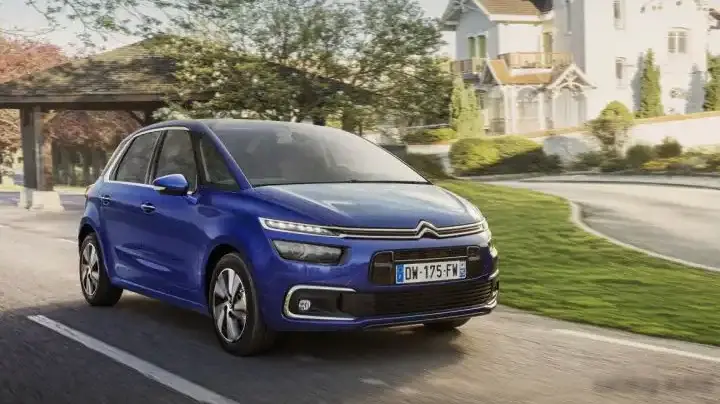
The Citroën C4 II Picasso 1.6 BlueHDi 120, produced from 2016 to 2018, represents a mid-cycle refresh of the second-generation C4 Picasso (internally known as the B78 platform). This variant occupied a key position in the C4 Picasso lineup, offering a balance between fuel efficiency, practicality, and reasonable performance for family transport. Positioned as a mainstream option, it sat between the lower-powered diesel variants and the more expensive, higher-specification models. The “S&S” designation indicates the inclusion of Citroën’s Stop & Start system, designed to improve fuel economy in urban driving conditions. This model was primarily aimed at the European market, where compact MPVs were highly popular due to their versatility and space-efficient designs.
Powertrain & Engine Architecture
The heart of the C4 II Picasso 1.6 BlueHDi 120 is the PSA Group’s DV6FC engine, specifically the BHZ variant. This 1.6-liter, four-cylinder diesel engine utilizes a common-rail direct injection system, delivering fuel at extremely high pressures for optimized combustion. The engine benefits from a turbocharger with an intercooler, enhancing power output and efficiency. The BlueHDi technology incorporates a Selective Catalytic Reduction (SCR) system, utilizing AdBlue (Diesel Exhaust Fluid) to reduce nitrogen oxide (NOx) emissions, ensuring compliance with stringent Euro 6 emission standards. The engine produces 120 horsepower at 3500 rpm and 300 Nm (221 lb-ft) of torque at 1750 rpm. The engine’s architecture features a cast iron block and aluminum cylinder head, contributing to its durability. The 6-speed manual transmission was the standard offering, providing a good balance between fuel economy and drivability.
Driving Characteristics
The 1.6 BlueHDi 120 S&S, paired with the 6-speed manual gearbox, offered a practical and economical driving experience. Acceleration from 0-100 km/h (0-62 mph) took around 11.3 seconds, which wasn’t particularly brisk, but adequate for everyday driving. The engine’s strong low-end torque made it feel more responsive in typical urban and highway scenarios than the outright acceleration figures might suggest. Compared to the more powerful 150 hp BlueHDi variant, this engine felt less strained when fully loaded with passengers and luggage. The gear ratios were well-chosen for maximizing fuel efficiency, with a relatively long sixth gear for comfortable cruising. While not a sporty vehicle, the C4 Picasso offered predictable handling and a comfortable ride, prioritizing passenger comfort over dynamic performance.
Equipment & Trim Levels
The C4 II Picasso 1.6 BlueHDi 120 S&S typically came equipped with a respectable level of standard features. These included air conditioning, a touchscreen infotainment system with Bluetooth connectivity, USB ports, and steering wheel-mounted audio controls. Safety features such as ABS, Electronic Stability Control (ESC), and multiple airbags were standard. Higher trim levels offered options like automatic climate control, panoramic sunroof, navigation system, and parking sensors. Interior upholstery was typically cloth, with options for leather upgrades. The dashboard design was modern and functional, with a focus on ergonomics and ease of use.
Chassis & Braking
The C4 II Picasso utilized a McPherson strut front suspension and a semi-independent coil spring rear suspension. This setup provided a comfortable ride quality, absorbing bumps and imperfections in the road surface effectively. The front brakes were ventilated discs, offering good stopping power, while the rear brakes were solid discs. The electric power steering provided light and precise steering feel. Stabilizer bars were fitted to both the front and rear axles to reduce body roll during cornering. The chassis was designed to prioritize comfort and practicality, rather than outright handling performance.
Market Reception & Comparison
The Citroën C4 II Picasso 1.6 BlueHDi 120 S&S was generally well-received by automotive critics for its fuel efficiency, spacious interior, and comfortable ride. It was often praised as a practical and sensible choice for families. Compared to the more powerful BlueHDi variants, this model offered a lower purchase price and slightly better fuel economy, making it an attractive option for budget-conscious buyers. However, some critics noted that the engine could feel underpowered when fully loaded or when tackling steep hills. Compared to competitors like the Renault Scenic and Volkswagen Touran, the C4 Picasso offered a distinctive design and a focus on comfort.
Legacy
The 1.6 BlueHDi engine, in various iterations, proved to be a reliable and durable powertrain. While early versions of the DV6 engine had some issues with diesel particulate filter (DPF) clogging, later revisions, including those found in the C4 Picasso, addressed these concerns. Today, used examples of the C4 II Picasso 1.6 BlueHDi 120 S&S are readily available and generally offer good value for money. Regular maintenance, including timely oil changes and DPF regeneration, is crucial for ensuring the long-term reliability of this powertrain. The C4 Picasso remains a popular choice for those seeking a practical, spacious, and fuel-efficient MPV.