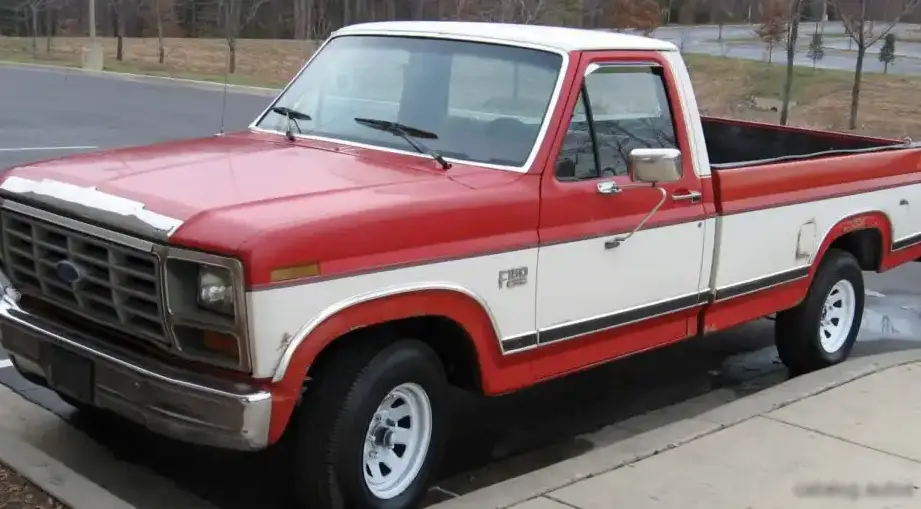
The Ford F-Series F-150 VII Regular Cab, equipped with the 5.8-liter V8 engine producing 210 horsepower, represents a significant iteration in the long and storied history of Ford’s full-size pickup trucks. Produced from 1984 to 1986, this variant occupied a middle ground within the seventh generation (1980-1986) F-Series lineup, offering a balance between capability and affordability. It served as a workhorse for a broad range of buyers, from farmers and ranchers to contractors and everyday drivers needing a robust vehicle. This configuration was a mainstay of the American automotive landscape during the mid-1980s, embodying the era’s emphasis on V8 power and rugged practicality.
Technical Specifications
| Brand | Ford |
| Model | F-Series F-100/F-150 |
| Generation | F-Series F-150 VII Regular Cab |
| Type (Engine) | 5.8 V8 (210 Hp) |
| Start of production | 1984 |
| End of production | 1986 |
| Powertrain Architecture | Internal Combustion engine |
| Body type | Pick-up |
| Seats | 2-3 |
| Doors | 2 |
| Fuel Type | Petrol (Gasoline) |
| Power | 210 Hp |
| Power per litre | 36.5 Hp/l |
| Torque | 414 Nm / 305.35 lb.-ft. |
| Engine layout | Front, Longitudinal |
| Engine displacement | 5752 cm3 / 351.01 cu. in. |
| Number of cylinders | 8 |
| Engine configuration | V-engine |
| Fuel injection system | Multi-port manifold injection |
| Engine aspiration | Naturally aspirated engine |
| Max. weight | 2767 kg / 6100.19 lbs. |
| Fuel tank capacity | 62-72 l / 16.38 – 19.02 US gal | 13.64 – 15.84 UK gal |
| Length | 4770-5291 mm / 187.8 – 208.31 in. |
| Width | 1372-1778 mm / 54.02 – 70 in. |
| Height | 1775-1778 mm / 69.88 – 70 in. |
| Wheelbase | 2967-3378 mm / 116.81 – 132.99 in. |
| Wading depth | 726-732 mm / 28.58 – 28.82 in. |
| Drivetrain Architecture | The Internal combustion engine (ICE) drives the rear wheels of the vehicle. |
| Drive wheel | Rear wheel drive |
| Number of gears and type of gearbox | 3 gears, manual transmission |
| Front suspension | Independent coil spring |
| Front brakes | Disc |
| Rear brakes | Drum |
| Power steering | Electric Steering |
| Tires size | 215/75 R15; 235/75 R15 |
| Wheel rims size | 15 |
Powertrain & Engine Architecture
The heart of this F-150 variant is Ford’s 5.8-liter (351 cubic inch) Windsor V8 engine. This engine, a staple of Ford trucks for many years, featured a cast iron block and cylinder heads, and utilized a multi-port fuel injection system. This was a relatively new addition for the time, replacing the carburetor systems of earlier F-Series models and contributing to improved fuel efficiency and smoother operation. The engine’s valvetrain employed a hydraulic lifter camshaft, reducing the need for frequent valve adjustments. The 210 horsepower output, while modest by modern standards, was considered adequate for the truck’s intended purpose. The engine’s longitudinal mounting within the chassis and rear-wheel drive configuration were standard for American trucks of this era. The standard transmission was a 3-speed manual, though a 4-speed automatic was available as an option.
Driving Characteristics
The 5.8L V8 and 3-speed manual transmission combination provided a fairly straightforward driving experience. Acceleration was adequate, but not particularly brisk, with a 0-60 mph time estimated to be around 10-12 seconds. The engine delivered its peak torque at relatively low RPMs, making it well-suited for hauling and towing. The manual transmission offered precise control, but required more driver involvement than an automatic. Compared to the available 6.9L diesel engine, the 5.8L V8 prioritized quicker acceleration over ultimate towing capacity. Compared to the smaller 3.8L V6 option, the 5.8L offered significantly more power and torque, making it the preferred choice for those regularly carrying heavy loads. The truck’s suspension, while designed for durability, provided a somewhat firm ride, especially when unladen.
Equipment & Trim Levels
The F-150 Regular Cab with the 5.8L V8 typically came with a fairly basic level of equipment. Standard features included a vinyl bench seat, basic instrumentation (speedometer, fuel gauge, temperature gauge), and a simple AM radio. Optional extras included air conditioning, a more powerful AM/FM radio, upgraded interior trim, and a sliding rear window. The Regular Cab configuration offered a no-frills interior focused on functionality. Trim levels were relatively limited during this period, with the primary differentiation being the addition of optional packages. The exterior typically featured minimal chrome trim, reflecting the truck’s work-oriented nature.
Chassis & Braking
The F-150’s chassis was a traditional body-on-frame construction, providing a robust and durable platform. The front suspension utilized independent coil springs, offering a degree of ride comfort and handling. The rear suspension employed leaf springs, designed to handle heavy loads. Braking duties were handled by disc brakes at the front and drum brakes at the rear. Power steering was standard, making maneuvering the large truck easier. Tire sizes typically ranged from 215/75R15 to 235/75R15, providing a balance between ride comfort and off-road capability. The truck’s relatively simple braking system was adequate for its weight class, but lacked the sophistication of more modern systems.
Market Reception & Comparison
The F-150 with the 5.8L V8 was generally well-received by buyers seeking a capable and reliable work truck. Critics praised the engine’s durability and torque output, but noted its relatively modest horsepower. Fuel economy was typical for a full-size truck of the era, averaging around 12-15 mpg. Compared to the 3.8L V6, the 5.8L offered a significant performance advantage, but at a higher price point. The diesel-powered F-Series models offered superior towing capacity, but were more expensive and had a different driving character. The 5.8L V8 struck a balance between performance, affordability, and reliability, making it a popular choice for a wide range of buyers.
Legacy
The 5.8L Windsor V8 engine, in all its applications, has earned a reputation for durability and longevity. While not known for its high performance, it proved to be a reliable powerplant capable of withstanding years of hard use. Today, well-maintained examples of the 1984-1986 F-150 with the 5.8L V8 are sought after by collectors and enthusiasts. Parts availability remains relatively good, making these trucks relatively easy to maintain and repair. The 5.8L engine’s simplicity and robust construction contribute to its continued appeal, making it a testament to Ford’s engineering prowess during the 1980s. These trucks represent a bygone era of American automotive design, characterized by ruggedness, practicality, and V8 power.