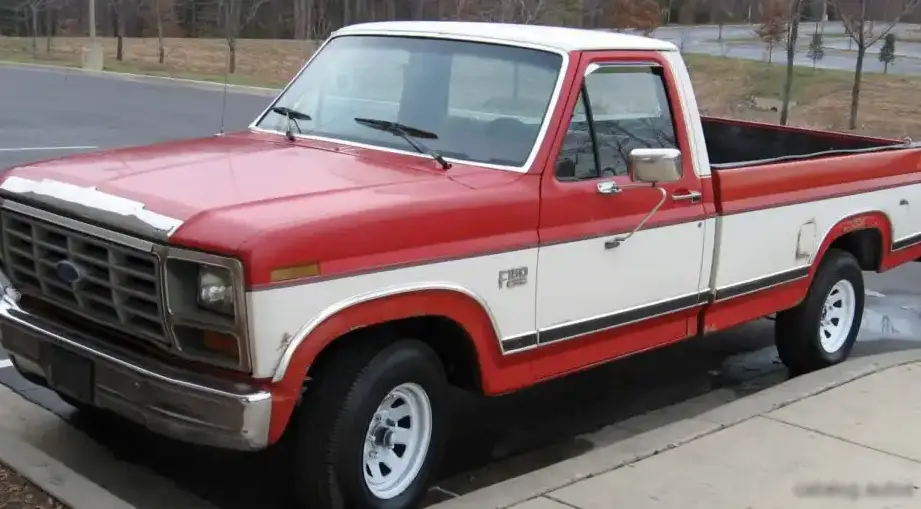
The Ford F-Series F-150 VII Regular Cab, specifically equipped with the 5.8-liter V8 engine producing 210 horsepower and a four-wheel-drive system, represents a significant iteration in Ford’s long-running and immensely popular F-Series pickup truck lineage. Produced from 1984 through 1986, this variant occupied a middle ground within the seventh generation (1980-1986) F-Series lineup, offering a balance between capability and affordability. It was positioned as a workhorse for those needing substantial towing and hauling capacity, but perhaps not requiring the higher performance or luxury features of other trims. This generation marked a substantial redesign for the F-Series, focusing on improved aerodynamics and interior comfort compared to its predecessor.
Technical Specifications
| Brand | Ford |
| Model | F-Series F-100/F-150 |
| Generation | F-Series F-150 VII Regular Cab |
| Type (Engine) | 5.8 V8 (210 Hp) 4×4 |
| Start of production | 1984 |
| End of production | 1986 |
| Powertrain Architecture | Internal Combustion engine |
| Body type | Pick-up |
| Seats | 2-3 |
| Doors | 2 |
| Fuel Type | Petrol (Gasoline) |
| Power | 210 Hp |
| Power per litre | 36.5 Hp/l |
| Torque | 414 Nm / 305.35 lb.-ft. |
| Engine layout | Front, Longitudinal |
| Engine displacement | 5752 cm3 / 351.01 cu. in. |
| Number of cylinders | 8 |
| Engine configuration | V-engine |
| Fuel injection system | Multi-port manifold injection |
| Engine aspiration | Naturally aspirated engine |
| Max. weight | 2835 kg / 6250.11 lbs. |
| Fuel tank capacity | 62-72 l / 16.38 – 19.02 US gal | 13.64 – 15.84 UK gal |
| Length | 4808-5291 mm / 189.29 – 208.31 in. |
| Width | 1372-1778 mm / 54.02 – 70 in. |
| Height | 1857-1864 mm / 73.11 – 73.39 in. |
| Wheelbase | 2967-3378 mm / 116.81 – 132.99 in. |
| Wading depth | 777-780 mm / 30.59 – 30.71 in. |
| Drivetrain Architecture | The Internal combustion engine (ICE) drives the rear wheels permanently, and the front wheels are driven through an electrically or mechanically operated clutch if necessary. |
| Drive wheel | All wheel drive (4×4) |
| Number of gears and type of gearbox | 3 gears, manual transmission |
| Front suspension | Independent coil spring |
| Front brakes | Disc |
| Rear brakes | Drum |
| Power steering | Electric Steering |
| Tires size | 235/75 R15 |
| Wheel rims size | 15 |
Powertrain & Engine Architecture
The heart of this F-150 variant is Ford’s 5.8-liter (351 cubic inch) Windsor V8 engine. This engine, designated internally as the 351W, was a mainstay of Ford’s truck and car lineups for decades. The 1984-1986 iteration featured a cast iron block and cylinder heads, and utilized a multi-port fuel injection system. This system, a relatively new technology at the time, improved fuel efficiency and throttle response compared to earlier carbureted versions. The engine’s valvetrain employed a hydraulic lifter camshaft, reducing the need for frequent valve adjustments. The 210 horsepower output, while modest by modern standards, was considered adequate for the truck’s intended purpose. The engine’s longitudinal front-engine layout was standard for the F-Series, and it was mated to a three-speed manual transmission. This transmission was chosen for its durability and simplicity, prioritizing reliability over outright performance.
Driving Characteristics
The 5.8L V8 and three-speed manual combination in the F-150 provided a robust, if not particularly refined, driving experience. Acceleration was adequate for everyday driving and hauling moderate loads, but it wasn’t designed for quick sprints. The three-speed transmission offered relatively wide gear ratios, prioritizing low-end torque for towing and off-road capability. The 4×4 system, engaged manually, provided enhanced traction in slippery conditions. Compared to the optional smaller six-cylinder engines, the V8 offered significantly more power and torque. However, it lacked the fuel efficiency of those smaller engines. Compared to later F-150 models with overdrive transmissions and fuel injection improvements, this variant felt somewhat dated in terms of smoothness and responsiveness.
Equipment & Trim Levels
The Regular Cab F-150 with the 5.8L V8 and 4×4 typically came with a fairly basic level of equipment. Standard features included a vinyl bench seat, basic instrumentation (speedometer, fuel gauge, temperature gauge), and a simple AM radio. Options included upgraded interior trim, air conditioning, a more powerful radio, and various towing packages. The interior was functional and durable, designed to withstand the rigors of work truck use. The exterior typically featured minimal chrome trim, reflecting its work-oriented nature. The Regular Cab configuration offered a two or three-person seating capacity, depending on the chosen bench seat configuration.
Chassis & Braking
The F-150’s chassis was a traditional body-on-frame construction, providing a robust and durable platform. The front suspension utilized independent coil springs, offering a reasonable ride quality for a truck of its size. The rear suspension employed leaf springs, which were well-suited for carrying heavy loads. Braking duties were handled by disc brakes in the front and drum brakes in the rear. Power steering was standard, making maneuvering the large truck easier. The 4×4 system featured a manually locking front axle, providing true four-wheel drive capability. Tire size was typically 235/75 R15, offering a good balance between on-road comfort and off-road traction.
Market Reception & Comparison
The 1984-1986 F-150 with the 5.8L V8 and 4×4 was generally well-received by truck buyers. Critics praised its durability, towing capacity, and overall value. However, some noted its relatively basic interior and lack of refinement compared to some competitors. Fuel economy was a common criticism, as the V8 engine was not particularly fuel-efficient. Compared to the smaller six-cylinder engines in the F-150 lineup, the V8 offered significantly more power but at the cost of fuel economy. Compared to the later fuel-injected and overdrive-equipped F-150 models, this variant felt somewhat dated in terms of performance and efficiency.
Legacy
The Ford F-Series F-150 VII Regular Cab 5.8 V8 4×4 remains a popular choice among classic truck enthusiasts and those seeking a durable and capable work truck. The 351W engine is known for its reliability and relatively simple maintenance requirements. Parts availability is generally good, making it easier to keep these trucks on the road. While not as sought-after as some of the higher-performance or more luxurious F-150 variants, this model offers a compelling combination of capability, affordability, and classic Ford truck styling. Today, well-maintained examples command reasonable prices in the used car market, and they continue to be used for work, recreation, and as a testament to Ford’s enduring legacy in the truck market.