
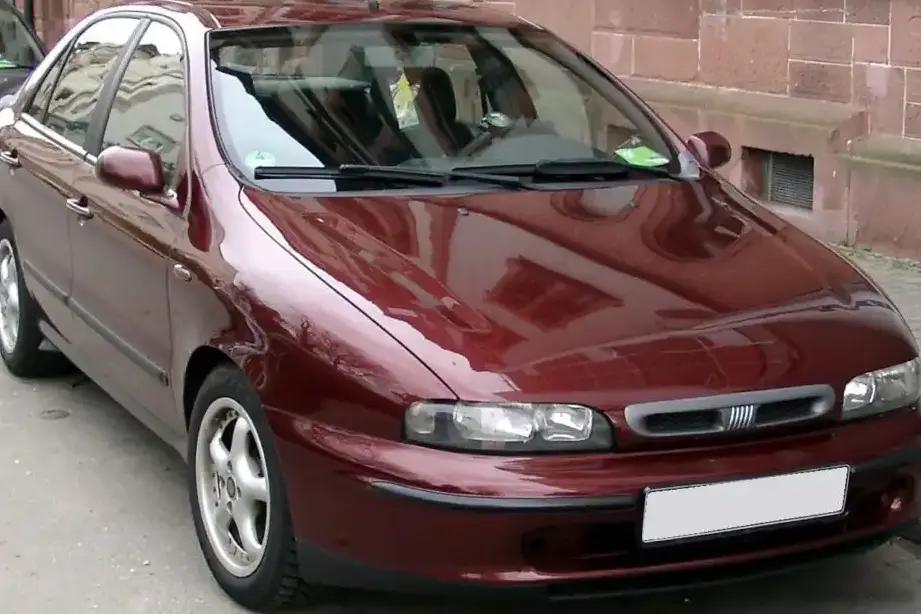
The Fiat Marea (185) 1.4 80 12V, produced between 1996 and 1999, represented an entry-level offering within the broader Marea range. The Marea, launched in 1996, was Fiat’s replacement for the aging Tipo, aiming to provide a more modern and spacious family car. Positioned as a mainstream, mid-size sedan, the 1.4 80 12V variant served as the most accessible powertrain option, prioritizing affordability and fuel economy over outright performance. It was a key model for Fiat in the European market, competing with vehicles like the Ford Mondeo and Opel/Vauxhall Vectra.
Technical Specifications
| Brand | Fiat |
| Model | Marea |
| Generation | Marea (185) |
| Type (Engine) | 1.4 80 12V (80 Hp) |
| Start of production | 1996 |
| End of production | 1999 |
| Powertrain Architecture | Internal Combustion engine |
| Body type | Sedan |
| Seats | 5 |
| Doors | 4 |
| Fuel consumption (urban) | 9.2 l/100 km (25.6 US mpg) |
| Fuel consumption (extra urban) | 5.4 l/100 km (43.6 US mpg) |
| Fuel consumption (combined) | 7.1 l/100 km (33.1 US mpg) |
| Fuel Type | Petrol (Gasoline) |
| Acceleration 0 – 100 km/h | 13.7 sec |
| Acceleration 0 – 62 mph | 13.7 sec |
| Acceleration 0 – 60 mph | 13 sec |
| Maximum speed | 170 km/h (105.63 mph) |
| Weight-to-power ratio | 13.6 kg/Hp |
| Weight-to-torque ratio | 9.7 kg/Nm |
| Power | 80 Hp @ 6000 rpm |
| Torque | 112 Nm @ 2750 rpm (82.61 lb.-ft. @ 2750 rpm) |
| Engine layout | Front, Transverse |
| Engine Model/Code | 183A3000 |
| Engine displacement | 1370 cm3 (83.6 cu. in.) |
| Number of cylinders | 4 |
| Engine configuration | Inline |
| Cylinder Bore | 82 mm (3.23 in.) |
| Piston Stroke | 64.9 mm (2.56 in.) |
| Compression ratio | 9.9:1 |
| Number of valves per cylinder | 3 |
| Fuel injection system | Single-point injection |
| Engine aspiration | Naturally aspirated |
| Valvetrain | OHC |
| Engine oil capacity | 4.1 l (4.33 US qt | 3.61 UK qt) |
| Coolant capacity | 5.6 l (5.92 US qt | 4.93 UK qt) |
| Kerb Weight | 1085 kg (2392.02 lbs.) |
| Max. weight | 1675 kg (3692.74 lbs.) |
| Max load | 590 kg (1300.73 lbs.) |
| Trunk (boot) space – minimum | 430 l (15.19 cu. ft.) |
| Fuel tank capacity | 63 l (16.64 US gal | 13.86 UK gal) |
| Length | 4378 mm (172.36 in.) |
| Width | 1741 mm (68.54 in.) |
| Height | 1420 mm (55.91 in.) |
| Wheelbase | 2540 mm (100 in.) |
| Front track | 1473 mm (57.99 in.) |
| Rear track | 1444 mm (56.85 in.) |
| Drivetrain Architecture | Front wheel drive |
| Number of gears | 5 |
| Gearbox type | Manual transmission |
| Front suspension | Wishbone |
| Rear suspension | Coil spring |
| Front brakes | Disc |
| Rear brakes | Drum |
| Assisting systems | ABS (Anti-lock braking system) |
| Steering type | Steering rack and pinion |
| Power steering | Hydraulic |
| Tires size | 175/70 R14 |
Powertrain & Engine Architecture
The Fiat Marea 1.4 80 12V utilized the 183A3.000 engine, a 1.4-liter inline-four cylinder gasoline engine. This engine featured a single overhead camshaft (OHC) design operating 12 valves (three per cylinder). Fuel delivery was managed by a single-point fuel injection system, a relatively basic setup for the mid-1990s, prioritizing cost-effectiveness. The engine produced 80 horsepower at 6000 rpm and 112 Nm (82.61 lb-ft) of torque at 2750 rpm. The engine’s compression ratio was 9.9:1. The engine was transversely mounted in the front of the vehicle, driving the front wheels. The standard transmission was a five-speed manual gearbox, although a four-speed automatic transmission was also available, albeit less common. The automatic transmission was a traditional hydraulic unit, offering smooth but not particularly quick shifts.
Driving Characteristics
The 1.4-liter engine, paired with the five-speed manual transmission, provided adequate, but not exhilarating, performance. Acceleration from 0 to 60 mph took approximately 13 seconds, and the top speed was around 105 mph. The engine felt somewhat strained when pushed hard, particularly when fully loaded with passengers and luggage. The gear ratios were tuned for fuel efficiency rather than sporty driving. Compared to the more powerful 1.8-liter and 2.0-liter versions of the Marea, the 1.4 felt noticeably slower, especially during overtaking maneuvers. The automatic transmission further dulled performance, increasing acceleration times and reducing responsiveness. However, the 1.4 offered a more relaxed driving experience, particularly in urban environments, and its lighter weight contributed to slightly better handling than its higher-powered siblings.
Equipment & Trim Levels
The 1.4 80 12V Marea typically came with a relatively basic level of equipment. Standard features generally included power steering, central locking, and electric front windows. Interior upholstery was typically cloth, and the dashboard featured a simple, functional design. Optional extras included air conditioning, alloy wheels, and a radio/cassette player. Higher trim levels, such as the “ELX” or “SX”, added features like upgraded upholstery, a sunroof, and more comprehensive instrumentation. The 1.4 was often seen as a fleet vehicle or a budget-conscious family car, so many examples were equipped with minimal options.
Chassis & Braking
The Marea 1.4 featured a MacPherson strut front suspension and a coil spring rear suspension. The suspension setup was tuned for comfort rather than sporty handling. The front brakes were ventilated discs, while the rear brakes were drums. ABS (Anti-lock Braking System) was standard equipment, enhancing safety. The 1.4’s lighter weight compared to other Marea variants meant that the braking system was generally adequate for its performance level. Stabilizer bars were fitted to both the front and rear axles, helping to reduce body roll during cornering.
Market Reception & Comparison
The Fiat Marea 1.4 80 12V was generally well-received as an affordable and practical family car. Critics praised its spacious interior and comfortable ride, but noted its lack of performance. Fuel economy was a strong point, with combined fuel consumption figures around 33 mpg. Compared to the 1.8-liter and 2.0-liter Marea models, the 1.4 offered significantly lower running costs but lacked the refinement and power of its more expensive siblings. The 1.8-liter engine provided a noticeable performance boost, while the 2.0-liter offered a more premium driving experience. The 1.9 TDI diesel version was also popular, offering excellent fuel economy and strong torque, but at the expense of refinement.
Legacy
The Fiat Marea 1.4 80 12V powertrain proved to be reasonably reliable, although the single-point fuel injection system could be prone to issues over time. The engine itself was generally durable, but regular maintenance was essential to prevent problems. Today, the Marea 1.4 is a relatively rare sight on the roads, and well-maintained examples are becoming increasingly sought after by classic car enthusiasts. Its affordability and simplicity make it an attractive option for those looking for a classic Italian sedan. Parts availability can be a challenge, but many components are still available through specialist suppliers. The Marea, in general, is remembered as a solid, if unspectacular, family car that offered good value for money.
