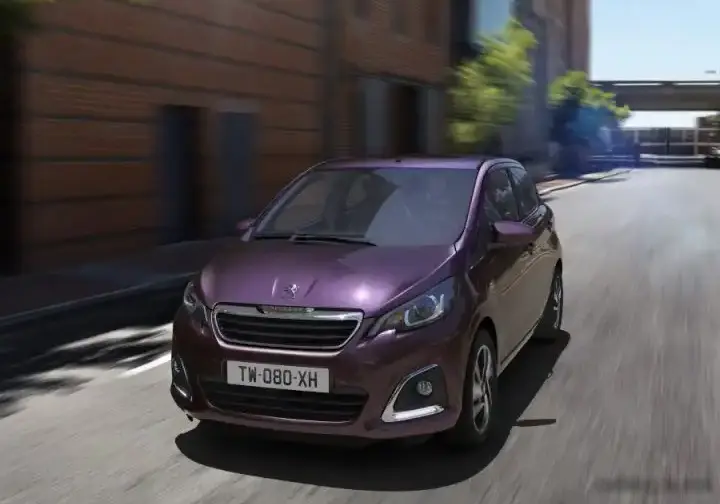
The Peugeot 108 Hatch 1.0 VTi (68 hp) Automatic, produced between 2014 and 2018, represents an entry-level offering within the second generation of the Peugeot 108. Positioned as a city car, it was part of the collaborative PSA Peugeot Citroën and Toyota Motor Corporation venture, sharing its platform and many components with the Citroën C1 and Toyota Aygo. This particular variant, combining the small-displacement 1.0-liter engine with a five-speed automatic transmission, aimed to provide accessible and convenient urban mobility. It was primarily sold in the European market, where demand for compact, fuel-efficient vehicles is high.
Technical Specifications
| Brand | Peugeot |
| Model | 108 |
| Generation | 108 Hatch |
| Type (Engine) | 1.0 VTi (68 Hp) Automatic |
| Start of production | 2014 |
| End of production | 2018 |
| Powertrain Architecture | Internal Combustion engine |
| Body type | Hatchback |
| Seats | 5 |
| Doors | 3-5 |
| Fuel consumption (urban) | 5 l/100 km (47 US mpg, 56.5 UK mpg, 20 km/l) |
| Fuel consumption (extra urban) | 3.8 l/100 km (61.9 US mpg, 74.3 UK mpg, 26.3 km/l) |
| Fuel consumption (combined) | 4.2 l/100 km (56 US mpg, 67.3 UK mpg, 23.8 km/l) |
| CO2 emissions | 97 g/km |
| Fuel Type | Petrol (Gasoline) |
| Acceleration 0 – 100 km/h | 14.3 sec |
| Acceleration 0 – 62 mph | 14.3 sec |
| Acceleration 0 – 60 mph | 13.6 sec |
| Maximum speed | 160 km/h (99.42 mph) |
| Emission standard | Euro 5 |
| Weight-to-power ratio | 14.4 kg/Hp, 69.4 Hp/tonne |
| Weight-to-torque ratio | 10.3 kg/Nm, 96.9 Nm/tonne |
| Power | 68 Hp @ 6000 rpm |
| Power per litre | 68.1 Hp/l |
| Torque | 95 Nm @ 4300 rpm (70.07 lb.-ft. @ 4300 rpm) |
| Engine layout | Front, Transverse |
| Engine Model/Code | 1KR-FE EB0 |
| Engine displacement | 998 cm3 (60.9 cu. in.) |
| Number of cylinders | 3 |
| Engine configuration | Inline |
| Number of valves per cylinder | 4 |
| Fuel injection system | Multi-port manifold injection |
| Engine aspiration | Naturally aspirated engine |
| Engine oil capacity | 2.8 l (2.96 US qt | 2.46 UK qt) |
| Kerb Weight | 980 kg (2160.53 lbs.) |
| Max. weight | 1240 kg (2733.73 lbs.) |
| Max load | 260 kg (573.2 lbs.) |
| Trunk (boot) space – minimum | 180 l (6.36 cu. ft.) |
| Trunk (boot) space – maximum | 780 l (27.55 cu. ft.) |
| Fuel tank capacity | 35 l (9.25 US gal | 7.7 UK gal) |
| Length | 3475 mm (136.81 in.) |
| Width | 1615 mm (63.58 in.) |
| Height | 1460 mm (57.48 in.) |
| Wheelbase | 2340 mm (92.13 in.) |
| Front track | 1425 mm (56.1 in.) |
| Rear (Back) track | 1420 mm (55.91 in.) |
| Minimum turning circle | 9.6 m (31.5 ft.) |
| Drivetrain Architecture | The Internal combustion engine (ICE) drives the front wheels of the vehicle. |
| Drive wheel | Front wheel drive |
| Number of gears | 5 gears, automatic transmission |
| Front suspension | Independent, type McPherson with coil spring and anti-roll bar |
| Rear suspension | Semi-independent, coil spring |
| Front brakes | Ventilated discs |
| Rear brakes | Drum |
| Assisting systems | ABS (Anti-lock braking system) |
| Steering type | Steering rack and pinion |
| Tires size | 165/65 R14 T |
| Wheel rims size | 14 |
Powertrain & Engine Architecture
The 108 1.0 VTi Automatic utilizes the 1KR-FE engine, a three-cylinder, 1.0-liter (998 cc) naturally aspirated gasoline engine. This engine was co-developed by Toyota and PSA, and is also found in the Aygo and C1. It features a multi-point fuel injection system and four valves per cylinder. The engine’s relatively simple design prioritizes fuel efficiency and low emissions over outright performance. The engine produces 68 horsepower at 6000 rpm and 95 Nm (70 lb-ft) of torque at 4300 rpm. Paired with this engine is a five-speed automatic transmission, a relatively uncommon offering in this segment, where manual transmissions are far more prevalent. This automatic transmission is a conventional torque converter type, prioritizing smooth shifts over sporty responsiveness.
Driving Characteristics
The 108 1.0 VTi Automatic is not designed for spirited driving. Acceleration is leisurely, taking approximately 14.3 seconds to reach 62 mph (100 km/h). The automatic transmission, while convenient, contributes to this lack of urgency. Gear changes are generally smooth, but can feel somewhat hesitant when needing to downshift for overtaking. The engine’s narrow powerband requires frequent use of the throttle, especially when climbing hills or carrying a full load. Compared to the five-speed manual version, the automatic suffers a slight performance penalty due to the transmission’s inherent inefficiencies. However, the automatic provides a more relaxed driving experience, particularly in congested urban environments.
Equipment & Trim Levels
The 1.0 VTi Automatic trim typically included basic features such as air conditioning, central locking, electric front windows, and a radio with USB connectivity. Safety equipment included ABS, front airbags, and ISOFIX child seat anchors. Higher trim levels, such as Active or Allure, added features like alloy wheels, a touchscreen infotainment system, and parking sensors. Interior upholstery was typically cloth, with a simple and functional dashboard layout. Optional extras included metallic paint, a panoramic sunroof, and a rear parking camera.
Chassis & Braking
The 108 utilizes a McPherson strut front suspension and a semi-independent torsion beam rear suspension. This setup provides a comfortable ride quality, well-suited for city driving. The front brakes are ventilated discs, while the rear brakes are drums. The steering is light and easy to use, making maneuvering in tight spaces effortless. The relatively light weight of the vehicle (around 980 kg or 2160 lbs) helps to compensate for the engine’s modest power output. Stabilizer bars were fitted to both the front and rear axles to reduce body roll during cornering.
Market Reception & Comparison
The Peugeot 108 1.0 VTi Automatic was generally well-received as a practical and affordable city car. Critics praised its fuel efficiency and ease of driving, but noted its lack of performance. Compared to other trims in the 108 lineup, the automatic version was less popular than the manual, primarily due to its higher price and slightly lower fuel economy. The 1.2-liter PureTech engine offered significantly more power and a more engaging driving experience, but at a higher cost. The automatic was aimed at buyers prioritizing convenience and ease of use over driving dynamics.
Legacy
The 1KR-FE engine, while not known for its longevity or complexity, has proven to be reasonably reliable in the Peugeot 108. Common issues are typically related to wear and tear on components such as the timing chain and water pump. The automatic transmission, if properly maintained with regular fluid changes, is also generally reliable. On the used car market, the 108 1.0 VTi Automatic remains an affordable option for those seeking a small, economical, and easy-to-drive city car. Its simple mechanicals and relatively low running costs make it an attractive proposition for first-time car buyers or those on a tight budget. However, potential buyers should be aware of its limited performance and the availability of more powerful and refined alternatives.