
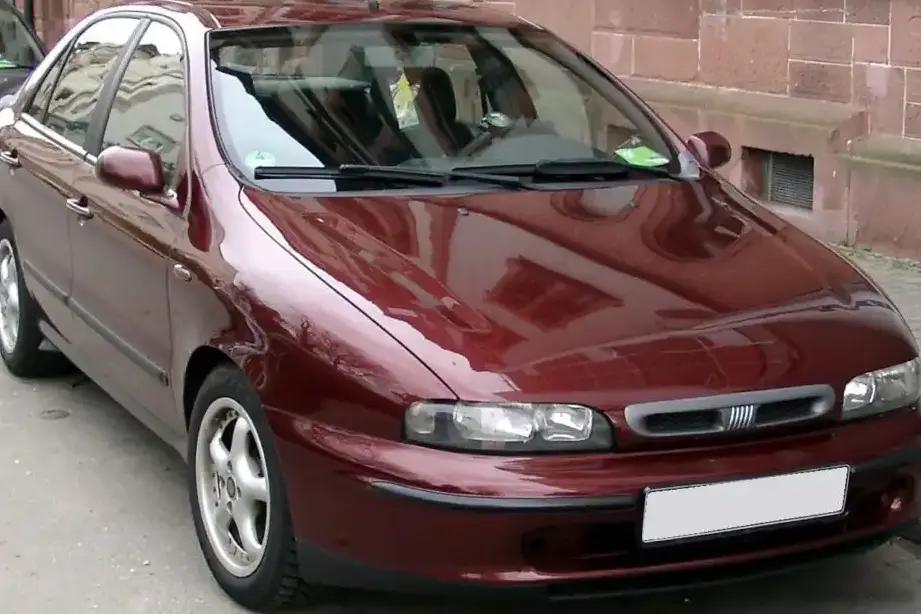
The Fiat Marea (185) 1.9 JTD 110, produced between 2001 and 2003, represented a significant offering in the European mid-size sedan market. Positioned as a practical and efficient option within the Marea range, this variant utilized a turbocharged diesel engine paired with a five-speed manual transmission. The Marea itself was a replacement for the aging Fiat Tempra, aiming to provide a more modern and competitive vehicle in a segment dominated by the Ford Mondeo, Opel Vectra, and Volkswagen Passat. The 1.9 JTD 110 served as a strong mid-range option, balancing performance with fuel economy, appealing to drivers prioritizing practicality and running costs.
Technical Specifications
| Brand | Fiat |
| Model | Marea |
| Generation | Marea (185) |
| Type (Engine) | 1.9 JTD 110 (110 Hp) |
| Start of production | 2001 |
| End of production | 2003 |
| Powertrain Architecture | Internal Combustion engine |
| Body type | Sedan |
| Seats | 5 |
| Doors | 4 |
| Fuel consumption (urban) | 7 l/100 km (33.6 US mpg, 40.4 UK mpg, 14.3 km/l) |
| Fuel consumption (extra urban) | 4.5 l/100 km (52.3 US mpg, 62.8 UK mpg, 22.2 km/l) |
| Fuel consumption (combined) | 5.4 l/100 km (43.6 US mpg, 52.3 UK mpg, 18.5 km/l) |
| Fuel Type | Diesel |
| Acceleration 0 – 100 km/h | 10.8 sec |
| Acceleration 0 – 62 mph | 10.8 sec |
| Acceleration 0 – 60 mph | 10.3 sec |
| Maximum speed | 188 km/h (116.82 mph) |
| Weight-to-power ratio | 11.7 kg/Hp, 85.3 Hp/tonne |
| Weight-to-torque ratio | 6.5 kg/Nm, 155 Nm/tonne |
| Power | 110 Hp @ 4000 rpm |
| Power per litre | 57.6 Hp/l |
| Torque | 200 Nm @ 1500 rpm (147.51 lb.-ft. @ 1500 rpm) |
| Engine layout | Front, Transverse |
| Engine Model/Code | 186 A6.000 |
| Engine displacement | 1910 cm3 (116.56 cu. in.) |
| Number of cylinders | 4 |
| Engine configuration | Inline |
| Cylinder Bore | 82 mm (3.23 in.) |
| Piston Stroke | 90.4 mm (3.56 in.) |
| Compression ratio | 18.5:1 |
| Number of valves per cylinder | 2 |
| Fuel injection system | Diesel Commonrail |
| Engine aspiration | Turbocharger, Intercooler |
| Valvetrain | OHC |
| Engine oil capacity | 4.3 l (4.54 US qt | 3.78 UK qt) |
| Coolant | 5.6 l (5.92 US qt | 4.93 UK qt) |
| Kerb Weight | 1290 kg (2843.96 lbs.) |
| Max. weight | 1805 kg (3979.34 lbs.) |
| Max load | 515 kg (1135.38 lbs.) |
| Trunk (boot) space – minimum | 430 l (15.19 cu. ft.) |
| Fuel tank capacity | 63 l (16.64 US gal | 13.86 UK gal) |
| Length | 4393 mm (172.95 in.) |
| Width | 1741 mm (68.54 in.) |
| Height | 1420 mm (55.91 in.) |
| Wheelbase | 2450 mm (96.46 in.) |
| Front track | 1480 mm (58.27 in.) |
| Rear (Back) track | 1455 mm (57.28 in.) |
| Drivetrain Architecture | The Internal combustion engine (ICE) drives the front wheels of the vehicle. |
| Drive wheel | Front wheel drive |
| Number of gears and type of gearbox | 5 gears, manual transmission |
| Front suspension | Wishbone |
| Rear suspension | Coil spring |
| Front brakes | Ventilated discs |
| Rear brakes | Drum |
| Assisting systems | ABS (Anti-lock braking system) |
| Steering type | Steering rack and pinion |
| Power steering | Hydraulic Steering |
| Tires size | 185/65 R14 H |
INTRODUCTION
The Fiat Marea (185) series, launched in 1998, was a significant model for Fiat, representing a move upmarket in terms of design, technology, and overall refinement. The 1.9 JTD 110 variant, introduced in 2001, was a key component of the Marea’s appeal, offering a compelling blend of performance and economy. Built on the Tipo platform (though significantly updated), the Marea aimed to compete with established rivals in the D-segment. This particular engine and transmission combination was aimed at buyers who needed a practical, reliable, and reasonably efficient family car, without necessarily prioritizing outright performance.
Powertrain & Engine Architecture
The heart of the Marea 1.9 JTD 110 is the 186A6.000 engine, a 1910cc inline-four cylinder diesel. This engine is a prime example of Fiat’s early adoption of common rail direct injection technology, which significantly improved fuel efficiency and reduced noise compared to older diesel designs. The 186A6.000 features a single overhead camshaft (OHC) operating two valves per cylinder. The turbocharger, coupled with an intercooler, provides a noticeable boost in power and torque. The five-speed manual transmission was a robust unit, known for its durability and relatively smooth shifting. The engine’s common rail system, supplied by Bosch, operates at a high pressure (typically around 1400 bar) to ensure fine atomization of the fuel, leading to more complete combustion.
Driving Characteristics
The Marea 1.9 JTD 110 offered a comfortable and composed driving experience. While not a sports sedan, the 110 horsepower and 200 Nm (147 lb-ft) of torque provided adequate performance for everyday driving and highway cruising. Acceleration from 0-60 mph took around 10.3 seconds, and the car could reach a top speed of 116.82 mph. The five-speed manual transmission allowed drivers to keep the engine in its optimal power band, providing good responsiveness. Compared to the more powerful 2.4 JTD versions, the 1.9 JTD 110 felt less strained during acceleration, and its lighter weight contributed to slightly better handling. The gear ratios were well-chosen for both urban and highway driving, offering a balance between fuel efficiency and performance.
Equipment & Trim Levels
The Marea 1.9 JTD 110 typically came with a reasonable level of standard equipment. This included power steering, central locking, electric front windows, and an ABS anti-lock braking system. Interior upholstery was typically cloth, with a functional and durable design. Optional extras included air conditioning, alloy wheels, a sunroof, and a radio/cassette player (later upgraded to CD players). Higher trim levels offered additional features such as leather upholstery, automatic climate control, and upgraded sound systems. The dashboard layout was straightforward and user-friendly, prioritizing practicality over stylistic flair.
Chassis & Braking
The Marea’s chassis featured independent front suspension with wishbones and a coil spring rear suspension. This setup provided a comfortable ride quality, absorbing bumps and imperfections in the road surface effectively. The front brakes were ventilated discs, offering good stopping power, while the rear brakes were drums. The ABS system helped to maintain stability during hard braking. The steering was a hydraulic rack and pinion system, providing precise and responsive control. Stabilizer bars were fitted to both the front and rear axles to reduce body roll during cornering.
Market Reception & Comparison
The Fiat Marea 1.9 JTD 110 was generally well-received by automotive critics. It was praised for its fuel efficiency, comfortable ride, and spacious interior. However, some critics noted that the interior design was somewhat dated compared to its rivals. Compared to the petrol-powered Marea variants, the 1.9 JTD 110 offered significantly better fuel economy and a more relaxed driving experience. Against competitors like the Ford Mondeo and Opel Vectra, the Marea offered a competitive package, particularly in terms of value for money. The 1.9 JTD engine proved to be reliable, although regular maintenance was essential to ensure optimal performance.
Legacy
The Fiat Marea, while not a massive sales success in all markets, established Fiat as a serious contender in the mid-size segment. The 1.9 JTD engine became a popular choice for its efficiency and durability. Today, the Marea 1.9 JTD 110 can be found as a relatively affordable used car, appealing to buyers seeking a practical and reliable vehicle. The engine itself is known for its longevity, provided it has been well-maintained. However, potential buyers should be aware of the age-related issues common to older vehicles, such as corrosion and wear and tear on suspension components. The Marea remains a testament to Fiat’s engineering capabilities and its commitment to providing affordable and efficient transportation.
