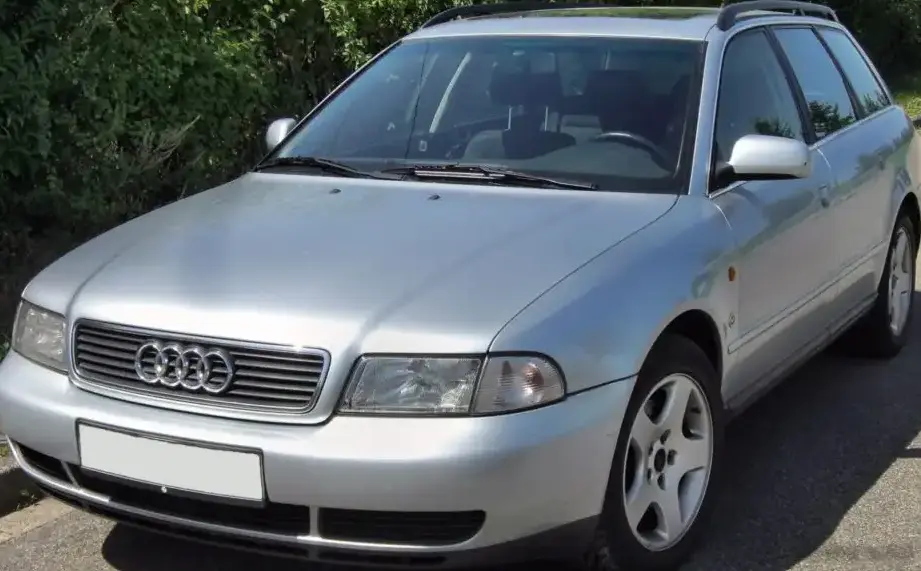
The Audi A4 Avant (B5, Typ 8D) 1.9 TDI with an automatic transmission, produced between 1996 and 1999, represented a popular entry point into the premium wagon segment for European buyers. Positioned as a fuel-efficient and practical alternative to its more powerful A4 siblings, this variant offered a blend of comfort, space, and the renowned build quality associated with the Audi brand. It was a key model within the B5 A4 range, which utilized the Volkswagen Group’s 1HX0 platform, shared with the Volkswagen Passat and other models. This particular configuration aimed at buyers prioritizing economy and ease of driving over outright performance.
Technical Specifications
| Brand | Audi |
| Model | A4 |
| Generation | A4 Avant (B5, Typ 8D) |
| Type (Engine) | 1.9 TDI (110 Hp) Automatic |
| Start of production | 1996 |
| End of production | 1999 |
| Powertrain Architecture | Internal Combustion engine |
| Body type | Station wagon (estate) |
| Seats | 5 |
| Doors | 5 |
| Fuel consumption (urban) | 9 l/100 km (26.1 US mpg, 31.4 UK mpg, 11.1 km/l) |
| Fuel consumption (extra urban) | 4.9 l/100 km (48 US mpg, 57.6 UK mpg, 20.4 km/l) |
| Fuel consumption (combined) | 4.9 l/100 km (48 US mpg, 57.6 UK mpg, 20.4 km/l) |
| Fuel Type | Diesel |
| Acceleration 0 – 100 km/h | 12.8 sec |
| Acceleration 0 – 62 mph | 12.8 sec |
| Acceleration 0 – 60 mph | 12.2 sec |
| Maximum speed | 190 km/h (118.06 mph) |
| Weight-to-power ratio | 11.9 kg/Hp, 84.3 Hp/tonne |
| Weight-to-torque ratio | 5.6 kg/Nm, 180.1 Nm/tonne |
| Power | 110 Hp @ 4150 rpm |
| Power per litre | 58 Hp/l |
| Torque | 235 Nm @ 1900 rpm (173.33 lb.-ft. @ 1900 rpm) |
| Engine layout | Front, Longitudinal |
| Engine Model/Code | AFN, AVG |
| Engine displacement | 1896 cm3 (115.7 cu. in.) |
| Number of cylinders | 4 |
| Engine configuration | Inline |
| Cylinder Bore | 79.5 mm (3.13 in.) |
| Piston Stroke | 95.5 mm (3.76 in.) |
| Compression ratio | 19.5:1 |
| Number of valves per cylinder | 2 |
| Fuel injection system | Direct injection |
| Engine aspiration | Turbocharger |
| Valvetrain | OHC |
| Engine oil capacity | 3.8 l (4.02 US qt | 3.34 UK qt) |
| Coolant | 6.5 l (6.87 US qt | 5.72 UK qt) |
| Kerb Weight | 1305 kg (2877.03 lbs.) |
| Max. weight | 1855 kg (4089.57 lbs.) |
| Max load | 550 kg (1212.54 lbs.) |
| Trunk (boot) space – minimum | 390 l (13.77 cu. ft.) |
| Trunk (boot) space – maximum | 1250 l (44.14 cu. ft.) |
| Fuel tank capacity | 62 l (16.38 US gal | 13.64 UK gal) |
| Length | 4479 mm (176.34 in.) |
| Width | 1733 mm (68.23 in.) |
| Height | 1417 mm (55.79 in.) |
| Wheelbase | 2622 mm (103.23 in.) |
| Front track | 1498 mm (58.98 in.) |
| Rear (Back) track | 1479 mm (58.23 in.) |
| Drag coefficient (Cd) | 0.31 |
| Minimum turning circle | 11.1 m (36.42 ft.) |
| Drivetrain Architecture | Front wheel drive |
| Number of gears | 4 |
| Gearbox type | Automatic transmission |
| Front suspension | Several levers and rods |
| Rear suspension | Rigid axle suspension |
| Front brakes | Disc |
| Rear brakes | Disc |
| Assisting systems | ABS (Anti-lock braking system) |
| Steering type | Steering rack and pinion |
| Power steering | Hydraulic Steering |
| Tires size | 195/65 R15 |
| Wheel rims size | 15 |
Powertrain & Engine Architecture
The heart of this A4 Avant was the 1.9-liter inline-four cylinder diesel engine, typically identified by engine codes AFN or AVG. This engine was a cornerstone of Volkswagen Group’s diesel offerings during the mid-to-late 1990s. It featured direct injection, a technology that significantly improved fuel efficiency and reduced emissions compared to older indirect injection systems. The direct injection system utilized a high-pressure pump and electronically controlled injectors to deliver fuel directly into the combustion chamber. The engine employed an overhead camshaft (OHC) valvetrain with two valves per cylinder. A turbocharger, typically a Garrett or BorgWarner unit, was integrated to boost power output. The four-speed automatic transmission was a conventional hydraulic unit, offering smooth but not particularly sporty shifts. It was chosen for its ease of use and suitability for the target market, prioritizing comfort over performance.
Driving Characteristics
The 1.9 TDI automatic A4 Avant delivered a comfortable, if not exhilarating, driving experience. With 110 horsepower and 235 Nm (173 lb-ft) of torque, acceleration was adequate for everyday driving, but noticeably slower than the more powerful 1.8T petrol or 2.5 TDI variants. The automatic transmission, while smooth, contributed to this relaxed pace, with gear ratios optimized for fuel economy rather than rapid acceleration. The turbocharger provided a noticeable boost in power at lower RPMs, making it easy to keep up with traffic. However, the engine could feel strained when pushed hard, particularly when fully loaded. The front-wheel-drive configuration offered predictable handling, but lacked the all-weather capability of the quattro all-wheel-drive models.
Equipment & Trim Levels
The 1.9 TDI automatic typically represented a mid-range trim level within the B5 A4 Avant lineup. Standard equipment generally included power windows, central locking, air conditioning, and an AM/FM radio. Interior upholstery was typically cloth, with options for leather available at an extra cost. Optional extras included a sunroof, upgraded audio systems, and alloy wheels. Safety features such as ABS were standard, but airbags were often optional depending on the market. The dashboard layout was typical of Audi at the time, with a clean and functional design.
Chassis & Braking
The A4 Avant’s chassis featured independent suspension at the front, utilizing several levers and rods for a comfortable ride. The rear suspension employed a torsion beam axle, a cost-effective solution that provided adequate handling for most driving conditions. Brakes were disc brakes on all four wheels, providing sufficient stopping power. ABS (Anti-lock Braking System) was standard, enhancing safety in emergency braking situations. Steering was rack and pinion with hydraulic power assistance, offering a light and easy steering feel.
Market Reception & Comparison
The 1.9 TDI automatic A4 Avant was well-received by European buyers seeking a practical and fuel-efficient wagon. Critics praised its build quality, comfortable ride, and spacious interior. However, some noted its relatively slow acceleration compared to other A4 variants. Compared to the 1.8T petrol engine, the 1.9 TDI offered significantly better fuel economy but less power. The 2.5 TDI provided more torque but was generally more expensive and less refined. The automatic transmission was seen as a convenient option for urban driving, but some enthusiasts preferred the more engaging experience of the manual gearbox.
Legacy
The 1.9 TDI engine, in its various iterations, proved to be remarkably durable and reliable. The B5 A4 Avant 1.9 TDI automatic remains a relatively common sight on European roads today, a testament to its longevity. While maintenance costs can increase with age, the engine is generally considered to be robust and capable of high mileage. On the used car market, these models are often sought after by buyers looking for an affordable and practical wagon with a reputation for reliability. The combination of fuel efficiency, practicality, and Audi build quality continues to make this variant a popular choice for those seeking a classic European wagon.