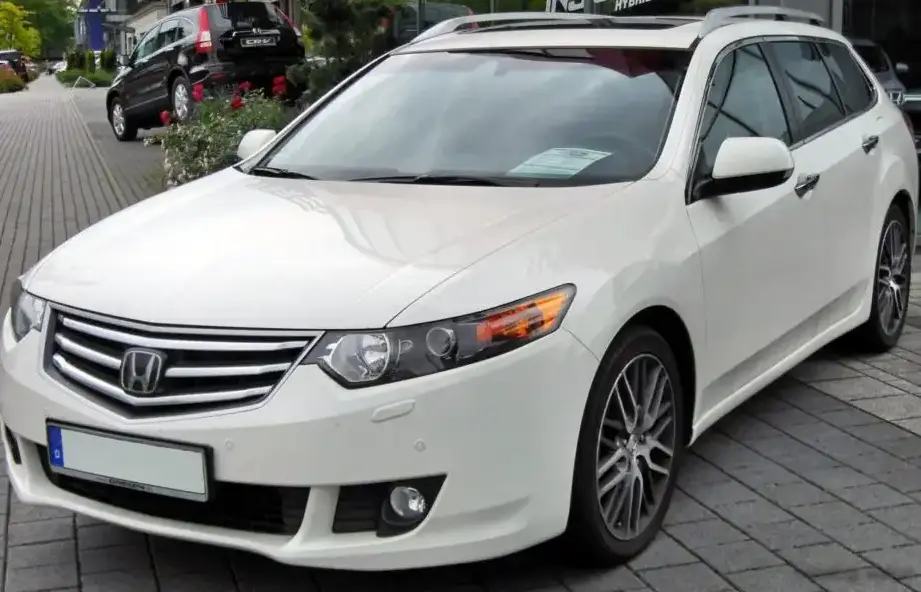
The Honda Accord VIII Wagon 2.2 i-Dtec Automatic, produced between 2008 and 2011, represented a practical and fuel-efficient offering within the broader eighth-generation (2008-2012) Accord lineup. Positioned as a diesel-powered wagon variant, it catered to European markets where estate cars were highly popular, offering a blend of family practicality, reasonable performance, and Honda’s reputation for reliability. This model utilized the 2.2-liter i-Dtec engine paired with a five-speed automatic transmission, aiming to provide a comfortable and convenient driving experience. It sat in the mid-range of the Accord wagon offerings, offering a step up in refinement and fuel economy compared to the petrol engines, but without the higher price tag of potential future performance or luxury trims.
Technical Specifications
| Brand | Honda |
| Model | Accord |
| Generation | Accord VIII Wagon |
| Type (Engine) | 2.2 i-Dtec (150 Hp) Automatic |
| Start of production | 2008 |
| End of production | 2011 |
| Powertrain Architecture | Internal Combustion engine |
| Body type | Station wagon (estate) |
| Seats | 5 |
| Doors | 5 |
| Fuel consumption (urban) | 7.5 l/100 km (31.4 US mpg) |
| Fuel consumption (extra urban) | 4.9 l/100 km (48 US mpg) |
| Fuel consumption (combined) | 5.9 l/100 km (39.9 US mpg) |
| Fuel Type | Diesel |
| Acceleration 0 – 100 km/h | 9.7 sec |
| Acceleration 0 – 62 mph | 9.7 sec |
| Acceleration 0 – 60 mph | 9.2 sec |
| Maximum speed | 207 km/h (128.62 mph) |
| Emission standard | Euro 5 |
| Weight-to-power ratio | 11.3 kg/Hp |
| Weight-to-torque ratio | 4.9 kg/Nm |
| Power | 150 Hp @ 4000 rpm |
| Torque | 350 Nm @ 2000 rpm (258.15 lb.-ft. @ 2000 rpm) |
| Engine layout | Front, Transverse |
| Engine Model/Code | N22B1 |
| Engine displacement | 2199 cm3 (134.19 cu. in.) |
| Number of cylinders | 4 |
| Engine configuration | Inline |
| Number of valves per cylinder | 4 |
| Fuel injection system | Diesel Commonrail |
| Engine aspiration | Turbocharger, Intercooler |
| Valvetrain | DOHC |
| Engine oil capacity | 5.5 l (5.81 US qt | 4.84 UK qt) |
| Coolant capacity | 6.9 l (7.29 US qt | 6.07 UK qt) |
| Kerb Weight | 1702 kg (3752.27 lbs.) |
| Max. weight | 2100 kg (4629.71 lbs.) |
| Max load | 398 kg (877.44 lbs.) |
| Trunk (boot) space – minimum | 395 l (13.95 cu. ft.) |
| Trunk (boot) space – maximum | 1252 l (44.21 cu. ft.) |
| Fuel tank capacity | 65 l (17.17 US gal | 14.3 UK gal) |
| Length | 4750 mm (187.01 in.) |
| Width | 1840 mm (72.44 in.) |
| Height | 1470 mm (57.87 in.) |
| Wheelbase | 2750 mm (108.27 in.) |
| Front track | 1595 mm (62.8 in.) |
| Rear track | 1600 mm (62.99 in.) |
| Minimum turning circle | 11.8 m (38.71 ft.) |
| Drivetrain | Front wheel drive |
| Number of gears | 5 |
| Gearbox type | Automatic transmission |
| Front suspension | Double wishbone |
| Rear suspension | Wishbone |
| Front brakes | Ventilated discs |
| Rear brakes | Disc |
| Assisting systems | ABS (Anti-lock braking system) |
| Steering type | Steering rack and pinion |
| Tires size | 215/60 R16 |
| Wheel rims size | 6.5J x 16 |
INTRODUCTION
The Honda Accord VIII Wagon 2.2 i-Dtec Automatic, launched in 2008, was a key component of Honda’s European strategy to offer a practical and efficient wagon option within the popular D-segment. Built on the 1HX0/A3 platform shared with other Honda models, the wagon body style was primarily aimed at the European market, where estate cars held a significant share of sales. This particular variant, combining the 2.2-liter diesel engine with a five-speed automatic transmission, was designed to appeal to buyers seeking a comfortable, refined, and economical vehicle for family use and long-distance travel. It offered a compromise between the more affordable petrol versions and the potentially more powerful, but also more expensive, higher-spec diesel models.
Powertrain & Engine Architecture
The heart of this Accord wagon is the N22B1 2.2-liter inline-four cylinder diesel engine. This engine is a common-rail direct injection diesel, meaning fuel is delivered directly into the cylinders at extremely high pressure via a sophisticated common rail system. This system, coupled with a turbocharger and intercooler, allowed for a good balance of power and fuel efficiency. The engine produces 150 horsepower at 4000 rpm and 350 Nm (258 lb-ft) of torque at 2000 rpm. The engine features a double overhead camshaft (DOHC) valvetrain with four valves per cylinder, optimizing airflow for improved performance. The five-speed automatic transmission was a conventional torque converter type, prioritizing smooth shifts and ease of use over outright performance. While not the most modern automatic available at the time, it was known for its reliability. The transmission’s gear ratios were tuned for fuel economy and comfortable cruising, rather than aggressive acceleration.
Driving Characteristics
The 2.2 i-Dtec Automatic Accord Wagon offered a comfortable and relaxed driving experience. Acceleration from 0-60 mph took around 9.2 seconds, which was adequate for everyday driving but not particularly sporty. The automatic transmission, while smooth, did exhibit some typical torque converter characteristics, such as a slight delay in response. Compared to the manual transmission versions of the same engine, the automatic felt slightly less responsive. However, the automatic’s convenience and ease of use were highly valued by many drivers. The engine provided ample torque for overtaking maneuvers and maintaining highway speeds, and the wagon’s suspension offered a good balance between ride comfort and handling. The relatively high kerb weight of 1702 kg (3752 lbs) did contribute to a slightly less agile feel compared to lighter Accord models.
Equipment & Trim Levels
The 2.2 i-Dtec Automatic trim level typically included standard features such as air conditioning, power windows, power mirrors, a CD player with auxiliary input, and ABS brakes. Higher trim levels, often available as optional packages, added features like leather upholstery, a sunroof, alloy wheels, and a more advanced audio system. Interior upholstery was generally cloth, though leather was an option. The dashboard layout was functional and well-designed, with clear instrumentation and logically placed controls. Safety features included multiple airbags and electronic stability control. The specific equipment levels varied slightly depending on the country of sale.
Chassis & Braking
The Accord Wagon featured a front independent double wishbone suspension and a rear independent wishbone suspension, providing a comfortable ride and decent handling. The front brakes were ventilated discs, offering good stopping power, while the rear brakes were solid discs. ABS (Anti-lock Braking System) was standard, enhancing safety during emergency braking situations. The steering was a rack and pinion system, providing precise and responsive steering feel. The tires were typically 215/60 R16, offering a good balance between grip and ride comfort.
Market Reception & Comparison
The Honda Accord VIII Wagon 2.2 i-Dtec Automatic was generally well-received by automotive critics. It was praised for its fuel efficiency, comfortable ride, and spacious interior. However, some critics noted that the automatic transmission could feel a bit sluggish compared to the manual version, and the overall driving experience wasn’t as engaging as some of its rivals. Compared to other diesel wagons in the D-segment, such as the Volkswagen Passat Estate and the Ford Mondeo Estate, the Accord offered a competitive level of equipment and refinement. Its fuel economy was comparable to its rivals, and its reliability was generally considered to be excellent.
Legacy
The N22B1 engine, when properly maintained, proved to be a durable and reliable unit. Common issues were relatively few, often relating to the diesel particulate filter (DPF) if the vehicle was primarily used for short journeys. The automatic transmission also proved to be generally reliable, although regular fluid changes were essential for longevity. Today, used examples of the Accord VIII Wagon 2.2 i-Dtec Automatic are still relatively common, and they represent a good value for buyers seeking a practical, economical, and reliable estate car. Its reputation for dependability and relatively low running costs continues to make it a popular choice in the used car market.