
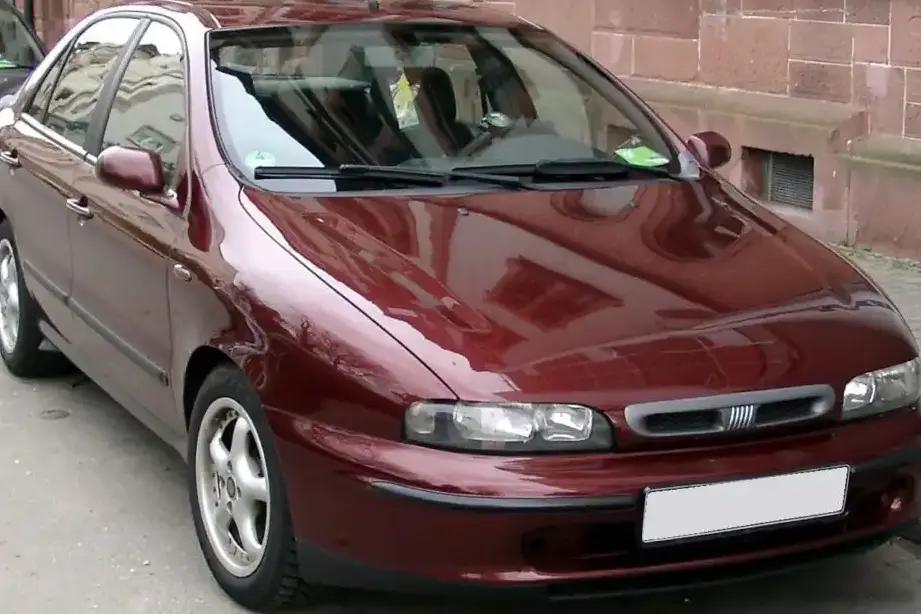
The Fiat Marea (185) 2.0 155 20V, produced between 1999 and 2000, represented a high-performance variant within the Marea range. Positioned as a sporty offering, it aimed to provide enthusiasts with a more engaging driving experience compared to the lower-spec models. The Marea itself was a mid-size family car designed to replace the aging Fiat Tempra, and the 185 series represented a significant refresh of the original model launched in 1996. This 2.0-liter 20-valve engine, coupled with a five-speed manual transmission, was a key component of the Marea’s appeal in European markets, offering a blend of performance and practicality.
Technical Specifications
| Brand | Fiat |
| Model | Marea |
| Generation | Marea (185) |
| Type (Engine) | 2.0 155 20V (154 Hp) |
| Start of production | 1999 |
| End of production | 2000 |
| Powertrain Architecture | Internal Combustion engine |
| Body type | Sedan |
| Seats | 5 |
| Doors | 4 |
| Fuel consumption (urban) | 11 l/100 km (21.4 US mpg) |
| Fuel consumption (extra urban) | 6.5 l/100 km (36.2 US mpg) |
| Fuel Type | Petrol (Gasoline) |
| Acceleration 0 – 100 km/h | 8.6 sec |
| Acceleration 0 – 62 mph | 8.6 sec |
| Acceleration 0 – 60 mph | 8.2 sec |
| Maximum speed | 210 km/h (130.49 mph) |
| Weight-to-power ratio | 8.1 kg/Hp |
| Weight-to-torque ratio | 6.7 kg/Nm |
| Power | 154 Hp @ 6700 rpm |
| Power per litre | 77.1 Hp/l |
| Torque | 186 Nm @ 3750 rpm (137.19 lb.-ft. @ 3750 rpm) |
| Engine layout | Front, Transverse |
| Engine Model/Code | 182.B7.000 |
| Engine displacement | 1998 cm3 (121.93 cu. in.) |
| Number of cylinders | 5 |
| Engine configuration | Inline |
| Cylinder Bore | 82 mm (3.23 in.) |
| Piston Stroke | 75.65 mm (2.98 in.) |
| Compression ratio | 10:1 |
| Number of valves per cylinder | 4 |
| Fuel injection system | Multi-port manifold injection |
| Engine aspiration | Naturally aspirated |
| Valvetrain | DOHC |
| Engine oil capacity | 5 l (5.28 US qt | 4.4 UK qt) |
| Coolant capacity | 7.2 l (7.61 US qt | 6.34 UK qt) |
| Kerb Weight | 1255 kg (2766.8 lbs.) |
| Max. weight | 1830 kg (4034.46 lbs.) |
| Max load | 575 kg (1267.66 lbs.) |
| Trunk (boot) space – minimum | 430 l (15.19 cu. ft.) |
| Fuel tank capacity | 63 l (16.64 US gal | 13.86 UK gal) |
| Length | 4390 mm (172.83 in.) |
| Width | 1740 mm (68.5 in.) |
| Height | 1420 mm (55.91 in.) |
| Wheelbase | 2540 mm (100 in.) |
| Front track | 1475 mm (58.07 in.) |
| Rear track | 1430 mm (56.3 in.) |
| Drivetrain Architecture | Front wheel drive |
| Number of gears | 5 |
| Gearbox type | Manual transmission |
| Front suspension | Wishbone |
| Rear suspension | Coil spring |
| Front brakes | Disc |
| Rear brakes | Drum |
| Assisting systems | ABS (Anti-lock braking system) |
| Steering type | Steering rack and pinion |
| Power steering | Hydraulic |
| Tires size | 195/60 R15 |
Powertrain & Engine Architecture
The heart of the Marea 2.0 155 20V is the 182.B7.000 engine, a 1.998-liter inline-five cylinder gasoline engine. This engine was a notable feature of several Fiat and Lancia models, prized for its relatively smooth operation and decent power output. The “20V” designation refers to the engine’s five valves per cylinder (four intake, one exhaust), a design intended to improve breathing and enhance performance across the rev range. It utilized a multi-port fuel injection system, delivering fuel directly into the intake ports, and a double overhead camshaft (DOHC) valvetrain for precise valve control. The engine’s architecture was designed for durability and relatively easy maintenance, although sourcing specific parts can be challenging today. The five-speed manual transmission was a robust unit, providing a direct and engaging driving experience. The transmission’s gear ratios were tuned to maximize the engine’s torque and provide good acceleration in everyday driving conditions.
Driving Characteristics
The Marea 2.0 155 20V offered a noticeable step up in performance compared to the lower-powered versions. Acceleration to 60 mph was achieved in approximately 8.2 seconds, and it could reach a top speed of around 130 mph. The inline-five engine provided a unique exhaust note and a relatively linear power delivery. While not a high-revving engine, it offered ample torque throughout the mid-range, making it suitable for both city driving and highway cruising. Compared to the 1.8-liter versions, the 2.0-liter engine felt significantly more responsive, especially during overtaking maneuvers. The manual transmission allowed for greater driver control, and the well-tuned suspension provided a comfortable yet controlled ride. However, the Marea’s front-wheel-drive layout could exhibit some torque steer under hard acceleration.
Equipment & Trim Levels
The Marea 2.0 155 20V typically came with a reasonably well-equipped specification. Standard features often included power steering, ABS brakes, central locking, electric front windows, and an adjustable steering column. Interior upholstery was typically cloth, although leather options were available. Dashboard design was functional and straightforward, with clear instrumentation. Optional extras could include air conditioning, a sunroof, alloy wheels, and a more advanced audio system. The trim level often dictated the availability of these options, with higher-spec versions offering a more luxurious interior and additional features.
Chassis & Braking
The Marea 185 featured a front-wheel-drive layout with independent wishbone suspension at the front and a coil spring rear suspension. This setup provided a good balance between ride comfort and handling. The front brakes were ventilated discs, offering good stopping power, while the rear brakes were drums. ABS was standard, enhancing braking safety. The chassis was relatively lightweight, contributing to the car’s agility. Stabilizer bars were fitted to both the front and rear axles to reduce body roll during cornering.
Market Reception & Comparison
The Marea 2.0 155 20V was generally well-received by automotive critics, who praised its performance, handling, and spacious interior. It was often seen as a practical and affordable alternative to more expensive rivals. Compared to the lower-powered Marea variants, the 2.0-liter model offered a significantly more engaging driving experience. Fuel economy was reasonable for a car of its class, although it was not as efficient as the diesel-powered versions. Reliability was generally good, although some owners reported issues with the electrical system. The Marea faced competition from cars like the Ford Mondeo, Opel Vectra, and Volkswagen Passat.
Legacy
The Fiat Marea 2.0 155 20V has developed a cult following among enthusiasts, particularly those who appreciate its unique inline-five engine and engaging driving dynamics. The engine itself is known for its durability, although finding replacement parts can be a challenge. Today, well-maintained examples are becoming increasingly rare and sought after by collectors. The Marea represents a period of innovation for Fiat, and the 2.0 155 20V variant stands out as a particularly capable and enjoyable model.
