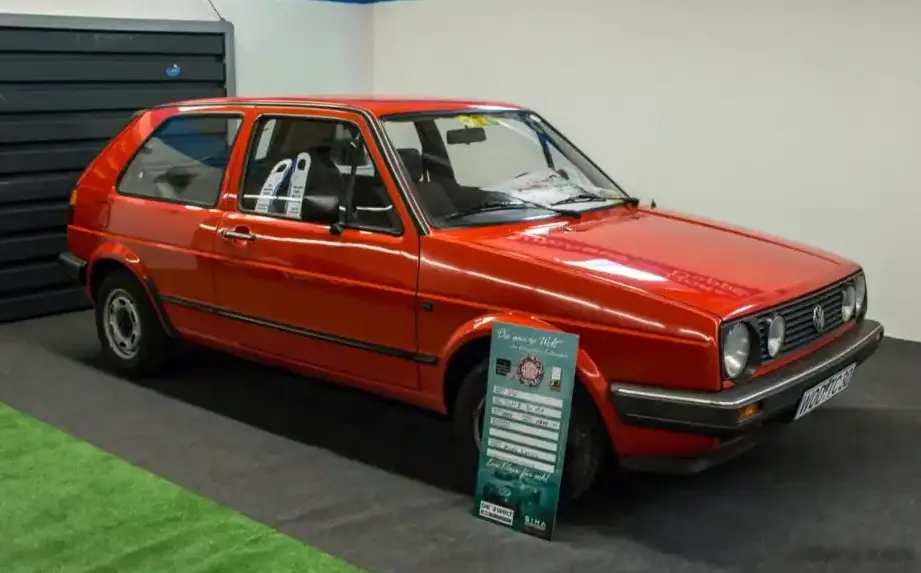
The Volkswagen Golf II 1.8 GTI 8V CAT, produced from 1985 to 1987, represents a pivotal point in the evolution of the iconic Golf lineage. Positioned as a mid-range performance offering within the Golf II (3-door) lineup, it bridged the gap between the more economical base models and the higher-performance 16V variants. Built on the 1HX0/A3 platform, this model aimed to deliver a balance of spirited driving and everyday usability, appealing to a broader customer base than its more focused siblings. The “CAT” designation indicates the inclusion of a catalytic converter, reflecting growing environmental regulations in many markets.
Technical Specifications
| Brand | Volkswagen |
| Model | Golf |
| Generation | Golf II (3-door) |
| Type (Engine) | 1.8 GTI 8V CAT (107 Hp) |
| Start of production | 1985 |
| End of production | 1987 |
| Powertrain Architecture | Internal Combustion engine |
| Body type | Hatchback |
| Seats | 5 |
| Doors | 3 |
| Fuel consumption (urban) | 11.3 l/100 km (20.8 US mpg, 25 UK mpg, 8.8 km/l) |
| Fuel consumption (extra urban) | 6.7 l/100 km (35.1 US mpg, 42.2 UK mpg, 14.9 km/l) |
| Fuel Type | Petrol (Gasoline) |
| Acceleration 0 – 100 km/h | 10.3 sec |
| Acceleration 0 – 62 mph | 10.3 sec |
| Acceleration 0 – 60 mph | 9.8 sec |
| Maximum speed | 186 km/h (115.58 mph) |
| Weight-to-power ratio | 8.6 kg/Hp, 116.3 Hp/tonne |
| Weight-to-torque ratio | 6 kg/Nm, 167.4 Nm/tonne |
| Power | 107 Hp @ 5250 rpm |
| Power per litre | 60.1 Hp/l |
| Torque | 154 Nm @ 3250 rpm (113.58 lb.-ft. @ 3250 rpm) |
| Engine layout | Front, Transverse |
| Engine Model/Code | RD |
| Engine displacement | 1781 cm3 (108.68 cu. in.) |
| Number of cylinders | 4 |
| Engine configuration | Inline |
| Cylinder Bore | 81 mm (3.19 in.) |
| Piston Stroke | 86.4 mm (3.4 in.) |
| Compression ratio | 10:1 |
| Number of valves per cylinder | 2 |
| Fuel injection system | Multi-port manifold injection |
| Engine aspiration | Naturally aspirated engine |
| Valvetrain | SOHC |
| Engine oil capacity | 4 l (4.23 US qt | 3.52 UK qt) |
| Coolant capacity | 4.5 l (4.76 US qt | 3.96 UK qt) |
| Kerb Weight | 920 kg (2028.25 lbs.) |
| Max. weight | 1400 kg (3086.47 lbs.) |
| Max load | 480 kg (1058.22 lbs.) |
| Trunk (boot) space – minimum | 345 l (12.18 cu. ft.) |
| Trunk (boot) space – maximum | 1145 l (40.44 cu. ft.) |
| Fuel tank capacity | 55 l (14.53 US gal | 12.1 UK gal) |
| Permitted trailer load with brakes (12%) | 1200 kg (2645.55 lbs.) |
| Permitted trailer load without brakes | 490 kg (1080.27 lbs.) |
| Length | 3985 mm (156.89 in.) |
| Width | 1680 mm (66.14 in.) |
| Height | 1405 mm (55.31 in.) |
| Wheelbase | 2475 mm (97.44 in.) |
| Front track | 1427 mm (56.18 in.) |
| Rear track | 1422 mm (55.98 in.) |
| Front overhang | 810 mm (31.89 in.) |
| Rear overhang | 700 mm (27.56 in.) |
| Drag coefficient (Cd) | 0.34 |
| Minimum turning circle | 10.5 m (34.45 ft.) |
| Drivetrain Architecture | Front wheel drive |
| Number of gears and type of gearbox | 5 gears, manual transmission |
| Front suspension | Independent type McPherson, Transverse stabilizer |
| Rear suspension | Transverse stabilizer, Elastic beam |
| Front brakes | Ventilated discs |
| Rear brakes | Disc |
| Steering type | Steering rack and pinion |
| Tires size | 175/70 R13 |
| Wheel rims size | 5.5J x 13 |
Powertrain & Engine Architecture
The heart of the Golf II 1.8 GTI 8V CAT is the RD engine code, a 1781cc inline-four cylinder gasoline engine. This engine featured a single overhead camshaft (SOHC) valvetrain operating two valves per cylinder. The “8V” designation signifies the eight valves total. Fuel delivery was managed by Bosch multi-port fuel injection, a significant advancement over earlier carbureted systems, contributing to improved fuel efficiency and smoother power delivery. The catalytic converter, denoted by the “CAT” suffix, was a crucial component in reducing harmful emissions, becoming increasingly important in automotive regulations of the era. The engine produced 107 horsepower at 5250 rpm and 154 Nm (113.58 lb-ft) of torque at 3250 rpm. While not the most powerful engine in the Golf II range, the RD engine offered a good balance of performance and economy.
Driving Characteristics
The 1.8 GTI 8V CAT, paired with a 5-speed manual transmission, provided a reasonably engaging driving experience. Acceleration from 0 to 60 mph took approximately 9.8 seconds, and it could achieve a top speed of 115.58 mph. Compared to the more potent 16V GTI, the 8V version felt less urgent, particularly at higher engine speeds. However, the 8V’s torque curve was more forgiving, making it easier to drive in everyday traffic. The gear ratios were well-chosen for both city driving and highway cruising. The front-wheel-drive configuration provided predictable handling, although it could exhibit some understeer when pushed hard. The 8V GTI offered a more accessible and less demanding driving experience than its 16V counterpart, making it a popular choice for drivers who prioritized usability over outright performance.
Equipment & Trim Levels
The Golf II 1.8 GTI 8V CAT typically came equipped with features considered standard for a performance-oriented hatchback of the time. This included a sporty interior with bolstered seats, a leather-wrapped steering wheel, and a comprehensive instrument cluster. Exterior features included GTI-specific body styling, including a small rear spoiler and unique alloy wheels. Optional extras included a sunroof, central locking, and upgraded audio systems. The interior trim was generally functional and durable, reflecting the Golf’s reputation for practicality. The level of equipment was a step up from the base Golf models, but less luxurious than the higher-spec 16V GTI.
Chassis & Braking
The Golf II 1.8 GTI 8V CAT utilized an independent McPherson strut suspension at the front and a torsion beam suspension at the rear. This setup provided a good compromise between ride comfort and handling. The front brakes were ventilated discs, offering good stopping power, while the rear brakes were solid discs. The steering was a rack-and-pinion system, providing precise and responsive control. The suspension was tuned to provide a slightly firmer ride than the base Golf models, enhancing handling and stability. The chassis was relatively lightweight, contributing to the car’s nimble handling characteristics.
Market Reception & Comparison
The Golf II 1.8 GTI 8V CAT was generally well-received by automotive critics. It was praised for its blend of performance, economy, and practicality. Compared to the 16V GTI, the 8V version was considered more affordable and easier to drive. However, it lacked the ultimate performance of its more powerful sibling. Fuel economy was respectable for a performance car of the era, averaging around 35.1 US mpg on the highway. Reliability was generally good, although regular maintenance was essential to ensure optimal performance. The 8V GTI offered a compelling alternative to other hot hatchbacks of the time, such as the Peugeot 205 GTI and the Ford Escort XR3.
Legacy
The Volkswagen Golf II 1.8 GTI 8V CAT remains a popular classic car today. The RD engine, while not known for being exceptionally robust, is generally reliable if properly maintained. Parts availability is good, and the car’s relatively simple mechanical design makes it relatively easy to repair. The Golf II 1.8 GTI 8V CAT is appreciated by enthusiasts for its classic styling, engaging driving experience, and affordability. It represents a significant chapter in the Golf’s history, bridging the gap between the original Golf and the more modern models that followed. Well-maintained examples continue to command a loyal following in the used car market.