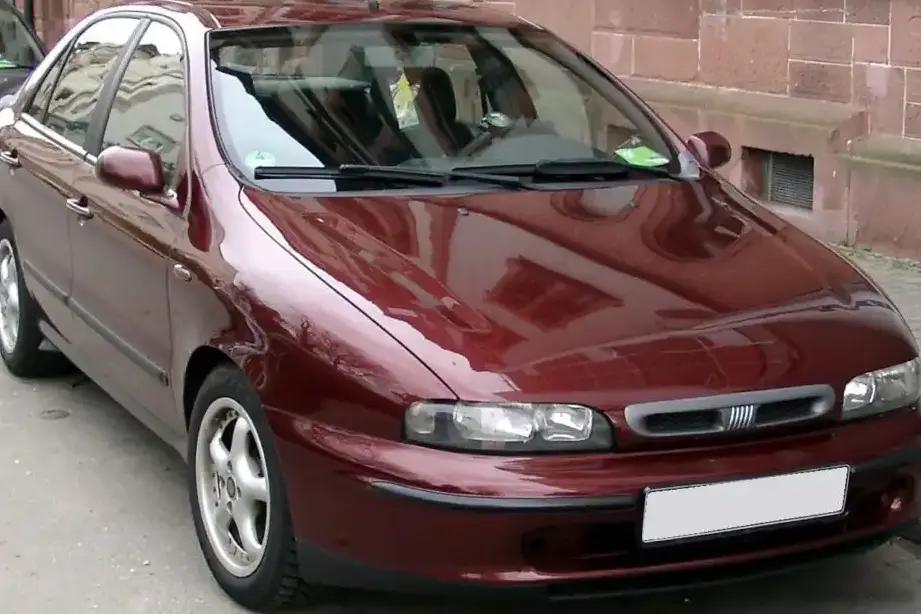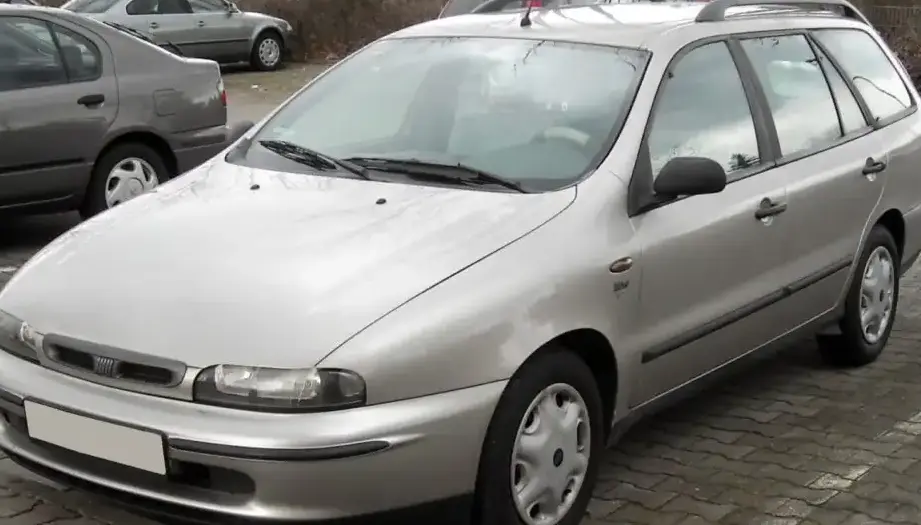
The Fiat Marea Weekend 1.8 16V, produced between 1996 and 2000, represented a practical and relatively affordable option within the Marea range. Positioned as a mid-range trim, it offered a balance between performance and economy for buyers seeking a spacious station wagon. The Marea Weekend (Type 185) itself was a significant model for Fiat, designed to compete in the European mid-size family car segment, offering a larger and more modern alternative to the aging Tipo. This variant, with its 1.8-liter engine and 5-speed manual transmission, aimed to provide a comfortable and capable vehicle for families and those needing substantial cargo space.
Technical Specifications
| Brand | Fiat |
| Model | Marea |
| Generation | Marea Weekend (185) |
| Type (Engine) | 1.8 115 16V (113 Hp) |
| Start of production | 1996 |
| End of production | 2000 |
| Powertrain Architecture | Internal Combustion engine |
| Body type | Station wagon (estate) |
| Seats | 5 |
| Doors | 5 |
| Fuel consumption (urban) | 11.5 l/100 km (20.5 US mpg) |
| Fuel consumption (extra urban) | 6.5 l/100 km (36.2 US mpg) |
| Fuel consumption (combined) | 7.1 l/100 km (33.1 US mpg) |
| Fuel Type | Petrol (Gasoline) |
| Acceleration 0 – 100 km/h | 10.6 sec |
| Acceleration 0 – 62 mph | 10.6 sec |
| Acceleration 0 – 60 mph | 10.1 sec |
| Maximum speed | 193 km/h (119.92 mph) |
| Weight-to-power ratio | 10.9 kg/Hp |
| Weight-to-torque ratio | 8 kg/Nm |
| Power | 113 Hp @ 5800 rpm |
| Torque | 154 Nm @ 4400 rpm (113.58 lb.-ft. @ 4400 rpm) |
| Engine layout | Front, Transverse |
| Engine Model/Code | 182A2000 |
| Engine displacement | 1747 cm3 (106.61 cu. in.) |
| Number of cylinders | 4 |
| Engine configuration | Inline |
| Cylinder Bore | 82 mm (3.23 in.) |
| Piston Stroke | 82.7 mm (3.26 in.) |
| Compression ratio | 10.3:1 |
| Number of valves per cylinder | 4 |
| Fuel injection system | Multi-port manifold injection |
| Engine aspiration | Naturally aspirated |
| Valvetrain | DOHC |
| Engine oil capacity | 4.6 l (4.86 US qt | 4.05 UK qt) |
| Coolant capacity | 6.2 l (6.55 US qt | 5.46 UK qt) |
| Kerb Weight | 1230 kg (2711.69 lbs.) |
| Max. weight | 1850 kg (4078.55 lbs.) |
| Max load | 620 kg (1366.87 lbs.) |
| Trunk (boot) space – minimum | 500 l (17.66 cu. ft.) |
| Trunk (boot) space – maximum | 1500 l (52.97 cu. ft.) |
| Fuel tank capacity | 63 l (16.64 US gal | 13.86 UK gal) |
| Length | 4485 mm (176.57 in.) |
| Width | 1740 mm (68.5 in.) |
| Height | 1510 mm (59.45 in.) |
| Wheelbase | 2540 mm (100 in.) |
| Front track | 1470 mm (57.87 in.) |
| Rear track | 1440 mm (56.69 in.) |
| Drivetrain Architecture | Front wheel drive |
| Number of gears | 5 |
| Gearbox type | Manual transmission |
| Front suspension | Wishbone |
| Rear suspension | Coil spring |
| Front brakes | Disc |
| Rear brakes | Drum |
| Assisting systems | ABS (Anti-lock braking system) |
| Steering type | Steering rack and pinion |
| Power steering | Hydraulic |
| Tires size | 185/65 R14 |
Powertrain & Engine Architecture
The heart of the Marea Weekend 1.8 16V was the 182A2000 engine, a naturally aspirated, four-cylinder inline engine displacing 1747cc. This engine featured a double overhead camshaft (DOHC) valvetrain operating four valves per cylinder, contributing to its relatively high output for its displacement. It utilized a multi-port fuel injection system, providing precise fuel delivery for improved efficiency and performance. The 1.8-liter engine produced 113 horsepower at 5800 rpm and 154 Nm (113.58 lb-ft) of torque at 4400 rpm. The engine’s design prioritized a balance between power and fuel economy, making it suitable for everyday driving. The 5-speed manual transmission was well-matched to the engine’s characteristics, offering a good spread of gears for both acceleration and cruising.
Driving Characteristics
The Marea Weekend 1.8 16V offered a competent, if not particularly sporty, driving experience. Acceleration from 0-60 mph took around 10.1 seconds, and it had a top speed of approximately 119.92 mph. Compared to the more powerful 2.0-liter versions of the Marea, the 1.8 felt less eager to rev, but it provided adequate power for most driving situations. The manual transmission allowed for precise control, and the gear ratios were well-chosen for both city and highway driving. The suspension provided a comfortable ride, absorbing bumps and imperfections in the road effectively. However, it wasn’t as tightly controlled as some of its rivals, resulting in a bit of body roll during cornering. The steering was light and easy to use, making it maneuverable in urban environments.
Equipment & Trim Levels
The 1.8 16V trim of the Marea Weekend typically included features such as power steering, central locking, electric front windows, and an adjustable steering column. Interior upholstery was generally cloth, with a functional and durable design. Optional extras included air conditioning, alloy wheels, a sunroof, and a radio/cassette player. The dashboard layout was straightforward and easy to use, with clearly labeled controls. Safety features included ABS (Anti-lock Braking System) as standard, a notable inclusion for a vehicle of its era.
Chassis & Braking
The Marea Weekend featured a front-wheel-drive layout with independent wishbone suspension at the front and a coil spring rear suspension. This setup provided a good balance between ride comfort and handling. The braking system consisted of disc brakes at the front and drum brakes at the rear. While adequate for normal driving, the rear drum brakes were a cost-saving measure and didn’t offer the same stopping power as disc brakes all around. The car’s weight of around 1230 kg (2711.69 lbs) contributed to its stable handling characteristics.
Market Reception & Comparison
The Fiat Marea Weekend 1.8 16V was generally well-received by automotive critics as a practical and spacious family car. It offered a good amount of interior space and a large trunk, making it ideal for families or those needing to transport bulky items. Fuel economy was respectable for its class, averaging around 33.1 US mpg in combined driving. Compared to the higher-powered Marea variants, the 1.8 offered a more affordable entry point into the range, but at the expense of outright performance. It also compared favorably to rivals like the Ford Mondeo and Opel/Vauxhall Vectra in terms of value for money and interior space.
Legacy
The Fiat Marea Weekend 1.8 16V has proven to be a relatively reliable vehicle, with the 182A2000 engine being generally durable. However, like many European cars of this era, it can be susceptible to corrosion, particularly in areas exposed to salt. Parts availability can be a challenge in some markets, but many components are still available through specialist suppliers. Today, the Marea Weekend 1.8 16V represents an affordable and practical classic car, offering a spacious and comfortable driving experience for those seeking a well-rounded family vehicle. Its simple mechanical design makes it relatively easy to maintain for those with some mechanical aptitude.