Technical Specifications
| Brand | Audi |
| Model | A6 |
| Generation | A6 Avant (C9) |
| Type (Engine) | 2.0 TDI (204 Hp) Mild Hybrid plus S tronic |
| Start of production | March, 2025 |
| Powertrain Architecture | MHEV (Mild Hybrid Electric Vehicle) |
| Body type | Station wagon (estate) |
| Seats | 5 |
| Doors | 5 |
| Fuel consumption at Low speed (WLTP) | 6.5 l/100 km (36.2 US mpg, 43.5 UK mpg, 15.4 km/l) |
| Fuel consumption at Medium speed (WLTP) | 4.6 l/100 km (51.1 US mpg, 61.4 UK mpg, 21.7 km/l) |
| Fuel consumption at High speed (WLTP) | 4.5 l/100 km (52.3 US mpg, 62.8 UK mpg, 22.2 km/l) |
| Fuel consumption at Very high speed (WLTP) | 5.4 l/100 km (43.6 US mpg, 52.3 UK mpg, 18.5 km/l) |
| Combined fuel consumption (WLTP) | 5-5.7 l/100 km (47 – 41.3 US mpg, 56.5 – 49.6 UK mpg, 20 – 17.5 km/l) |
| CO2 emissions (WLTP) | 130-148 g/km |
| Fuel Type | Diesel |
| Acceleration 0 – 100 km/h | 7.9 sec |
| Acceleration 0 – 62 mph | 7.9 sec |
| Acceleration 0 – 60 mph | 7.5 sec |
| Maximum speed | 241 km/h (149.75 mph) |
| Emission standard | Euro 6e |
| Weight-to-power ratio | 9.5 kg/Hp, 105.7 Hp/tonne |
| Weight-to-torque ratio | 4.8 kg/Nm, 207.3 Nm/tonne |
| Gross battery capacity | 1.7 kWh |
| Battery voltage | 48 V |
| Battery technology | Lithium iron phosphate (LiFePO4) |
| Battery location | Under the trunk |
| Recuperation output | 25 kW |
| Electric motor power | 24 Hp |
| Electric motor Torque | 230 Nm (169.64 lb.-ft.) |
| Electric motor location | Middle, Longitudinal |
| Power | 204 Hp @ 3800-4200 rpm |
| Power per litre | 103.7 Hp/l |
| Torque | 400 Nm @ 1750-3250 rpm (295.02 lb.-ft. @ 1750-3250 rpm) |
| Engine layout | Front, Longitudinal |
| Engine displacement | 1968 cm3 (120.09 cu. in.) |
| Number of cylinders | 4 |
| Engine configuration | Inline |
| Cylinder Bore | 81 mm (3.19 in.) |
| Piston Stroke | 95.5 mm (3.76 in.) |
| Compression ratio | 15.5:1 |
| Number of valves per cylinder | 4 |
| Fuel injection system | Diesel Commonrail |
| Engine aspiration | Turbocharger, Intercooler |
| Valvetrain | DOHC |
| Engine oil capacity | 5.5 l (5.81 US qt, 4.84 UK qt) |
| Coolant | 17.1 l (18.07 US qt, 15.05 UK qt) |
| Kerb Weight | 1930 kg (4254.92 lbs.) |
| Max. weight | 2555 kg (5632.81 lbs.) |
| Max load | 625 kg (1377.89 lbs.) |
| Trunk (boot) space – minimum | 466 l (16.46 cu. ft.) |
| Trunk (boot) space – maximum | 1497 l (52.87 cu. ft.) |
| Fuel tank capacity | 60 l (15.85 US gal, 13.2 UK gal) |
| AdBlue tank | 20 l (5.28 US gal, 4.4 UK gal) |
| Max. roof load | 100 kg (220.46 lbs.) |
| Permitted trailer load with brakes (8%) | 2000 kg (4409.25 lbs.) |
| Permitted trailer load with brakes (12%) | 2000 kg (4409.25 lbs.) |
| Permitted trailer load without brakes | 750 kg (1653.47 lbs.) |
| Permitted towbar download | 95 kg (209.44 lbs.) |
| Length | 4999 mm (196.81 in.) |
| Width | 1875 mm (73.82 in.) |
| Width including mirrors | 2099 mm (82.64 in.) |
| Height | 1472 mm (57.95 in.) |
| Wheelbase | 2923 mm (115.08 in.) |
| Front track | 1626-1631 mm (64.02 – 64.21 in.) |
| Rear (Back) track | 1610-1616 mm (63.39 – 63.62 in.) |
| Front overhang | 938 mm (36.93 in.) |
| Rear overhang | 1138 mm (44.8 in.) |
| Drag coefficient (Cd) | 0.25 |
| Minimum turning circle (turning diameter) | 12.3 m (40.35 ft.) |
| Approach angle | 14.1° |
| Departure angle | 16.9° |
| Drivetrain Architecture | ICE and electric motor drive the front wheels |
| Drive wheel | Front wheel drive |
| Number of gears and type of gearbox | 7 gears, automatic transmission S tronic |
| Front suspension | Coil spring, Independent multi-link suspension, Transverse stabilizer, Air Suspension – Optional |
| Rear suspension | Independent multi-link spring suspension with stabilizer, Air Suspension – Optional |
| Front brakes | Ventilated discs, 338 mm |
| Rear brakes | Ventilated discs, 330 mm |
| Tires size | 225/60 R17; 225/55 R18; 245/45 R19; 255/40 R20; 255/35 R21 |
| Wheel rims size | 7.5J x 17; 8J x 18; 8.5J x 19; 8.5J x 20; 8.5J x 21 |
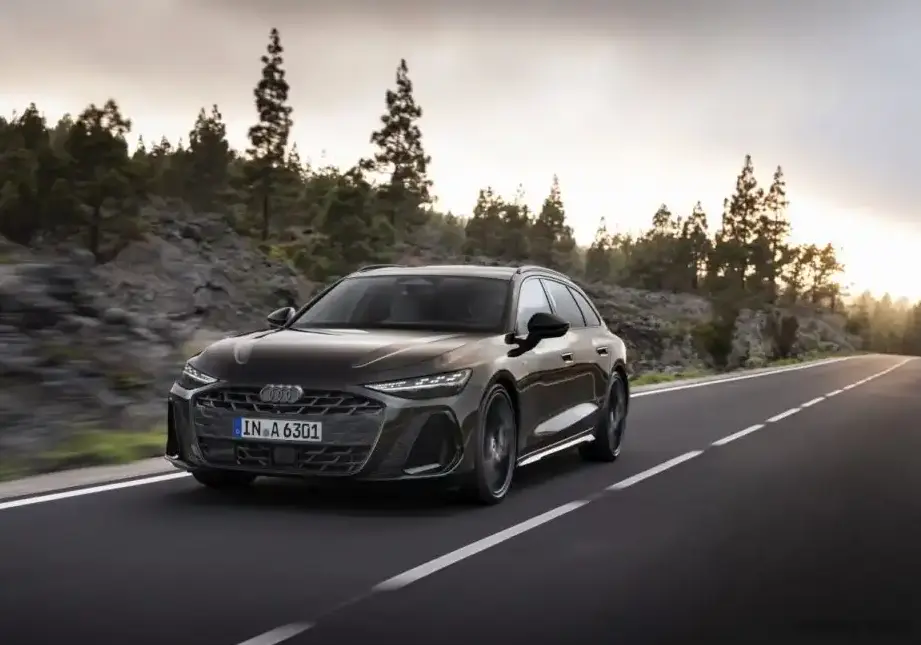
The Audi A6 Avant (C9) 2.0 TDI, introduced in March 2025, represents a significant iteration of Audi’s popular executive wagon. Positioned as a mid-range offering within the C9 A6 Avant lineup, this variant combines a 2.0-liter turbocharged diesel engine with a 48-volt mild hybrid system and Audi’s seven-speed S tronic dual-clutch transmission. It’s designed to balance fuel efficiency, respectable performance, and the practicality expected of a premium estate car, primarily targeting the European market where wagons remain highly popular. This model builds upon the foundation of the A6 family, known for its blend of luxury, technology, and driving dynamics.
Powertrain & Engine Architecture
At the heart of the A6 Avant C9 2.0 TDI lies the EA288 evo series of diesel engines, specifically the 1968cc inline-four cylinder configuration. This engine, often identified by engine codes like DNU or DNT depending on specific calibration, utilizes a turbocharger with an intercooler to deliver 204 horsepower at 3800-4200 rpm and 400 Nm (295 lb-ft) of torque between 1750 and 3250 rpm. The engine employs a common-rail direct injection system, operating at extremely high pressures to optimize combustion efficiency and reduce emissions. The 48V mild hybrid system adds a belt-driven starter-generator, enabling features like extended start-stop operation, coasting with engine off, and a small boost in power during acceleration. The seven-speed S tronic dual-clutch transmission provides quick and smooth gear changes, contributing to both performance and fuel economy. This transmission is known for its efficiency and responsiveness, offering both automatic and manual shift modes.
Driving Characteristics
The 2.0 TDI with the S tronic transmission delivers a refined and capable driving experience. While not as overtly sporty as higher-powered A6 variants, it provides ample power for everyday driving and long-distance cruising. The 7.9-second 0-62 mph acceleration is respectable, and the readily available torque makes overtaking maneuvers easy. The S tronic transmission’s quick shifts contribute to a feeling of responsiveness. The mild hybrid system is largely transparent to the driver, working in the background to improve efficiency. Compared to a manual transmission version of the same engine, the S tronic offers greater convenience and ease of use, particularly in urban traffic. However, some enthusiasts may prefer the more direct engagement of a manual gearbox. The gear ratios are tuned for a balance between acceleration and fuel economy, with taller gearing in higher gears for efficient highway cruising.
Equipment & Trim Levels
The 2.0 TDI variant typically comes well-equipped, reflecting Audi’s premium positioning. Standard features generally include Audi’s MMI touch response infotainment system with a dual-screen setup, Audi Virtual Cockpit digital instrument cluster, leather upholstery, three-zone automatic climate control, and a comprehensive suite of driver-assistance systems such as lane departure warning, adaptive cruise control, and automatic emergency braking. Optional extras often include features like a Bang & Olufsen sound system, matrix LED headlights, massaging front seats, and a head-up display. Trim levels beyond the base specification often add cosmetic enhancements, such as different wheel designs and interior trim materials.
Chassis & Braking
The A6 Avant C9 features a sophisticated chassis design. The front suspension utilizes a multi-link setup with coil springs, while the rear suspension employs a similar multi-link configuration. Optional air suspension is available, providing adjustable ride height and improved comfort. The braking system consists of ventilated discs on all four wheels, providing ample stopping power. The size of the front discs is 338mm, and the rear discs are 330mm. ABS (Anti-lock Braking System) and electronic stability control are standard features, enhancing safety and control.
Market Reception & Comparison
The Audi A6 Avant 2.0 TDI has been generally well-received by automotive critics. It’s praised for its refined driving experience, spacious interior, and excellent fuel economy. Compared to the more powerful 3.0-liter TDI variants, the 2.0 TDI offers a more affordable entry point into the A6 Avant range, albeit with slightly less performance. Its fuel economy is notably better than the larger engine, making it a more attractive option for drivers who prioritize efficiency. Reliability has been generally good, although, as with any modern diesel, it’s important to ensure the AdBlue system is properly maintained.
Legacy
The EA288 engine family, including the 2.0 TDI variant, has proven to be a durable and reliable powertrain when properly maintained. The mild hybrid technology adds a layer of future-proofing, helping to reduce emissions and improve fuel economy. On the used car market, the A6 Avant 2.0 TDI represents a compelling value proposition, offering a blend of luxury, practicality, and efficiency. Regular servicing, particularly of the diesel particulate filter and AdBlue system, is crucial to ensure long-term reliability. The S tronic transmission, while generally robust, may require servicing at specific intervals to maintain optimal performance.