Technical Specifications
| Brand | DS |
| Model | 3 |
| Generation | 3 |
| Type (Engine) | 1.2 PureTech (110 Hp) Stop&Start Automatic |
| Start of production | 2016 |
| End of production | 2018 |
| Powertrain Architecture | Internal Combustion engine |
| Body type | Hatchback |
| Seats | 5 |
| Doors | 3 |
| Fuel consumption (urban) | 5.6 l/100 km (42 US mpg, 50.4 UK mpg, 17.9 km/l) |
| Fuel consumption (extra urban) | 3.9 l/100 km (60.3 US mpg, 72.4 UK mpg, 25.6 km/l) |
| Fuel consumption (combined) | 4.6 l/100 km (51.1 US mpg, 61.4 UK mpg, 21.7 km/l) |
| CO2 emissions | 105 g/km |
| Fuel Type | Petrol (Gasoline) |
| Acceleration 0 – 100 km/h | 9.9 sec |
| Acceleration 0 – 62 mph | 9.9 sec |
| Acceleration 0 – 60 mph | 9.4 sec |
| Maximum speed | 189 km/h (117.44 mph) |
| Emission standard | Euro 6 |
| Weight-to-power ratio | 9.9 kg/Hp, 100.9 Hp/tonne |
| Weight-to-torque ratio | 5.3 kg/Nm, 188.1 Nm/tonne |
| Power | 110 Hp @ 5500 rpm |
| Power per litre | 91.7 Hp/l |
| Torque | 205 Nm @ 1500 rpm (151.2 lb.-ft. @ 1500 rpm) |
| Engine layout | Front, Transverse |
| Engine Model/Code | HNZ EB2DT |
| Engine displacement | 1199 cm3 (73.17 cu. in.) |
| Number of cylinders | 3 |
| Engine configuration | Inline |
| Cylinder Bore | 75 mm (2.95 in.) |
| Piston Stroke | 90.5 mm (3.56 in.) |
| Number of valves per cylinder | 4 |
| Fuel injection system | Multi-port manifold injection |
| Engine aspiration | Turbocharger, Intercooler |
| Engine oil capacity | 3.5 l (3.7 US qt | 3.08 UK qt) |
| Kerb Weight | 1090 kg (2403.04 lbs.) |
| Max. weight | 1600 kg (3527.4 lbs.) |
| Max load | 510 kg (1124.36 lbs.) |
| Trunk (boot) space – minimum | 285 l (10.06 cu. ft.) |
| Trunk (boot) space – maximum | 980 l (34.61 cu. ft.) |
| Fuel tank capacity | 50 l (13.21 US gal | 11 UK gal) |
| Max. roof load | 70 kg (154.32 lbs.) |
| Permitted trailer load with brakes (12%) | 900 kg (1984.16 lbs.) |
| Permitted trailer load without brakes | 570 kg (1256.63 lbs.) |
| Permitted towbar download | 46 kg (101.41 lbs.) |
| Length | 3954 mm (155.67 in.) |
| Width | 1715 mm (67.52 in.) |
| Width including mirrors | 2004 mm (78.9 in.) |
| Height | 1458-1483 mm (57.4 – 58.39 in.) |
| Wheelbase | 2464 mm (97.01 in.) |
| Front track | 1465-1468 mm (57.68 – 57.8 in.) |
| Rear (Back) track | 1467-1471 mm (57.76 – 57.91 in.) |
| Front overhang | 830 mm (32.68 in.) |
| Rear overhang | 660 mm (25.98 in.) |
| Minimum turning circle | 10.2 m (33.46 ft.) |
| Drivetrain Architecture | The Internal combustion engine (ICE) drives the front wheels of the vehicle. |
| Drive wheel | Front wheel drive |
| Number of gears and type of gearbox | 6 gears, automatic transmission |
| Front suspension | Independent type McPherson |
| Rear suspension | Semi-independent, coil spring |
| Front brakes | Ventilated discs |
| Rear brakes | Disc |
| Assisting systems | ABS (Anti-lock braking system) |
| Steering type | Steering rack and pinion |
| Power steering | Electric Steering |
| Tires size | 195/55 R16; 205/45 R17 |
| Wheel rims size | 16; 17 |
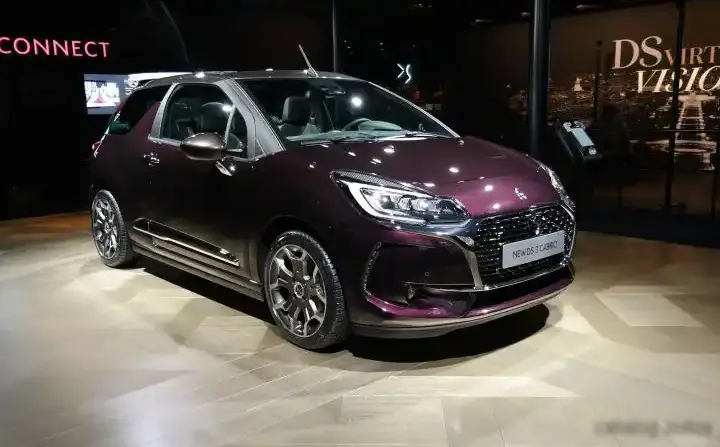
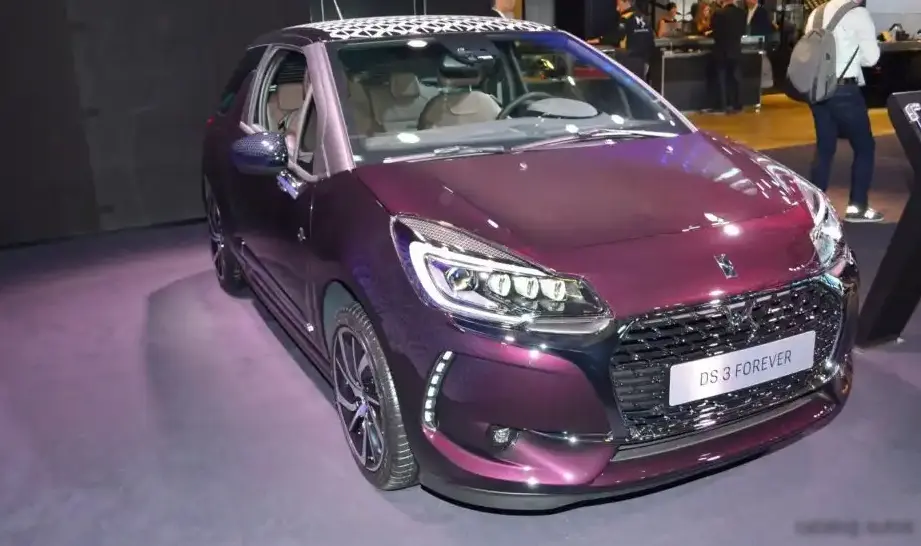
The DS 3 1.2 PureTech 110 Stop&Start Automatic is a front-wheel-drive hatchback produced by the French manufacturer DS Automobiles between 2016 and 2018. Positioned as a mid-range offering within the DS 3 lineup, it aimed to provide a balance between fuel efficiency, reasonable performance, and the convenience of an automatic transmission. This variant was part of the second generation of the DS 3, which built upon the foundations of the original Citroën DS3, gaining a more premium feel and distinct brand identity after DS Automobiles was established as a separate entity. It competed with vehicles like the Audi A1, Mini Cooper, and Volkswagen Polo in the premium subcompact segment.
Powertrain & Engine Architecture
The DS 3 1.2 PureTech 110 Automatic is powered by the HNZ EB2DT engine, a 1.2-liter turbocharged three-cylinder petrol engine. This engine is part of Peugeot-Citroën’s (PSA) PureTech family, known for its efficiency and responsiveness. The engine utilizes multi-point fuel injection and a single-scroll turbocharger with an intercooler to boost power output. The three-cylinder configuration inherently creates some vibration, which PSA addressed through the use of dual-mass flywheels and engine mounts. The engine’s aluminum block contributes to weight reduction. The automatic transmission is a six-speed Aisin-sourced unit, chosen for its smooth operation and efficiency. This transmission features a torque converter and is programmed for comfort and fuel economy rather than outright performance.
Driving Characteristics
The 110 horsepower and 205 Nm (151 lb-ft) of torque provided by the 1.2 PureTech engine, coupled with the six-speed automatic, resulted in a comfortable, if not particularly sporty, driving experience. Acceleration from 0-60 mph took approximately 9.4 seconds, and the car reached a top speed of 117.44 mph. The automatic transmission’s gear ratios were tuned for fuel efficiency, meaning that while adequate for everyday driving, it wasn’t as quick to downshift as some performance-oriented automatics. The engine delivered usable torque from low RPMs, making it suitable for urban driving, but felt somewhat strained at higher speeds or when fully loaded. Compared to the manual version of the same engine, the automatic offered less driver engagement but greater convenience. Higher-output versions of the DS 3, such as those with more powerful engines, provided significantly quicker acceleration and a more dynamic driving experience.
Equipment & Trim Levels
The DS 3 1.2 PureTech 110 Automatic typically came equipped with features such as air conditioning, a touchscreen infotainment system with Bluetooth connectivity, USB ports, and power windows. Standard safety equipment included ABS, electronic stability control, and multiple airbags. Higher trim levels offered options like leather upholstery, automatic climate control, a panoramic sunroof, and parking sensors. The interior design aimed for a premium feel, with unique dashboard trim and seat designs differentiating it from the Citroën DS3. The specific trim level (e.g., Chic, Elegance, Prestige) determined the level of standard equipment and available options.
Chassis & Braking
The DS 3 featured a McPherson strut front suspension and a semi-independent coil spring rear suspension. This setup provided a reasonable balance between ride comfort and handling. The front brakes were ventilated discs, while the rear brakes were solid discs. ABS (Anti-lock Braking System) was standard. The steering utilized an electric power steering system, offering light and precise control. The suspension tuning was generally geared towards comfort, resulting in a slightly softer ride compared to more performance-focused hatchbacks. Stabilizer bars were included to reduce body roll during cornering.
Market Reception & Comparison
The DS 3 1.2 PureTech 110 Automatic was generally well-received by critics for its fuel efficiency and comfortable ride. However, some reviewers noted that the engine could feel underpowered, especially when fully loaded or on inclines. Compared to the 1.6-liter petrol and 1.6-liter diesel variants, the 1.2 PureTech offered better fuel economy but less outright performance. The automatic transmission was praised for its smoothness but criticized for its occasional hesitation. In terms of reliability, the PureTech engine has been subject to some reports of timing chain issues, although these were more prevalent in earlier iterations of the engine.
Legacy
The DS 3 1.2 PureTech 110 Automatic remains a relatively common sight on the used car market. Its fuel efficiency and comfortable ride continue to appeal to buyers seeking a stylish and practical subcompact hatchback. While the PureTech engine has had some reported reliability concerns, regular maintenance and adherence to recommended service intervals can mitigate these risks. The DS 3 helped establish the DS Automobiles brand as a distinct entity, offering a more premium alternative to mainstream Citroën models. The combination of a small, turbocharged engine and an automatic transmission proved popular with buyers seeking a convenient and economical city car.