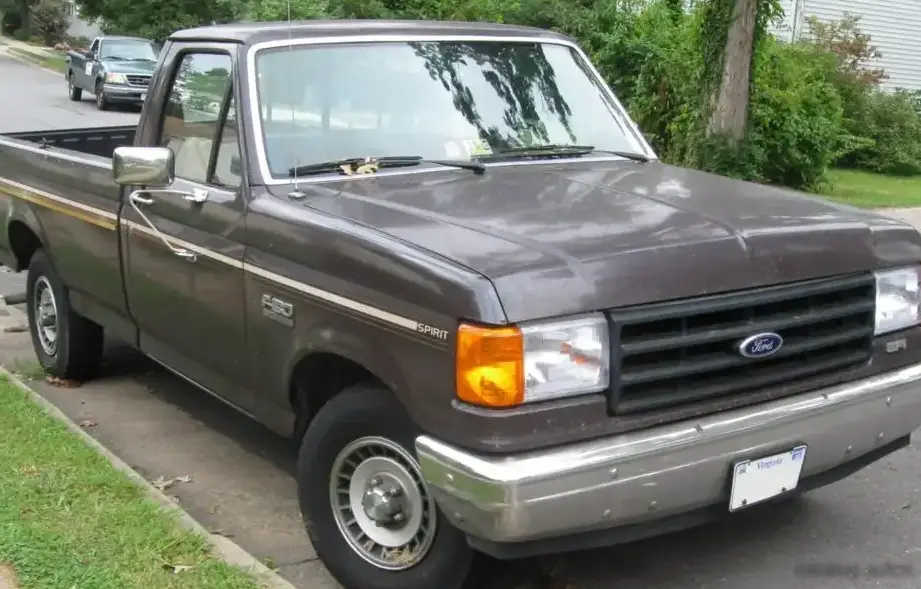
The Ford F-Series F-150 VIII Regular Cab, equipped with the 4.9-liter inline-six engine producing 145 horsepower, represents a significant iteration in the long and storied history of Ford’s full-size pickup trucks. Produced from 1986 to 1991, this configuration occupied the entry-level position within the eighth generation of the F-Series (1987-1991), offering a balance of affordability and capability for buyers prioritizing workhorse functionality over outright performance. This model played a crucial role in maintaining Ford’s dominance in the highly competitive American pickup truck market, appealing to farmers, ranchers, and tradespeople who needed a reliable and durable vehicle for everyday tasks.
Technical Specifications
| Brand | Ford |
| Model | F-Series F-100/F-150 |
| Generation | F-Series F-150 VIII Regular Cab |
| Type (Engine) | 4.9 300 Six (145 Hp) |
| Start of production | 1986 |
| End of production | 1991 |
| Powertrain Architecture | Internal Combustion engine |
| Body type | Pick-up |
| Seats | 3 |
| Doors | 2 |
| Fuel Type | Petrol (Gasoline) |
| Power | 145 Hp |
| Power per litre | 29.5 Hp/l |
| Torque | 359 Nm / 264.78 lb.-ft. |
| Engine layout | Front, Longitudinal |
| Engine displacement | 4916 cm3 / 299.99 cu. in. |
| Number of cylinders | 6 |
| Engine configuration | Inline |
| Fuel injection system | Multi-port manifold injection |
| Engine aspiration | Naturally aspirated engine |
| Max. weight | 2835 kg / 6250.11 lbs. |
| Fuel tank capacity | 62-72 l / 16.38 – 19.02 US gal | 13.64 – 15.84 UK gal |
| Length | 4917-5339 mm / 193.58 – 210.2 in. |
| Height | 1773-1775 mm / 69.8 – 69.88 in. |
| Wheelbase | 2967-3378 mm / 116.81 – 132.99 in. |
| Wading depth | 742-767 mm / 29.21 – 30.2 in. |
| Drivetrain Architecture | The Internal combustion engine (ICE) drives the rear wheels of the vehicle. |
| Drive wheel | Rear wheel drive |
| Number of gears and type of gearbox | 4 gears, manual transmission |
| Front suspension | Independent coil spring |
| Front brakes | Disc |
| Rear brakes | Drum |
| Power steering | Electric Steering |
| Tires size | 215/75 R15; 235/75 R15 |
| Wheel rims size | 6J x 15 |
Powertrain & Engine Architecture
The heart of this F-150 variant is the 4.9-liter (299 cubic inch) inline-six engine, often referred to as the “300 Six.” This engine, a mainstay of Ford trucks for decades, is renowned for its durability and low-end torque. The 1986-1991 version utilized a multi-port fuel injection system, a significant upgrade from the carburetor-equipped earlier models, improving fuel efficiency and responsiveness. The engine’s valvetrain features a single overhead camshaft, operating two valves per cylinder. The 300 Six is a naturally aspirated engine, meaning it doesn’t employ a turbocharger or supercharger. The engine’s robust construction, featuring a cast-iron block and cylinder head, contributed to its legendary longevity. The standard transmission for this model was a four-speed manual, although a three-speed automatic transmission was available as an option, albeit impacting performance and fuel economy.
Driving Characteristics
The 145-horsepower 4.9-liter engine, coupled with the four-speed manual transmission, provided adequate, though not exhilarating, performance. Acceleration was modest, and highway passing required careful planning. However, the engine’s strong low-end torque made it well-suited for hauling and towing. The manual transmission offered precise control, allowing drivers to maximize the engine’s power band. Compared to the optional 5.0-liter V8, the 300 Six offered significantly less horsepower but a noticeable advantage in fuel economy. The gear ratios in the four-speed manual were spaced to provide a balance between acceleration and cruising efficiency. The rear-wheel-drive configuration, standard on all F-150s of this era, provided a traditional truck driving experience, requiring careful throttle control in slippery conditions.
Equipment & Trim Levels
The F-150 with the 4.9-liter engine typically represented the base trim level. Standard features included a basic vinyl interior, a simple dashboard layout, and manual windows and locks. The bench seat accommodated three passengers, although comfort was prioritized over luxury. Optional extras included an AM/FM radio, air conditioning, and upgraded interior trim. The exterior typically featured minimal chrome trim and steel wheels. The Regular Cab configuration offered a single row of seating and a relatively compact cab size, prioritizing functionality over passenger space. The bed lengths varied, offering buyers a choice between a short bed and a long bed depending on their hauling needs.
Chassis & Braking
The F-150 VIII Regular Cab utilized a body-on-frame construction, providing a robust and durable platform. The front suspension featured independent coil springs, offering a reasonably comfortable ride. The rear suspension employed leaf springs, designed to handle heavy loads. Braking duties were handled by disc brakes at the front and drum brakes at the rear. Power steering was standard, making maneuvering the large truck easier. Tire sizes typically ranged from 215/75 R15 to 235/75 R15, providing adequate traction for most road conditions. The chassis was designed to prioritize load-carrying capacity and durability over sporty handling.
Market Reception & Comparison
The 4.9-liter F-150 was generally well-received by buyers seeking an affordable and reliable work truck. Critics praised the engine’s durability and fuel efficiency, but noted its lack of outright power. Compared to the V8-powered F-150s, the 300 Six offered a lower purchase price and better gas mileage, making it an attractive option for budget-conscious buyers. However, the V8 models provided significantly more power and towing capacity. The 300 Six was also often compared to similar inline-six engines offered by Chevrolet and Dodge, with the Ford engine generally considered to be the most durable and reliable of the three.
Legacy
The 4.9-liter inline-six engine has earned a reputation as one of the most reliable and long-lasting engines ever produced by Ford. Many examples of this engine are still in service today, often with hundreds of thousands of miles on the odometer. The F-150 VIII Regular Cab with the 300 Six remains a popular choice among collectors and enthusiasts seeking a classic American pickup truck. Its simplicity, durability, and affordability have ensured its continued relevance in the used car market. While not the fastest or most luxurious truck of its era, the 1986-1991 Ford F-150 with the 4.9-liter engine represents a testament to Ford’s commitment to building tough and dependable vehicles.