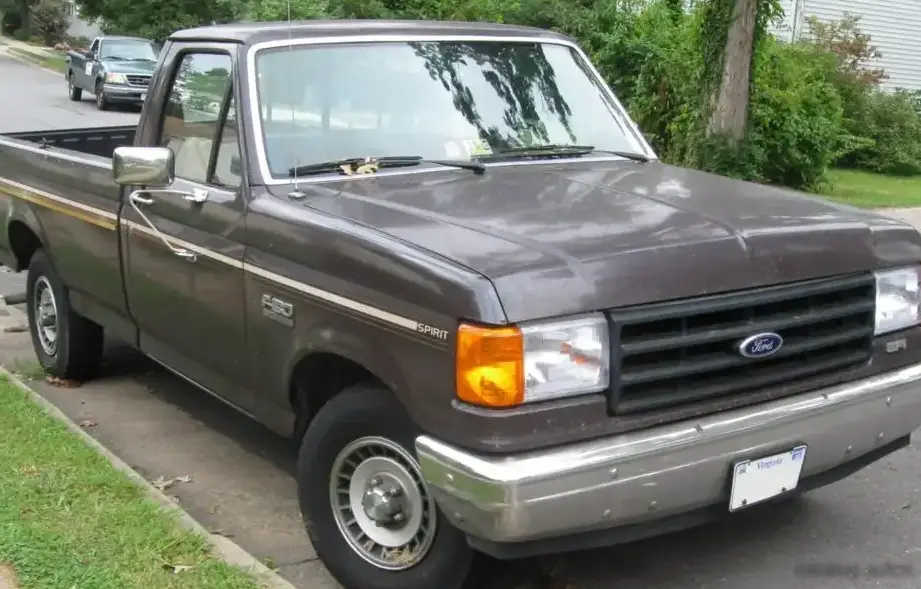
The Ford F-Series F-150 VIII Regular Cab, equipped with the 4.9-liter inline-six engine and a four-speed automatic transmission, represents a significant workhorse configuration within the eighth generation of Ford’s immensely popular F-Series pickup trucks. Produced from 1986 to 1991, this variant occupied an important position as a base-level offering, providing a balance of affordability, durability, and capability for a broad range of buyers. It was a mainstay for farmers, ranchers, and tradespeople who needed a reliable truck without the expense of higher trim levels or more powerful engines. This configuration was a direct descendant of the long-running 300 cubic inch (4.9L) Ford inline-six, a powerplant renowned for its longevity and low-end torque.
Technical Specifications
| Brand | Ford |
| Model | F-Series F-100/F-150 |
| Generation | F-Series F-150 VIII Regular Cab |
| Type (Engine) | 4.9 300 Six (145 Hp) Automatic |
| Start of production | 1986 |
| End of production | 1991 |
| Powertrain Architecture | Internal Combustion engine |
| Body type | Pick-up |
| Seats | 3 |
| Doors | 2 |
| Fuel Type | Petrol (Gasoline) |
| Power | 145 Hp |
| Power per litre | 29.5 Hp/l |
| Torque | 359 Nm / 264.78 lb.-ft. |
| Engine layout | Front, Longitudinal |
| Engine displacement | 4916 cm3 / 299.99 cu. in. |
| Number of cylinders | 6 |
| Engine configuration | Inline |
| Fuel injection system | Multi-port manifold injection |
| Engine aspiration | Naturally aspirated engine |
| Max. weight | 2835 kg / 6250.11 lbs. |
| Fuel tank capacity | 62-72 l / 16.38 – 19.02 US gal | 13.64 – 15.84 UK gal |
| Length | 4917-5339 mm / 193.58 – 210.2 in. |
| Height | 1773-1775 mm / 69.8 – 69.88 in. |
| Wheelbase | 2967-3378 mm / 116.81 – 132.99 in. |
| Wading depth | 742-767 mm / 29.21 – 30.2 in. |
| Drivetrain Architecture | The Internal combustion engine (ICE) drives the rear wheels of the vehicle. |
| Drive wheel | Rear wheel drive |
| Number of gears and type of gearbox | 4 gears, automatic transmission |
| Front suspension | Independent coil spring |
| Front brakes | Disc |
| Rear brakes | Drum |
| Power steering | Electric Steering |
| Tires size | 215/75 R15; 235/75 R15 |
| Wheel rims size | 6J x 15 |
Powertrain & Engine Architecture
The heart of this F-150 variant is the 4.9-liter (299 cubic inch) inline-six cylinder engine, often referred to as the “300 Six.” This engine, a long-stroke design, was known for its exceptional durability and ample low-end torque. The 1986-1991 versions utilized multi-port fuel injection, a significant upgrade from the carburetor systems of earlier iterations, improving fuel efficiency and throttle response. The engine code varied, but commonly included designations like 302. The valvetrain employed a single overhead camshaft, keeping the design relatively simple and reliable. The four-speed automatic transmission (typically a Ford C6) was chosen for its robustness and ability to handle the engine’s torque output. While not offering the quickest acceleration, the C6 provided smooth shifts and dependable operation. The transmission was geared towards work applications, prioritizing towing capacity and hauling ability over outright speed.
Driving Characteristics
The 145 horsepower and 265 lb-ft of torque delivered by this combination resulted in a truck that was competent, but not particularly quick. Acceleration was modest, and passing maneuvers required planning. However, the 300 Six’s strength lay in its low-end grunt. The truck felt strong when starting from a stop, and it could comfortably handle moderate loads. The automatic transmission’s gear ratios were optimized for towing and hauling, meaning the engine rarely felt strained, even when working hard. Compared to the available 5.0-liter V8 or the 6.9-liter diesel options, this 4.9L automatic was noticeably slower, but it offered a smoother, quieter ride and significantly better fuel economy. The manual transmission versions of the 4.9L offered slightly better performance due to reduced drivetrain loss, but the automatic was favored by many drivers for its ease of use.
Equipment & Trim Levels
The 4.9L automatic F-150 typically represented the base trim level. Standard features included a basic vinyl interior, a simple dashboard layout, and manual windows and locks. Air conditioning and an AM radio were often included, but more luxurious options like power windows, power locks, and a better sound system were typically reserved for higher trim levels like the XL or XLT. The standard cab configuration offered a bench seat capable of seating three passengers. Optional extras included a sliding rear window, a chrome front bumper, and various towing packages. The interior was designed for practicality and durability, with easy-to-clean surfaces and a focus on functionality.
Chassis & Braking
The F-150 VIII utilized a body-on-frame construction, providing a robust and durable platform. The front suspension consisted of independent coil springs, offering a reasonably comfortable ride. The rear suspension employed leaf springs, which were well-suited for carrying heavy loads. Braking was accomplished via front disc brakes and rear drum brakes. Power steering was standard, making maneuvering the large truck easier. Tire sizes typically ranged from 215/75R15 to 235/75R15, providing a good balance of ride comfort and load-carrying capacity. The chassis was designed to withstand the rigors of daily work, and the suspension was tuned to prioritize stability and load-hauling capability.
Market Reception & Comparison
The 4.9L automatic F-150 was generally well-received as a dependable and affordable work truck. Critics acknowledged its lack of outright performance but praised its fuel efficiency and durability. Compared to the V8 options, it offered significantly better gas mileage, making it a popular choice for those who drove long distances or frequently used their trucks for work. The diesel option provided even more torque, but at a higher initial cost and with more maintenance requirements. The 4.9L automatic struck a balance between cost, performance, and reliability, making it a sensible choice for many buyers. Its simplicity also meant lower repair costs and easier maintenance.
Legacy
The 4.9-liter inline-six engine and the Ford C6 automatic transmission have earned a reputation for exceptional longevity. Many examples of this powertrain combination are still on the road today, often with well over 200,000 miles. The engine’s simple design and robust construction contribute to its reliability. In the used car market, these F-150s are often sought after by those looking for a dependable and affordable truck. While not a collector’s item, a well-maintained example can provide years of reliable service. The 300 Six remains a favorite among those who appreciate a simple, durable, and capable engine. Its legacy as a workhorse powerplant continues to this day, solidifying its place in Ford truck history.