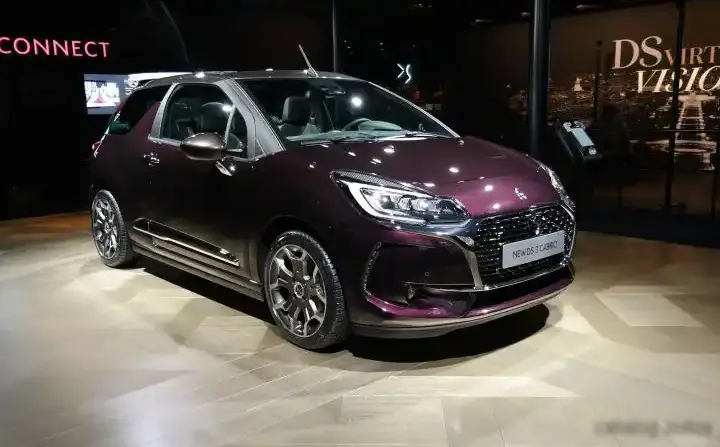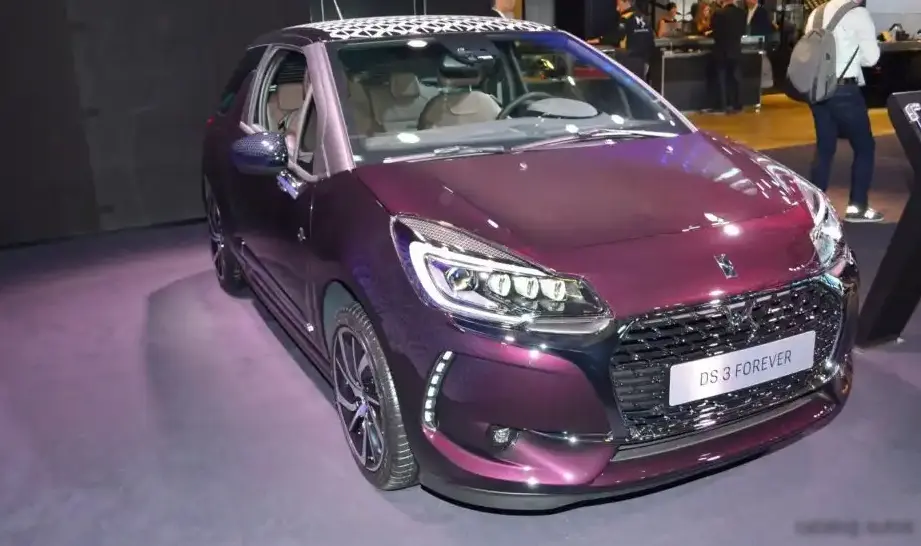
The DS 3 1.6 THP 165 Start&Stop was a performance-oriented variant of the DS 3 hatchback, produced between 2016 and 2018. Positioned as a mid-range offering within the DS 3 lineup, it bridged the gap between the entry-level PureTech engines and the more potent, but also more expensive, performance models. This variant was primarily marketed in Europe, where the DS brand, spun off from Citroën, aimed to establish a distinct identity focused on style and technology. The DS 3 itself was based on the PF1 platform, shared with the second-generation Citroën C3 and Peugeot 208.
Technical Specifications
| Brand | DS |
| Model | 3 |
| Generation | 3 |
| Type (Engine) | 1.6 THP (165 Hp) Start&Stop |
| Start of production | 2016 |
| End of production | 2018 |
| Powertrain Architecture | Internal Combustion engine |
| Body type | Hatchback |
| Seats | 5 |
| Doors | 3 |
| Fuel consumption (urban) | 7.1 l/100 km (33.1 US mpg, 39.8 UK mpg, 14.1 km/l) |
| Fuel consumption (extra urban) | 4.6 l/100 km (51.1 US mpg, 61.4 UK mpg, 21.7 km/l) |
| Fuel consumption (combined) | 5.6 l/100 km (42 US mpg, 50.4 UK mpg, 17.9 km/l) |
| CO2 emissions | 129 g/km |
| Fuel Type | Petrol (Gasoline) |
| Acceleration 0 – 100 km/h | 8.1 sec |
| Acceleration 0 – 62 mph | 8.1 sec |
| Acceleration 0 – 60 mph | 7.7 sec |
| Maximum speed | 218 km/h (135.46 mph) |
| Emission standard | Euro 6 |
| Weight-to-power ratio | 6.9 kg/Hp, 144.7 Hp/tonne |
| Weight-to-torque ratio | 4.8 kg/Nm, 210.5 Nm/tonne |
| Power | 165 Hp @ 6000 rpm |
| Power per litre | 103.3 Hp/l |
| Torque | 240 Nm @ 1400 rpm (177.01 lb.-ft. @ 1400 rpm) |
| Engine layout | Front, Transverse |
| Engine Model/Code | 5GZ EP6FDT |
| Engine displacement | 1598 cm3 (97.52 cu. in.) |
| Number of cylinders | 4 |
| Engine configuration | Inline |
| Cylinder Bore | 77 mm (3.03 in.) |
| Piston Stroke | 85.8 mm (3.38 in.) |
| Fuel injection system | Direct injection |
| Engine aspiration | Turbocharger, Intercooler |
| Engine oil capacity | 4.3 l (4.54 US qt | 3.78 UK qt) |
| Kerb Weight | 1140-1173 kg (2513.27 – 2586.02 lbs.) |
| Max. weight | 1605 kg (3538.42 lbs.) |
| Max load | 432-465 kg (952.4 – 1025.15 lbs.) |
| Trunk (boot) space – minimum | 285 l (10.06 cu. ft.) |
| Fuel tank capacity | 50 l (13.21 US gal | 11 UK gal) |
| Max. roof load | 70 kg (154.32 lbs.) |
| Permitted trailer load with brakes (12%) | 1150 kg (2535.32 lbs.) |
| Permitted trailer load without brakes | 570 kg (1256.63 lbs.) |
| Permitted towbar download | 46 kg (101.41 lbs.) |
| Length | 3954 mm (155.67 in.) |
| Width | 1715 mm (67.52 in.) |
| Width including mirrors | 2004 mm (78.9 in.) |
| Height | 1458-1483 mm (57.4 – 58.39 in.) |
| Wheelbase | 2464 mm (97.01 in.) |
| Front track | 1465-1468 mm (57.68 – 57.8 in.) |
| Rear (Back) track | 1467-1471 mm (57.76 – 57.91 in.) |
| Front overhang | 830 mm (32.68 in.) |
| Rear overhang | 660 mm (25.98 in.) |
| Drivetrain Architecture | The Internal combustion engine (ICE) drives the front wheels of the vehicle. |
| Drive wheel | Front wheel drive |
| Number of gears and type of gearbox | 6 gears, manual transmission |
| Front suspension | Independent type McPherson |
| Rear suspension | Semi-independent, coil spring |
| Front brakes | Ventilated discs |
| Rear brakes | Disc |
| Assisting systems | ABS (Anti-lock braking system) |
| Steering type | Steering rack and pinion |
| Power steering | Electric Steering |
| Tires size | 205/45 R17 |
| Wheel rims size | 17 |
Powertrain & Engine Architecture
The heart of the DS 3 1.6 THP 165 was the EP6FDT engine, a 1.6-liter turbocharged inline-four cylinder petrol engine. This engine was part of the Prince engine family, jointly developed by PSA Peugeot Citroën and BMW. The ‘THP’ designation stands for ‘Turbo High Pressure’, indicating the use of a twin-scroll turbocharger and direct fuel injection. The engine code 5GZ identifies a specific calibration for the DS brand. Direct injection, utilizing piezo injectors, allowed for precise fuel delivery and improved combustion efficiency. The engine featured variable valve timing on both the intake and exhaust camshafts, optimizing performance across the rev range. The 165 horsepower output was achieved at 6000 rpm, while peak torque of 240 Nm (177 lb-ft) was available from a low 1400 rpm. This engine was paired with a 6-speed manual transmission, delivering power to the front wheels. The Start&Stop system automatically shut off the engine when the vehicle came to a halt, improving fuel economy in urban driving conditions.
Driving Characteristics
The DS 3 1.6 THP 165 offered a noticeably more engaging driving experience than the lower-powered versions. The turbocharger provided a strong mid-range punch, making overtaking and merging onto highways relatively effortless. While not a dedicated hot hatch, the 8.1-second 0-62 mph acceleration time was respectable for its class. The 6-speed manual transmission was well-matched to the engine’s characteristics, offering precise shifts and a good overall feel. Compared to the base 1.2 PureTech models, the 1.6 THP felt significantly more responsive. However, it didn’t possess the outright performance of the DS 3 Performance, which featured a more powerful engine and a sport-tuned chassis. The gear ratios were tuned for a balance between acceleration and fuel efficiency, with a relatively long sixth gear for comfortable cruising on the motorway.
Equipment & Trim Levels
The DS 3 1.6 THP 165 typically came equipped with a generous level of standard features. These included air conditioning, a touchscreen infotainment system with Bluetooth connectivity, alloy wheels, and a leather-wrapped steering wheel. Higher trim levels offered additional features such as automatic climate control, parking sensors, a reversing camera, and upgraded upholstery. Optional extras included a panoramic sunroof, navigation system, and premium audio system. The interior design was characterized by a stylish and modern aesthetic, with a focus on quality materials and attention to detail. The DS 3 aimed to provide a more premium feel than its Citroën and Peugeot counterparts.
Chassis & Braking
The DS 3 1.6 THP 165 utilized a McPherson strut front suspension and a semi-independent coil spring rear suspension. This setup provided a good balance between ride comfort and handling. The steering was electrically assisted, offering a light and precise feel. Braking duties were handled by ventilated discs at the front and solid discs at the rear, equipped with ABS (Anti-lock Braking System). The suspension was tuned to provide a slightly firmer ride than the lower-powered models, reflecting the car’s more performance-oriented character. Stabilizer bars were fitted to both the front and rear axles to reduce body roll during cornering.
Market Reception & Comparison
The DS 3 1.6 THP 165 was generally well-received by automotive critics. It was praised for its stylish design, comfortable interior, and engaging driving experience. The engine was considered a strong performer, offering a good balance of power and fuel efficiency. However, some reviewers noted that the ride could be a little firm on rough roads. Compared to rivals such as the Audi A1 and Mini Cooper, the DS 3 offered a more affordable price point while still providing a premium feel. In terms of fuel economy, the 1.6 THP 165 offered a combined figure of 5.6 l/100 km (42 US mpg), which was competitive for its class. Reliability reports suggested that the Prince engine family was generally robust, although some owners reported issues with the turbocharger and fuel injectors.
Legacy
The DS 3 1.6 THP 165 remains a popular choice in the used car market. Its combination of style, performance, and affordability has made it a desirable option for buyers looking for a small, premium hatchback. The EP6FDT engine, while not without its potential issues, has proven to be relatively durable when properly maintained. Regular oil changes and timely replacement of wear items are crucial for ensuring long-term reliability. Today, the DS 3 1.6 THP 165 represents a significant step in the DS brand’s efforts to establish itself as a distinct and desirable automotive manufacturer.