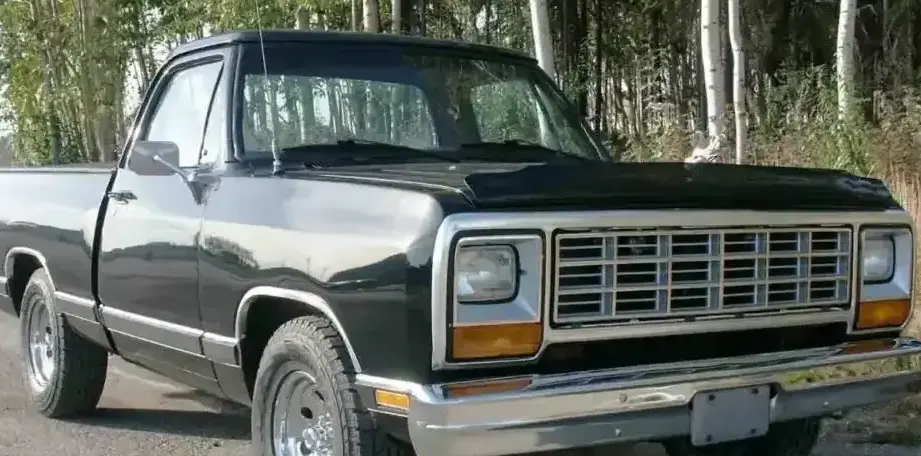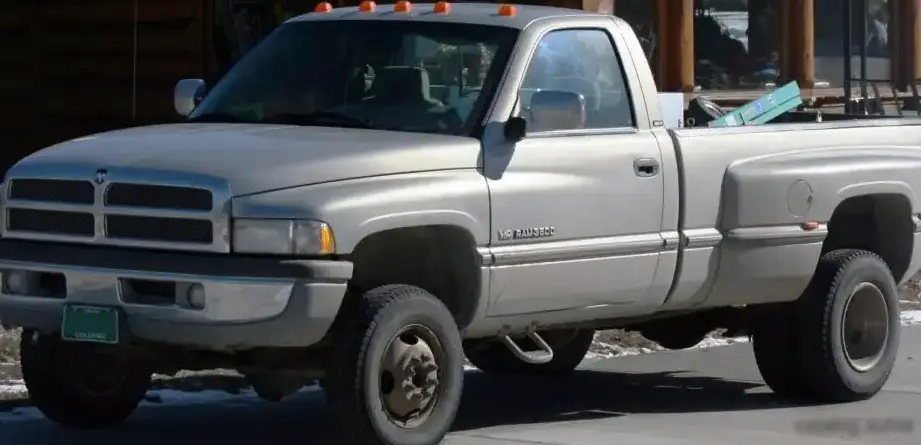
The Dodge Ram 3500 Regular Cab Long Bed (BR/BE) DRW 8.0 V10, produced from 1994 to 1998, was a significant offering in the heavy-duty pickup truck segment. This particular variant, equipped with the 488 Magnum V10 engine and a 5-speed manual transmission, was positioned as a workhorse for those needing substantial towing and hauling capacity. The “DRW” designation indicates a Dual Rear Wheel configuration, further emphasizing its capability. It was part of the second generation of the Ram series, known for its robust construction and focus on practicality.
Technical Specifications
| Brand | Dodge |
| Model | RAM |
| Generation | Ram 3500 Regular Cab Long Bed (BR/BE) |
| Type (Engine) | DRW 8.0 V10 (300 Hp) |
| Start of production | 1994 |
| End of production | 1998 |
| Powertrain Architecture | Internal Combustion engine |
| Body type | Pick-up |
| Seats | 3 |
| Doors | 2 |
| Fuel Type | Petrol (Gasoline) |
| Power | 300 Hp @ 4000 rpm |
| Power per litre | 37.5 Hp/l |
| Torque | 610 Nm @ 2400 rpm / 449.91 lb.-ft. @ 2400 rpm |
| Engine layout | Front, Longitudinal |
| Engine Model/Code | 488 Magnum |
| Engine displacement | 7997 cm3 / 488.01 cu. in. |
| Number of cylinders | 10 |
| Engine configuration | V-engine |
| Fuel injection system | Multi-port manifold injection |
| Engine aspiration | Naturally aspirated engine |
| Engine oil capacity | 6.6 l / 6.97 US qt | 5.81 UK qt |
| Max. weight | 4763 kg / 10500.62 lbs |
| Permitted trailer load with brakes (12%) | 5987 kg / 13199.08 lbs |
| Length | 5692 mm / 224.09 in |
| Width including mirrors | 2383 mm / 93.82 in |
| Height | 1854 mm / 72.99 in |
| Wheelbase | 3429 mm / 135 in |
| Approach angle | 26.1° |
| Departure angle | 24.7° |
| Ramp-over (brakeover) angle | 19.4° |
| Drivetrain Architecture | The Internal combustion engine (ICE) drives the rear wheels of the vehicle. |
| Drive wheel | Rear wheel drive |
| Number of gears and type of gearbox | 5 gears, manual transmission |
| Front suspension | Independent coil spring |
| Rear suspension | Rigid axle suspension, Leaf spring |
| Front brakes | Disc |
| Rear brakes | Drum |
| Assisting systems | ABS (Anti-lock braking system) |
| Steering type | Steering rack and pinion |
| Power steering | Hydraulic Steering |
| Tires size | 215/85 R16 |
| Wheel rims size | 6J x 16 |
Powertrain & Engine Architecture
The heart of this Ram 3500 variant is the 488 Magnum 8.0-liter V10 engine. This engine was a significant departure from the traditional small-block and big-block V8s commonly found in trucks, introduced to provide substantial torque for heavy-duty applications. The 488 Magnum utilizes a cast iron block and aluminum cylinder heads. It features multi-port fuel injection, delivering fuel directly to each cylinder for improved efficiency and power. The valvetrain consists of two valves per cylinder, operated by a hydraulic roller camshaft. The 5-speed manual transmission, a New Venture 3550, was chosen for its durability and ability to handle the engine’s substantial torque output. This transmission featured a relatively deep first gear for enhanced pulling power and well-spaced ratios for highway cruising.
Driving Characteristics
The 300 horsepower and 450 lb-ft of torque delivered by the 8.0L V10, coupled with the 5-speed manual transmission, provided a unique driving experience. While not particularly quick in terms of acceleration, the truck excelled at towing and hauling. The manual transmission allowed for precise control when navigating challenging terrain or managing heavy loads. The gear ratios were optimized for work, with a focus on low-end torque rather than high-speed performance. Compared to the later 24-valve Cummins diesel options, the V10 offered a different character – a more responsive throttle and a higher-revving nature, but with significantly lower fuel economy and reduced ultimate towing capacity. The dual rear wheels provided enhanced stability when carrying or towing heavy loads.
Equipment & Trim Levels
The Ram 3500 Regular Cab Long Bed (BR/BE) DRW 8.0 V10 was typically offered in a relatively basic trim level, reflecting its intended use as a work truck. Standard features included a vinyl bench seat, basic instrumentation, and manual windows and locks. Air conditioning was often an optional extra. The interior was designed for durability and ease of cleaning, rather than luxury. Options could include upgraded audio systems, power windows and locks, and a tilt steering wheel. The exterior typically featured minimal chrome trim and heavy-duty suspension components.
Chassis & Braking
The chassis of the Ram 3500 was built around a robust ladder frame, designed to withstand the stresses of heavy-duty use. The front suspension utilized independent coil springs, providing a relatively comfortable ride for a heavy-duty truck. The rear suspension employed a traditional leaf spring setup, optimized for load-carrying capacity. Braking duties were handled by disc brakes at the front and drum brakes at the rear. An Anti-lock Braking System (ABS) was included as a standard safety feature. The heavy-duty chassis and suspension components contributed to the truck’s high gross vehicle weight rating (GVWR) and permitted trailer load.
Market Reception & Comparison
The Dodge Ram 3500 with the 8.0L V10 engine received mixed reviews. While praised for its substantial power and towing capacity, it was often criticized for its poor fuel economy. Compared to the Cummins diesel options, the V10 was less fuel-efficient and offered lower torque. However, the V10 was generally considered more reliable than early iterations of the Cummins diesel, and its simpler design made it easier to maintain. The manual transmission was appreciated by those who preferred greater control, but it was less popular than the available automatic transmission. The DRW configuration added significant cost and complexity, but it was essential for those requiring maximum towing capacity.
Legacy
The Dodge Ram 3500 DRW 8.0 V10, while not as common as its diesel counterparts, holds a unique place in the history of heavy-duty trucks. The 488 Magnum V10 engine, though short-lived, demonstrated Dodge’s willingness to innovate and offer alternative powertrain options. Today, these trucks are sought after by collectors and enthusiasts who appreciate their rarity and unique character. While the V10 engine is known for its reliability, regular maintenance is crucial to prevent issues such as oil leaks and cooling system failures. The availability of parts is generally good, but some components may be becoming increasingly difficult to find. The DRW configuration continues to be a popular choice for those requiring maximum towing and hauling capability.