
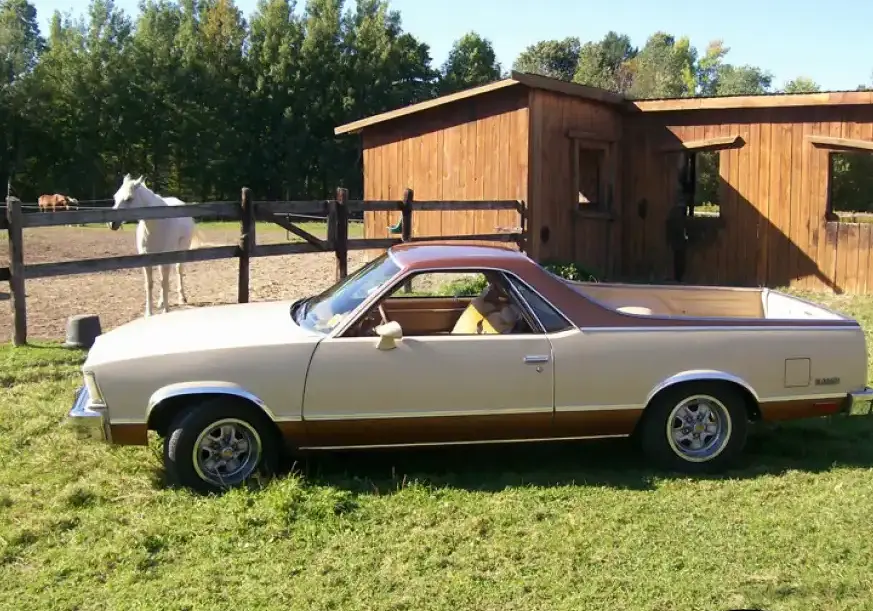
The Chevrolet Malibu El Camino, specifically the 5.0 V8 (145 hp) variant produced between 1977 and 1978, represents a unique chapter in Chevrolet’s history. Falling within the third generation of the Malibu (1973-1977), the El Camino was Chevrolet’s answer to the Ford Ranchero, blending the practicality of a pickup truck with the styling of a mid-size car. This particular configuration, featuring the 305 cubic inch V8 and a catalytic converter (hence the “CAT” designation), occupied a middle ground in the El Camino lineup, offering a balance between performance and affordability. It was positioned below the higher-output 350 cubic inch V8 models, and aimed at buyers who desired V8 power without the higher price tag or fuel consumption of the larger engine.
Technical Specifications
| Brand | Chevrolet |
| Model | Malibu |
| Generation | Malibu El Camino (Sedan Pickup) |
| Type (Engine) | 5.0 V8 (145 Hp) CAT |
| Start of production | 1977 |
| End of production | 1978 |
| Powertrain Architecture | Internal Combustion engine |
| Body type | Pick-up |
| Seats | 3 |
| Doors | 2 |
| Fuel Type | Petrol (Gasoline) |
| Power | 145 Hp @ 3800 rpm |
| Power per litre | 29 Hp/l |
| Torque | 332 Nm @ 2400 rpm / 244.87 lb.-ft. @ 2400 rpm |
| Engine layout | Front, Longitudinal |
| Engine displacement | 5001 cm3 / 305.18 cu. in. |
| Number of cylinders | 8 |
| Engine configuration | V-engine |
| Cylinder Bore | 94.89 mm / 3.74 in. |
| Piston Stroke | 88.4 mm / 3.48 in. |
| Compression ratio | 8.4:1 |
| Number of valves per cylinder | 2 |
| Fuel injection system | Carburettor |
| Engine aspiration | Naturally aspirated engine |
| Valvetrain | OHV |
| Engine oil capacity | 4.2 l / 4.44 US qt | 3.7 UK qt |
| Trunk (boot) space – maximum | 2033 l / 71.79 cu. ft. |
| Fuel tank capacity | 66 l / 17.44 US gal | 14.52 UK gal |
| Length | 5121 mm / 201.61 in. |
| Width | 1826 mm / 71.89 in. |
| Height | 1366 mm / 53.78 in. |
| Wheelbase | 2974 mm / 117.09 in. |
| Front track | 1486 mm / 58.5 in. |
| Rear (Back) track | 1467 mm / 57.76 in. |
| Front overhang | 915 mm / 36.02 in. |
| Rear overhang | 1232 mm / 48.5 in. |
| Ride height (ground clearance) | 147 mm / 5.79 in. |
| Approach angle | 20° |
| Departure angle | 15° |
| Ramp-over (brakeover) angle | 13° |
| Drivetrain Architecture | The Internal combustion engine (ICE) drives the rear wheels of the vehicle. |
| Drive wheel | Rear wheel drive |
| Number of gears and type of gearbox | 4 gears, manual transmission |
| Front suspension | Independent, type McPherson with coil spring and anti-roll bar |
| Rear suspension | dependent spring suspension, Transverse stabilizer, Trailing arm |
| Front brakes | Ventilated discs |
| Rear brakes | Drum |
| Steering type | Steering rack and pinion |
| Tires size | 205/75 R14 |
| Wheel rims size | 6.0J x 14 |
Powertrain & Engine Architecture
The heart of this El Camino variant was the Chevrolet 305 cubic inch (5.0L) small-block V8 engine. Designated with engine codes varying depending on specific calibration, this engine was a staple of Chevrolet’s lineup during the 1970s. It featured a cast iron block and cylinder heads, with a two-barrel carburetor managing fuel delivery. The overhead valve (OHV) valvetrain, while traditional, was known for its simplicity and reliability. The catalytic converter, mandated by increasingly stringent emissions regulations, was a key component of this engine, reducing harmful exhaust gases. The 305 V8 produced 145 horsepower at 3800 rpm and 245 lb-ft of torque at 2400 rpm. While not a high-performance engine, it provided adequate power for everyday driving and light hauling. The engine was mounted longitudinally in the front of the vehicle, driving the rear wheels.
Driving Characteristics
The 145 hp 5.0L V8 El Camino offered a comfortable, if not exhilarating, driving experience. Compared to the more powerful 350 V8 versions, acceleration was noticeably slower. However, the 305 provided sufficient torque for hauling moderate loads and maintaining highway speeds. The four-speed manual transmission, standard on this trim, offered a reasonable level of control, though the gear ratios were optimized for fuel economy and cruising rather than outright performance. The El Camino’s rear-wheel-drive layout provided a traditional driving feel, and the suspension, while not particularly sophisticated, offered a decent ride quality. The overall driving experience was geared towards practicality and ease of use, making it a suitable vehicle for those who needed a versatile vehicle for work and leisure.
Equipment & Trim Levels
The 1977-1978 Malibu El Camino 5.0 V8 CAT typically came with a fairly basic level of standard equipment. Interior appointments included cloth upholstery, a basic instrument cluster, and a standard AM radio. Optional extras included air conditioning, power steering, power brakes, upgraded sound systems, and various trim packages. The exterior featured brightwork around the windows and along the body sides. The El Camino’s bed was typically equipped with a standard bed liner. The trim level of this variant positioned it as a step up from the base six-cylinder models, offering V8 power and a slightly more refined interior, but falling short of the luxury features found on the higher-end trims.
Chassis & Braking
The El Camino chassis was based on the Chevrolet A-body platform, shared with other mid-size cars of the era. The front suspension utilized an independent McPherson strut design with coil springs and an anti-roll bar, providing reasonable handling characteristics. The rear suspension employed a traditional leaf spring setup with a transverse stabilizer, offering a comfortable ride but limiting handling precision. Braking duties were handled by ventilated disc brakes at the front and drum brakes at the rear. Steering was accomplished via a rack-and-pinion system. The El Camino rode on 14-inch wheels with 205/75 R14 tires.
Market Reception & Comparison
The 1977-1978 Malibu El Camino 5.0 V8 CAT received mixed reviews. Critics generally praised its versatility and styling, but noted that the 305 V8 engine lacked the performance of the larger 350 cubic inch option. Fuel economy, while improved by the catalytic converter, was still relatively poor by modern standards. Compared to the 350 V8 models, the 305 offered better fuel economy and a lower purchase price, making it an attractive option for budget-conscious buyers. Compared to the six-cylinder models, the 305 V8 provided a significant boost in power and towing capacity. The El Camino faced competition from the Ford Ranchero and, to a lesser extent, various pickup trucks.
Legacy
The Chevrolet Malibu El Camino 5.0 V8 CAT, while not the most powerful or sought-after version of the El Camino, remains a popular classic among collectors and enthusiasts. The 305 V8 engine, while not known for its high performance, is generally considered to be reliable and relatively easy to maintain. Parts availability is good, thanks to the engine’s widespread use in other Chevrolet vehicles of the era. Today, well-maintained examples of this El Camino variant command reasonable prices in the used car market, appealing to those who appreciate its unique blend of style, practicality, and classic American automotive heritage. The El Camino, in general, represents a unique moment in automotive history, bridging the gap between cars and trucks and offering a versatile vehicle that continues to resonate with enthusiasts today.
