Technical Specifications
| Brand | Volkswagen |
| Model | Golf |
| Generation | Golf II (5-door) |
| Type (Engine) | 1.6 D (54 Hp) |
| Start of production | 1983 |
| End of production | 1987 |
| Powertrain Architecture | Internal Combustion engine |
| Body type | Hatchback |
| Seats | 5 |
| Doors | 5 |
| Fuel consumption (urban) | 6.3 l/100 km (37.3 US mpg, 44.8 UK mpg, 15.9 km/l) |
| Fuel consumption (extra urban) | 4.8 l/100 km (49 US mpg, 58.9 UK mpg, 20.8 km/l) |
| Fuel Type | Diesel |
| Acceleration 0 – 100 km/h | 18.7 sec |
| Acceleration 0 – 62 mph | 18.7 sec |
| Acceleration 0 – 60 mph | 17.8 sec |
| Maximum speed | 148 km/h (91.96 mph) |
| Weight-to-power ratio | 17 kg/Hp, 58.7 Hp/tonne |
| Weight-to-torque ratio | 9.2 kg/Nm, 108.7 Nm/tonne |
| Power | 54 Hp @ 4800 rpm |
| Power per litre | 34 Hp/l |
| Torque | 100 Nm @ 2300 rpm (73.76 lb.-ft. @ 2300 rpm) |
| Engine layout | Front, Transverse |
| Engine Model/Code | JP |
| Engine displacement | 1588 cm3 (96.91 cu. in.) |
| Number of cylinders | 4 |
| Engine configuration | Inline |
| Cylinder Bore | 76.5 mm (3.01 in.) |
| Piston Stroke | 86.4 mm (3.4 in.) |
| Compression ratio | 23:1 |
| Number of valves per cylinder | 2 |
| Fuel injection system | Precombustion chamber injection |
| Engine aspiration | Naturally aspirated engine |
| Valvetrain | SOHC |
| Engine oil capacity | 3 l (3.17 US qt | 2.64 UK qt) |
| Coolant capacity | 6.5 l (6.87 US qt | 5.72 UK qt) |
| Kerb Weight | 920 kg (2028.25 lbs.) |
| Max. weight | 1430 kg (3152.61 lbs.) |
| Max load | 510 kg (1124.36 lbs.) |
| Trunk (boot) space – minimum | 345 l (12.18 cu. ft.) |
| Trunk (boot) space – maximum | 1145 l (40.44 cu. ft.) |
| Fuel tank capacity | 55 l (14.53 US gal | 12.1 UK gal) |
| Permitted trailer load with brakes (12%) | 850 kg (1873.93 lbs.) |
| Permitted trailer load without brakes | 480 kg (1058.22 lbs.) |
| Length | 3985 mm (156.89 in.) |
| Width | 1665 mm (65.55 in.) |
| Height | 1415 mm (55.71 in.) |
| Wheelbase | 2475 mm (97.44 in.) |
| Front track | 1413 mm (55.63 in.) |
| Rear (Back) track | 1408 mm (55.43 in.) |
| Front overhang | 810 mm (31.89 in.) |
| Rear overhang | 700 mm (27.56 in.) |
| Ride height (ground clearance) | 120 mm (4.72 in.) |
| Drag coefficient (Cd) | 0.34 |
| Minimum turning circle | 10.5 m (34.45 ft.) |
| Drivetrain Architecture | The Internal combustion engine (ICE) drives the front wheels of the vehicle. |
| Drive wheel | Front wheel drive |
| Number of gears and type of gearbox | 4 gears, manual transmission |
| Front suspension | Independent type McPherson |
| Rear suspension | Elastic beam |
| Front brakes | Disc |
| Rear brakes | Drum |
| Steering type | Steering rack and pinion |
| Tires size | 155/65 R13 |
| Wheel rims size | 5J x 13 |
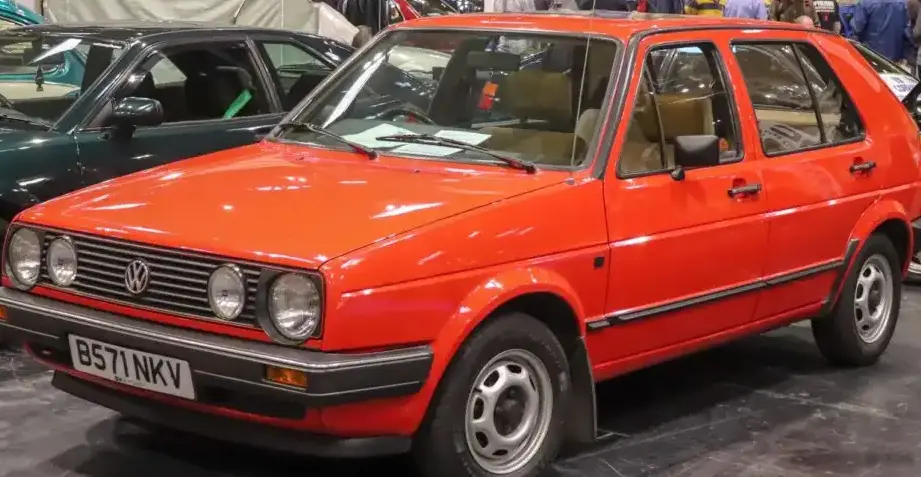
The Volkswagen Golf II, produced from 1983 to 1991, marked a significant advancement over its predecessor. The five-door 1.6 D variant, equipped with a 1.6-liter diesel engine producing 54 horsepower, was a popular choice in the European market between 1983 and 1987. Positioned as an entry-level model, it prioritized fuel efficiency and practicality, appealing to buyers seeking affordable and dependable transportation. This model was part of the Golf Mk2 generation (internal codes 19E and 1G), which improved upon the original Golf Mk1 with increased space, enhanced refinement, and updated technology.
Powertrain & Engine Architecture
The Golf II 1.6 D’s engine was the JP, a 1.6-liter inline-four diesel. This engine employed a precombustion chamber injection system, a common feature in diesel engines of that period. This system injected fuel into a small precombustion chamber connected to the main cylinder, initiating partial ignition before fuel entered the main chamber. This design improved cold-starting and reduced engine noise compared to direct injection. The engine featured a single overhead camshaft (SOHC) operating two valves per cylinder. The 1.6 D engine was known for its robust construction and inherent simplicity, contributing to its longevity. A four-speed automatic transmission was offered, providing a convenient, though less engaging, driving experience. The transmission’s gear ratios were tuned for fuel economy rather than quick acceleration.
Driving Characteristics
The 1.6 D automatic Golf II wasn’t built for performance. With only 54 horsepower, acceleration was slow, taking around 18.7 seconds to reach 62 mph. The primary focus was on economical transportation. The automatic transmission, while convenient, further reduced performance. Gear changes were deliberate, and the transmission lacked the responsiveness of modern units. However, the engine delivered a usable amount of torque at lower RPMs, making it suitable for daily driving and city conditions. Fuel economy was a major benefit, achieving around 37.3 US mpg (44.8 UK mpg) in combined driving. The suspension offered a comfortable ride, effectively absorbing road imperfections.
Equipment & Trim Levels
The 1.6 D automatic trim was generally the base model in the Golf II lineup. Standard features included cloth upholstery, basic instrumentation, and manual windows and door locks. Optional extras included a sunroof, an upgraded stereo system, and central locking. The interior was functional and durable, prioritizing practicality over luxury. The dashboard layout was simple and easy to understand, with clear gauges. The five-door body style offered increased practicality and easier access to the rear seats compared to the three-door version.
Chassis & Braking
The Golf II 1.6 D utilized an independent McPherson strut front suspension and a torsion beam rear suspension. This setup balanced ride comfort and handling. The front brakes were discs, while the rear brakes were drums – a typical configuration for vehicles in this class at the time. The steering was a rack and pinion system, providing reasonably precise control. The car’s relatively light weight (approximately 920 kg or 2028 lbs) helped offset the low horsepower output.
Market Reception & Comparison
The Golf II 1.6 D was well-received in Europe as an affordable and reliable family car. Critics praised its fuel economy and practicality but noted its lack of performance. Compared to other Golf II variants, like the GTI with its more powerful gasoline engine, the 1.6 D was considerably slower. However, it offered a lower purchase price and running costs. Compared to the later 1.9 TDI diesel, the 1.6 D offered less torque and slightly lower fuel economy but was generally considered mechanically simpler and potentially more reliable long-term.
Legacy
The Golf II 1.6 D, while not a performance icon, remains a popular classic car among enthusiasts. Its simple mechanical design and robust construction make it relatively easy to maintain and repair. The JP engine is known for its durability, and many examples are still in operation today. In the used car market, these models are typically affordable and provide an accessible entry point into classic Volkswagen ownership. The Golf II 1.6 D played a crucial role in establishing the Golf as a dominant force in the European hatchback market, and its influence continues to be felt today.