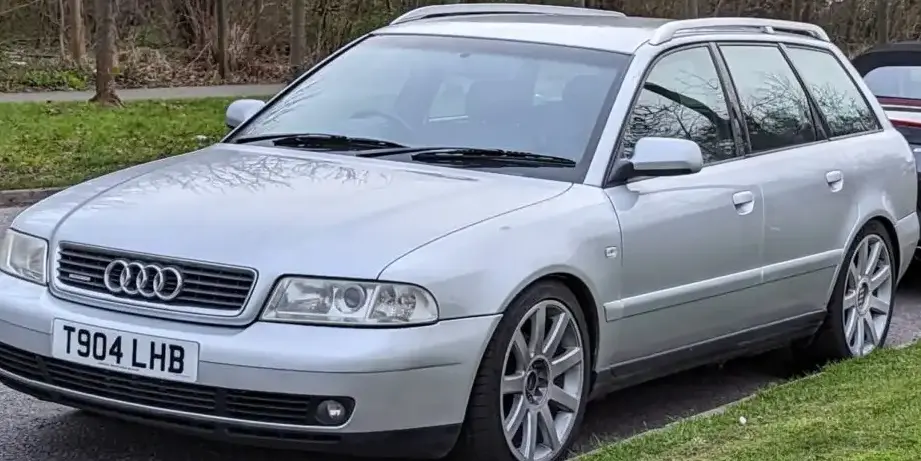
The Audi A4 Avant (B5, Typ 8D) facelift of 1999, specifically the 1.9 TDI variant producing 115 horsepower, represented a compelling blend of practicality, efficiency, and Audi’s established build quality. Introduced as part of the B5 generation’s mid-cycle refresh, this model aimed to broaden the A4’s appeal, offering a diesel-powered wagon option to European buyers seeking fuel economy and cargo space. Production of this specific configuration ran from 1999 to September 2001, solidifying its place as a popular choice in the compact executive wagon segment.
Technical Specifications
| Brand | Audi |
| Model | A4 |
| Generation | A4 Avant (B5, Typ 8D, facelift 1999) |
| Type (Engine) | 1.9 TDI (115 Hp) |
| Start of production | 1999 |
| End of production | September, 2001 |
| Powertrain Architecture | Internal Combustion engine |
| Body type | Station wagon (estate) |
| Seats | 5 |
| Doors | 5 |
| Fuel consumption (urban) | 6.8 l/100 km (34.6 US mpg, 41.5 UK mpg, 14.7 km/l) |
| Fuel consumption (extra urban) | 4.4 l/100 km (53.5 US mpg, 64.2 UK mpg, 22.7 km/l) |
| Fuel consumption (combined) | 5.3 l/100 km (44.4 US mpg, 53.3 UK mpg, 18.9 km/l) |
| Fuel Type | Diesel |
| Acceleration 0 – 100 km/h | 10.8 sec |
| Acceleration 0 – 62 mph | 10.8 sec |
| Acceleration 0 – 60 mph | 10.3 sec |
| Maximum speed | 196 km/h (121.79 mph) |
| Weight-to-power ratio | 11.5 kg/Hp, 87.1 Hp/tonne |
| Weight-to-torque ratio | 4.6 kg/Nm, 215.9 Nm/tonne |
| Power | 115 Hp @ 4000 rpm |
| Power per litre | 60.7 Hp/l |
| Torque | 285 Nm @ 1900 rpm (210.21 lb.-ft. @ 1900 rpm) |
| Engine layout | Front, Longitudinal |
| Engine Model/Code | AJM, ATJ |
| Engine displacement | 1896 cm3 (115.7 cu. in.) |
| Number of cylinders | 4 |
| Engine configuration | Inline |
| Cylinder Bore | 79.5 mm (3.13 in.) |
| Piston Stroke | 95.5 mm (3.76 in.) |
| Compression ratio | 19.5:1 |
| Number of valves per cylinder | 2 |
| Fuel injection system | Pump-nozzle (Unit Injector) |
| Engine aspiration | Turbocharger |
| Valvetrain | OHC |
| Engine oil capacity | 3.8 l (4.02 US qt | 3.34 UK qt) |
| Coolant | 6.5 l (6.87 US qt | 5.72 UK qt) |
| Kerb Weight | 1320 kg (2910.1 lbs.) |
| Max. weight | 1870 kg (4122.64 lbs.) |
| Max load | 550 kg (1212.54 lbs.) |
| Trunk (boot) space – minimum | 390 l (13.77 cu. ft.) |
| Trunk (boot) space – maximum | 1250 l (44.14 cu. ft.) |
| Fuel tank capacity | 62 l (16.38 US gal | 13.64 UK gal) |
| Length | 4479 mm (176.34 in.) |
| Width | 1733 mm (68.23 in.) |
| Height | 1417 mm (55.79 in.) |
| Wheelbase | 2622 mm (103.23 in.) |
| Front track | 1498 mm (58.98 in.) |
| Rear (Back) track | 1479 mm (58.23 in.) |
| Drag coefficient (Cd) | 0.31 |
| Minimum turning circle | 11.1 m (36.42 ft.) |
| Drivetrain Architecture | The Internal combustion engine (ICE) drives the front wheels of the vehicle. |
| Drive wheel | Front wheel drive |
| Number of gears | 5 gears, manual transmission |
| Front suspension | Independent multi-link suspension |
| Rear suspension | Suspension with traction connecting levers |
| Front brakes | Ventilated discs |
| Rear brakes | Disc |
| Assisting systems | ABS (Anti-lock braking system) |
| Steering type | Steering rack and pinion |
| Power steering | Hydraulic Steering |
| Tires size | 195/65 R15 |
| Wheel rims size | 6J x 15 |
Powertrain & Engine Architecture
The heart of this A4 Avant was the 1.9-liter inline-four cylinder diesel engine, specifically the AJM or ATJ engine code depending on the exact production date and market. This engine was a mainstay of the Volkswagen Group’s diesel offerings during the late 1990s and early 2000s. It featured a robust cast iron block and aluminum cylinder head. The engine utilized a Bosch pump-nozzle (unit injector) fuel injection system, a technology that allowed for precise fuel delivery and contributed to the engine’s efficiency and relatively low emissions for its time. The single overhead camshaft (OHC) operated two valves per cylinder. A turbocharger with an intercooler was employed to boost power output, delivering 115 horsepower at 4000 rpm and a substantial 285 Nm (210 lb-ft) of torque at a low 1900 rpm. This torque curve was a key characteristic of the engine, providing strong pulling power from low engine speeds. The engine was mounted longitudinally in the front of the vehicle, driving the front wheels through a five-speed manual transmission.
Driving Characteristics
The 1.9 TDI 115 hp A4 Avant offered a distinctly different driving experience compared to its gasoline-powered siblings or the higher-output TDI variants. While not a performance-oriented vehicle, the abundant low-end torque made it surprisingly capable for everyday driving and overtaking maneuvers. The five-speed manual transmission was well-matched to the engine’s characteristics, providing adequate gear spacing. Acceleration to 60 mph took around 10.3 seconds, and top speed was approximately 122 mph. Compared to the more powerful 1.8T gasoline engine, the TDI offered significantly better fuel economy but lacked the same level of responsiveness. The manual transmission provided a more engaging driving experience than the optional four-speed automatic, which could feel sluggish and detract from the engine’s torque. The focus was on efficiency and usability rather than outright speed.
Equipment & Trim Levels
The 1.9 TDI 115 hp A4 Avant typically occupied a mid-range position in the A4 lineup. Standard equipment included power windows, central locking, ABS brakes, and a basic stereo system. Interior upholstery was typically cloth, although leather options were available. The dashboard layout was functional and straightforward, typical of Audi’s design philosophy at the time. Optional extras included alloy wheels, a sunroof, climate control, and upgraded audio systems. The Avant body style itself added a level of practicality with its generous cargo capacity, making it a popular choice for families and those needing to transport larger items.
Chassis & Braking
The B5 A4 Avant featured an independent multi-link front suspension and a semi-independent suspension with trailing arms at the rear. This setup provided a good balance of ride comfort and handling. The front brakes were ventilated discs, while the rear brakes were solid discs. ABS (Anti-lock Braking System) was standard. The suspension was tuned to prioritize comfort and stability, rather than sporty handling. The weight distribution was reasonably balanced, contributing to predictable handling characteristics.
Market Reception & Comparison
The 1.9 TDI A4 Avant was well-received in Europe, where diesel engines were – and continue to be – highly popular due to their fuel efficiency and lower running costs. Critics praised the engine’s torque and fuel economy, but some noted the engine could be somewhat noisy compared to gasoline alternatives. Compared to the 1.8T gasoline engine, the TDI offered significantly better fuel economy (around 44 mpg combined) but less overall performance. The TDI was also generally considered more reliable than the 1.8T, which was prone to oil consumption issues. Against other diesel competitors, such as the BMW 3 Series Touring and Mercedes-Benz C-Class Estate, the A4 Avant offered a compelling combination of value, practicality, and build quality.
Legacy
The 1.9 TDI engine, in its various iterations, proved to be remarkably durable and reliable. Many examples of the B5 A4 Avant 1.9 TDI continue to be on the road today, a testament to the engine’s robust construction. The pump-nozzle injection system, while advanced for its time, can require specialized maintenance as the vehicles age. On the used car market, these A4 Avants are often sought after by those looking for an affordable, fuel-efficient, and practical wagon. They represent a sweet spot in terms of price, reliability, and usability, making them a popular choice for budget-conscious buyers.