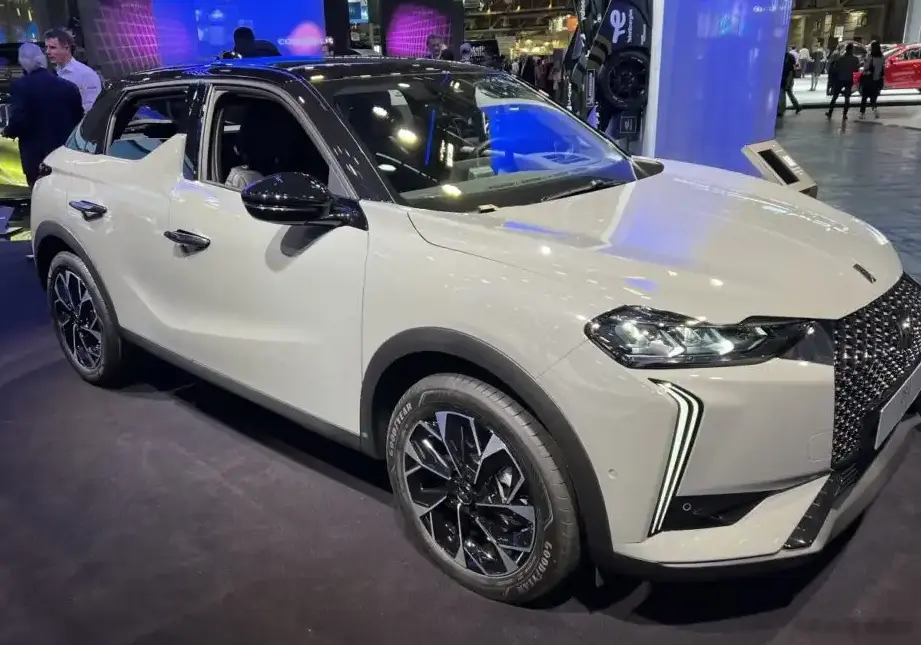
The DS 3 (facelift 2023) 1.2 (136 Hp) Hybrid e-DSC represents a compelling entry point into the DS Automobiles lineup, offering a blend of style, efficiency, and technology within the subcompact crossover segment. Introduced in April 2024 and produced through March 2025, this variant builds upon the refreshed styling and features of the third-generation DS 3, incorporating a mild-hybrid powertrain to enhance fuel economy and reduce emissions. It occupies a mid-range position within the DS 3 family, slotting between the standard gasoline-powered models and the more potent plug-in hybrid options.
| Brand | DS |
| Model | 3 |
| Generation | 3 (facelift 2023) |
| Type (Engine) | 1.2 (136 Hp) Hybrid e-DSC |
| Start of production | April, 2024 |
| End of production | March, 2025 |
| Powertrain Architecture | MHEV (Mild Hybrid Electric Vehicle) |
| Body type | Crossover |
| Seats | 5 |
| Doors | 5 |
| Fuel consumption at Low speed (WLTP) | 4.2 l/100 km (56 US mpg, 67.3 UK mpg, 23.8 km/l) |
| Fuel consumption at Medium speed (WLTP) | 4.2 l/100 km (56 US mpg, 67.3 UK mpg, 23.8 km/l) |
| Fuel consumption at high speed (WLTP) | 4.6 l/100 km (51.1 US mpg, 61.4 UK mpg, 21.7 km/l) |
| Fuel consumption at very high speed (WLTP) | 6 l/100 km (39.2 US mpg, 47.1 UK mpg, 16.7 km/l) |
| Combined fuel consumption (WLTP) | 5 l/100 km (47 US mpg, 56.5 UK mpg, 20 km/l) |
| CO2 emissions (WLTP) | 112 g/km |
| Fuel Type | Petrol (Gasoline) |
| Acceleration 0 – 100 km/h | 8.4 sec |
| Acceleration 0 – 62 mph | 8.4 sec |
| Acceleration 0 – 60 mph | 8 sec (Calculated) |
| Maximum speed | 204 km/h (126.76 mph) |
| Emission standard | Euro 6.4 |
| Weight-to-power ratio | 9.5 kg/Hp |
| Weight-to-torque ratio | 5.6 kg/Nm |
| Gross battery capacity | 0.88 kWh |
| Battery voltage | 48 V |
| Battery technology | Lithium nickel manganese cobalt oxides (Li-NMC) |
| Electric motor power | 21 Hp |
| Electric motor Torque | 51 Nm (37.62 lb.-ft.) |
| Power | 136 Hp |
| Torque | 230 Nm @ 1750 rpm (169.64 lb.-ft. @ 1750 rpm) |
| Engine displacement | 1199 cm3 (73.17 cu. in.) |
| Number of cylinders | 3 |
| Engine oil capacity | 3.5 l (3.7 US qt, 3.08 UK qt) |
| Kerb Weight | 1297 kg (2859.4 lbs.) |
| Max. weight | 1770 kg (3902.18 lbs.) |
| Max load | 473 kg (1042.79 lbs.) |
| Trunk (boot) space – minimum | 350 l (12.36 cu. ft.) |
| Trunk (boot) space – maximum | 1050 l (37.08 cu. ft.) |
| Length | 4118 mm (162.13 in.) |
| Width | 1791 mm (70.51 in.) |
| Height | 1536 mm (60.47 in.) |
| Wheelbase | 2558 mm (100.71 in.) |
| Number of gears | 6 |
| Gearbox type | Automatic transmission e-DCS |
Powertrain & Engine Architecture
At the heart of the DS 3 1.2 Hybrid e-DSC lies a 1.2-liter, three-cylinder turbocharged gasoline engine, designated as part of the PureTech engine family. This engine produces 136 horsepower and 230 Nm (169.64 lb-ft) of torque at 1750 rpm. The engine utilizes direct fuel injection and an intercooled turbocharger to optimize performance and efficiency. Crucially, this is a mild-hybrid system, meaning it incorporates a 48-volt electrical system and a small electric motor (21 hp, 51 Nm) integrated with the transmission. This electric motor provides assistance during acceleration and allows for regenerative braking, capturing energy that would otherwise be lost during deceleration. The e-DCS (efficient Dual-Clutch System) 6-speed automatic transmission is specifically tuned to work in conjunction with the mild-hybrid system, providing smooth and efficient gear changes. The system doesn’t allow for fully electric driving, but it does enable extended periods of engine-off coasting, further improving fuel economy.
Driving Characteristics
The 1.2-liter Hybrid e-DSC offers a balanced driving experience. While not as overtly sporty as some of its rivals, it provides adequate acceleration for everyday driving, achieving 0-60 mph in approximately 8 seconds. The mild-hybrid system contributes to a responsive feel, particularly during initial acceleration, filling in torque gaps from the turbocharger. The e-DCS transmission shifts smoothly and efficiently, although it can occasionally exhibit some hesitation at lower speeds. Compared to the standard gasoline versions of the DS 3, the hybrid model offers improved fuel economy, especially in urban environments. It doesn’t match the performance of the more powerful engine options, but it provides a more refined and economical driving experience. The gear ratios are optimized for fuel efficiency, prioritizing smooth cruising over outright performance.
Equipment & Trim Levels
The DS 3 1.2 Hybrid e-DSC typically comes well-equipped, reflecting DS Automobiles’ focus on premium features. Standard equipment often includes a touchscreen infotainment system with Apple CarPlay and Android Auto compatibility, automatic climate control, rear parking sensors, and a suite of advanced driver-assistance systems (ADAS) such as lane departure warning and automatic emergency braking. Interior upholstery is typically a combination of cloth and synthetic leather, with options for full leather available. Higher trim levels add features like a larger touchscreen, a premium sound system, and more extensive ADAS features. Exterior styling elements, such as unique alloy wheel designs and chrome accents, also differentiate the trim levels.
Chassis & Braking
The DS 3 utilizes a McPherson strut front suspension and a semi-independent coil spring rear suspension. This setup provides a comfortable ride quality, absorbing bumps and imperfections in the road surface effectively. The chassis is tuned to prioritize comfort and stability over outright sportiness. Braking duties are handled by ventilated discs at the front and solid discs at the rear. ABS (Anti-lock Braking System) and Electronic Stability Control (ESC) are standard features, enhancing safety and control. The steering is electrically assisted, providing a light and precise feel.
Market Reception & Comparison
The DS 3 1.2 Hybrid e-DSC was generally well-received by automotive critics, who praised its stylish design, comfortable interior, and improved fuel economy compared to the non-hybrid models. However, some reviewers noted that the mild-hybrid system doesn’t offer the same level of fuel savings as a full hybrid or plug-in hybrid. Compared to rivals like the Audi A1, Mini Cooper, and Peugeot 208, the DS 3 offers a unique blend of French flair and premium features. Its fuel economy is competitive within its class, and its reliability is generally considered to be good, although long-term data is still emerging.
Legacy
The DS 3 1.2 Hybrid e-DSC represents an important step in DS Automobiles’ transition towards electrification. While it’s a relatively short-lived variant, it demonstrates the brand’s commitment to offering more efficient and environmentally friendly vehicles. The 1.2 PureTech engine, in its various iterations, has proven to be a reliable and durable powerplant, and the e-DCS transmission has also demonstrated good long-term reliability. On the used car market, these models are likely to appeal to buyers seeking a stylish and economical subcompact crossover with a touch of French sophistication. The mild-hybrid technology, while not groundbreaking, provides a tangible benefit in terms of fuel economy and emissions reduction, making it a desirable option for environmentally conscious buyers.