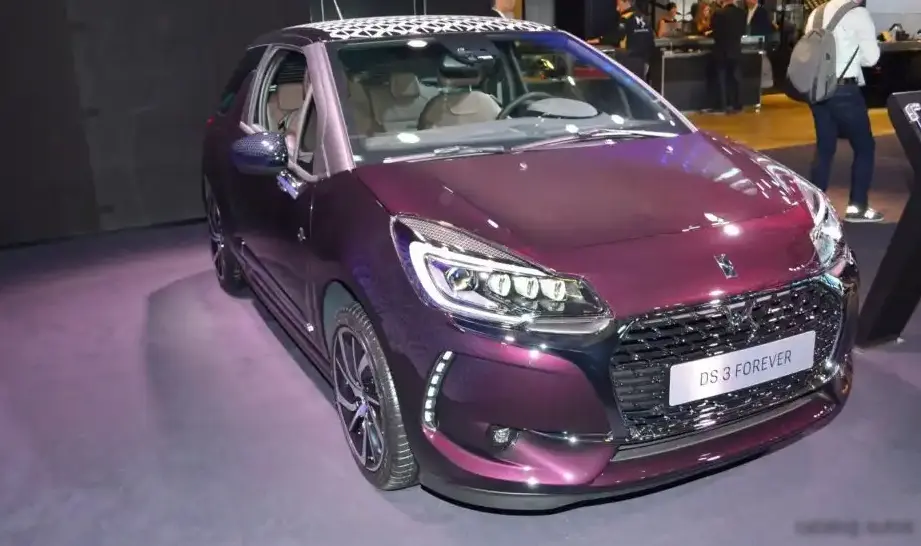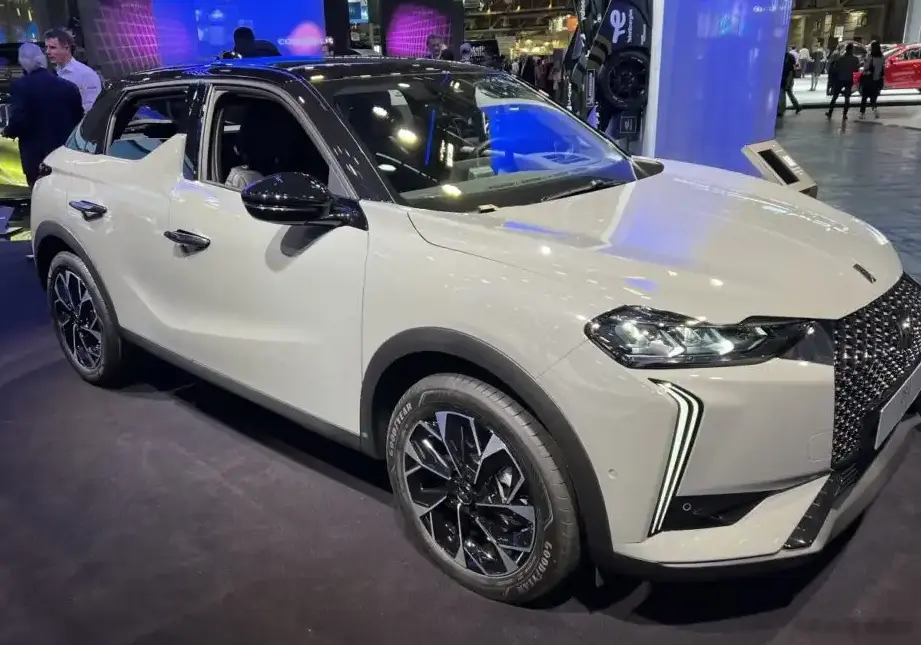
The DS 3 (facelift 2023) 1.2 PureTech 101 Hp represents an entry-level offering within the updated third-generation DS 3 range, launched in April 2023 and continuing through September 2024. Positioned as a stylish and compact crossover, this variant aimed to provide a balance of affordability and modern features within the premium subcompact segment. It builds upon the foundation of the original DS 3, which itself was a spin-off from the Citroën DS3, but with a greater emphasis on luxury and technology. The facelift brought revised styling, enhanced interior materials, and updated technology, solidifying the DS 3’s position as a more upscale alternative to mainstream competitors.
Technical Specifications
| Brand | DS |
| Model | 3 |
| Generation | 3 (facelift 2023) |
| Type (Engine) | 1.2 PureTech (101 Hp) |
| Start of production | April, 2023 |
| End of production | September, 2024 |
| Powertrain Architecture | Internal Combustion engine |
| Body type | Crossover |
| Seats | 5 |
| Doors | 5 |
| Combined fuel consumption (WLTP) | 5.7-6.2 l/100 km (41.3 – 37.9 US mpg, 49.6 – 45.6 UK mpg, 17.5 – 16.1 km/l) |
| CO2 emissions (WLTP) | 128-141 g/km |
| Fuel Type | Petrol (Gasoline) |
| Acceleration 0 – 100 km/h | 10.9 sec |
| Acceleration 0 – 62 mph | 10.9 sec |
| Acceleration 0 – 60 mph | 10.4 sec |
| Maximum speed | 180 km/h (111.85 mph) |
| Emission standard | Euro 6 |
| Weight-to-power ratio | 11.6 kg/Hp, 86.3 Hp/tonne |
| Weight-to-torque ratio | 5.7 kg/Nm, 175.2 Nm/tonne |
| Power | 101 Hp @ 5500 rpm |
| Power per litre | 84.2 Hp/l |
| Torque | 205 Nm @ 1750 rpm (151.2 lb.-ft. @ 1750 rpm) |
| Engine layout | Front, Transverse |
| Engine Model/Code | HNK EB2ADTD |
| Engine displacement | 1199 cm3 (73.17 cu. in.) |
| Number of cylinders | 3 |
| Engine configuration | Inline |
| Cylinder Bore | 75 mm (2.95 in.) |
| Piston Stroke | 90.5 mm (3.56 in.) |
| Number of valves per cylinder | 4 |
| Fuel injection system | Direct injection |
| Engine aspiration | Turbocharger, Intercooler |
| Engine oil capacity | 3.5 l (3.7 US qt | 3.08 UK qt) |
| Kerb Weight | 1170 kg (2579.41 lbs.) |
| Max. weight | 1650 kg (3637.63 lbs.) |
| Max load | 480 kg (1058.22 lbs.) |
| Trunk (boot) space – minimum | 350 l (12.36 cu. ft.) |
| Trunk (boot) space – maximum | 1050 l (37.08 cu. ft.) |
| Fuel tank capacity | 44 l (11.62 US gal | 9.68 UK gal) |
| Permitted trailer load with brakes (12%) | 1200 kg (2645.55 lbs.) |
| Permitted trailer load without brakes | 620 kg (1366.87 lbs.) |
| Permitted towbar download | 48 kg (105.82 lbs.) |
| Length | 4118 mm (162.13 in.) |
| Width | 1791 mm (70.51 in.) |
| Width with mirrors folded | 1802 mm (70.94 in.) |
| Width including mirrors | 1988 mm (78.27 in.) |
| Height | 1534 mm (60.39 in.) |
| Wheelbase | 2558 mm (100.71 in.) |
| Front track | 1548 mm (60.94 in.) |
| Rear (Back) track | 1557 mm (61.3 in.) |
| Front overhang | 860 mm (33.86 in.) |
| Rear overhang | 700 mm (27.56 in.) |
| Ride height (ground clearance) | 170 mm (6.69 in.) |
| Minimum turning circle (turning diameter) | 10.7 m (35.1 ft.) |
| Drivetrain Architecture | The Internal combustion engine (ICE) drives the front wheels of the vehicle. |
| Drive wheel | Front wheel drive |
| Number of gears and type of gearbox | 6 gears, manual transmission |
| Front suspension | Independent type McPherson |
| Rear suspension | Independent multi-link suspension |
| Front brakes | Ventilated discs |
| Rear brakes | Disc |
| Assisting systems | ABS (Anti-lock braking system) |
| Steering type | Steering rack and pinion |
| Power steering | Electric Steering |
| Tires size | 215/60 R17 |
| Wheel rims size | 6.5J x 17 |
INTRODUCTION
The DS 3 1.2 PureTech 101 Hp, introduced with the 2023 facelift, is a front-wheel-drive, five-door crossover positioned as the entry point to the DS 3 range. It’s built on the Common Modular Platform (CMP) shared with other Stellantis brands like Peugeot and Opel/Vauxhall. This generation of DS 3 aimed to elevate the brand’s image with a more sophisticated design and a focus on interior quality. The 1.2 PureTech 101 Hp variant specifically targeted buyers seeking a stylish and economical urban vehicle, offering a balance between fuel efficiency and acceptable performance. Production ran from April 2023 to September 2024, representing a relatively short production run for this specific configuration.
Powertrain & Engine Architecture
At the heart of the DS 3 1.2 PureTech 101 Hp lies the HNK EB2ADTD engine, a 1.2-liter, three-cylinder turbocharged gasoline engine. This engine is part of the PureTech family developed by the PSA Group (now Stellantis). It utilizes direct fuel injection, optimizing combustion efficiency and contributing to lower emissions. The engine features a single scroll turbocharger and an intercooler to enhance power output. The 101 horsepower is achieved at 5500 rpm, while peak torque of 205 Nm (151.2 lb.-ft.) is delivered at 1750 rpm. This engine is paired with a 6-speed manual transmission, providing a relatively conventional driving experience. The engine’s architecture prioritizes compactness and lightweight construction, contributing to the vehicle’s overall efficiency. It also incorporates Start & Stop technology and a particulate filter to meet Euro 6 emission standards.
Driving Characteristics
The DS 3 1.2 PureTech 101 Hp offers a comfortable, if not particularly exhilarating, driving experience. Acceleration from 0-100 km/h (0-62 mph) takes approximately 10.9 seconds. The engine provides adequate power for everyday driving situations, particularly in urban environments. The turbocharger helps to mitigate the effects of the small displacement, providing a reasonable amount of low-end torque. However, when fully loaded or tackling steep inclines, the engine can feel strained. The 6-speed manual transmission is well-matched to the engine’s characteristics, offering precise shifts and allowing drivers to maintain optimal engine speed. Compared to higher-output versions of the DS 3, such as those with more powerful gasoline engines or diesel options, this variant prioritizes fuel economy over outright performance. The steering is light and responsive, making it easy to maneuver in tight spaces.
Equipment & Trim Levels
The DS 3 1.2 PureTech 101 Hp typically came equipped with a respectable level of standard features. These generally included air conditioning, a touchscreen infotainment system with Apple CarPlay and Android Auto compatibility, LED headlights, and a suite of safety features such as lane departure warning and automatic emergency braking. Interior upholstery was typically cloth, with options for upgraded materials available. Trim levels varied by market, but generally offered progressive enhancements in features such as parking sensors, a reversing camera, and more advanced infotainment systems. Optional extras included a panoramic sunroof, premium audio systems, and various styling packages. The interior design emphasized a modern and sophisticated aesthetic, with attention paid to material quality and detailing.
Chassis & Braking
The DS 3 1.2 PureTech 101 Hp utilizes an independent McPherson strut suspension at the front and an independent multi-link suspension at the rear. This setup provides a good balance between ride comfort and handling. The suspension is tuned to prioritize comfort, absorbing bumps and imperfections in the road surface effectively. The vehicle is equipped with ventilated disc brakes at the front and solid disc brakes at the rear, providing adequate stopping power for its weight class. Anti-lock Braking System (ABS) is standard, enhancing safety during emergency braking situations. The electric power steering provides a light and precise steering feel.
Market Reception & Comparison
The DS 3 1.2 PureTech 101 Hp was generally well-received by critics as a stylish and economical option within the subcompact crossover segment. However, some reviewers noted that the engine could feel underpowered in certain situations. Fuel economy was a strong point, with combined fuel consumption figures ranging from 5.7 to 6.2 l/100 km. Compared to other trims in the DS 3 lineup, such as the more powerful gasoline or diesel variants, this version offered a lower price point but sacrificed some performance. It competed with vehicles like the Audi A1, Mini Cooper, and Volkswagen Polo, offering a more premium alternative to mainstream competitors.
Legacy
The DS 3 1.2 PureTech 101 Hp, while having a relatively short production run, represents an important step in the DS brand’s evolution. The 1.2 PureTech engine, despite some early reliability concerns regarding the timing chain (which were addressed in later iterations), proved to be a popular and efficient powerplant across the Stellantis range. On the used car market, these models offer a compelling combination of style, fuel economy, and affordability. However, potential buyers should be aware of the potential for timing chain issues and ensure that the vehicle has been properly maintained. The DS 3’s distinctive design and focus on interior quality have helped to establish the brand as a credible alternative in the premium subcompact segment.