Technical Specifications
| Brand | Chevrolet |
| Model | Malibu |
| Generation | Malibu IV Sedan |
| Type (Engine) | 3.3 V6 (95 Hp) CAT |
| Start of production | 1977 |
| End of production | 1978 |
| Powertrain Architecture | Internal Combustion engine |
| Body type | Sedan |
| Seats | 6 |
| Doors | 4 |
| Fuel Type | Petrol (Gasoline) |
| Weight-to-power ratio | 14.8 kg/Hp, 67.4 Hp/tonne |
| Weight-to-torque ratio | 6.5 kg/Nm, 153.9 Nm/tonne |
| Power | 95 Hp @ 3800 rpm |
| Power per litre | 28.9 Hp/l |
| Torque | 217 Nm @ 2000 rpm, 160.05 lb.-ft. @ 2000 rpm |
| Engine layout | Front, Longitudinal |
| Engine displacement | 3292 cm3, 200.89 cu. in. |
| Number of cylinders | 6 |
| Engine configuration | V-engine |
| Cylinder Bore | 88.9 mm, 3.5 in. |
| Piston Stroke | 88.4 mm, 3.48 in. |
| Compression ratio | 8.2:1 |
| Number of valves per cylinder | 2 |
| Fuel injection system | Carburettor |
| Engine aspiration | Naturally aspirated engine |
| Valvetrain | OHV |
| Engine oil capacity | 4 l, 4.23 US qt | 3.52 UK qt |
| Kerb Weight | 1410 kg, 3108.52 lbs |
| Trunk (boot) space – maximum | 470 l, 16.6 cu. ft |
| Fuel tank capacity | 68 l, 17.96 US gal | 14.96 UK gal |
| Length | 4895 mm, 192.72 in |
| Width | 1816 mm, 71.5 in |
| Height | 1376 mm, 54.17 in |
| Wheelbase | 2745 mm, 108.07 in |
| Front track | 1486 mm, 58.5 in |
| Rear (Back) track | 1467 mm, 57.76 in |
| Front overhang | 915 mm, 36.02 in |
| Rear overhang | 1235 mm, 48.62 in |
| Ride height (ground clearance) | 137 mm, 5.39 in |
| Drag coefficient (Cd) | 0.45 |
| Minimum turning circle (turning diameter) | 12.2 m, 40.03 ft |
| Approach angle | 20° |
| Departure angle | 15° |
| Ramp-over (brakeover) angle | 14° |
| Drivetrain Architecture | The Internal combustion engine (ICE) drives the rear wheels of the vehicle. |
| Drive wheel | Rear wheel drive |
| Number of gears and type of gearbox | 3 gears, manual transmission |
| Front suspension | Independent, type McPherson with coil spring and anti-roll bar |
| Rear suspension | dependent spring suspension, Transverse stabilizer, Trailing arm |
| Front brakes | Ventilated discs |
| Rear brakes | Drum |
| Steering type | Steering rack and pinion |
| Tires size | 195/75 R14; 205/75 R14 |
| Wheel rims size | 6.0J x 14 |
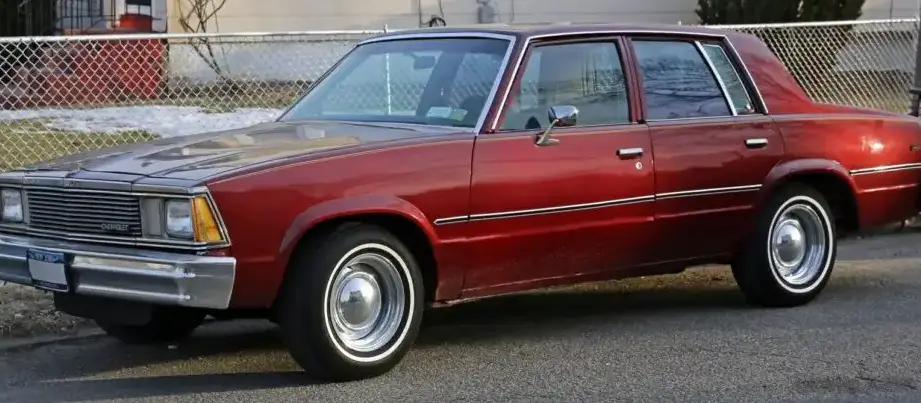
The Chevrolet Malibu IV Sedan, produced for the 1977 and 1978 model years, marked a significant downsizing for Chevrolet’s mid-size offering. Responding to changing market demands and the energy crisis of the 1970s, Chevrolet moved away from the larger, heavier models of the early part of the decade. The fourth-generation Malibu was built on the A-body platform, prioritizing improved fuel efficiency and maneuverability. The 3.3-liter V6 engine, producing 95 horsepower and paired with a 3-speed manual transmission, served as the base engine option. This configuration was positioned as the entry-level choice within the Malibu IV lineup, appealing to buyers seeking affordability and basic transportation, sitting below the more powerful V8 variants.
Powertrain & Engine Architecture
The 3.3-liter V6 engine, a Chevrolet design, was a relatively straightforward powerplant. It featured an overhead valve (OHV) valvetrain and utilized a two-barrel carburetor for fuel delivery. While not known for its high performance, the engine was appreciated for its durability and relative ease of maintenance. The 95 horsepower output, achieved at 3800 rpm, and 217 Nm (160 lb-ft) of torque at 2000 rpm were considered adequate for the Malibu’s reduced weight. The engine was mounted longitudinally in the front of the vehicle, sending power to the rear wheels. The standard 3-speed manual transmission provided basic gear selection for everyday driving. Notably, it featured a non-synchronized first gear, a common characteristic of transmissions from that era. This design choice aimed to reduce manufacturing costs and complexity.
Driving Characteristics
The combination of the 3.3L V6 engine and the 3-speed manual transmission resulted in a driving experience geared towards practicality rather than performance. Acceleration was sufficient for merging onto highways and passing slower vehicles, but the Malibu wasn’t a particularly quick car. The gear ratios were optimized for fuel economy and low-end torque, making it reasonably drivable in urban environments. Compared to the V8-powered Malibu models, this variant felt noticeably less powerful, with a corresponding difference in responsiveness. The manual transmission offered drivers more control over gear selection than the optional automatic, but the absence of an overdrive gear meant higher engine speeds at cruising velocities, potentially impacting fuel economy on long trips.
Equipment & Trim Levels
The base Malibu equipped with the 3.3L V6 and manual transmission was rather sparsely equipped. Standard features typically included basic cloth upholstery, a simple dashboard layout with analog gauges, and manual windows and locks. Optional extras, such as air conditioning, power steering, and an upgraded sound system, were available to those willing to spend more. The interior trim was durable but lacked the refinement found in higher-end Malibu models. The overall focus was on providing a functional and affordable vehicle, prioritizing essential features over luxury amenities.
Chassis & Braking
The Malibu IV featured an independent McPherson strut front suspension with coil springs and an anti-roll bar, contributing to a reasonable level of ride comfort and handling. The rear suspension utilized a traditional leaf spring setup with trailing arms and a transverse stabilizer. Braking was provided by ventilated discs at the front and drum brakes at the rear. While adequate for the car’s weight and performance, the braking system lacked the stopping power of more modern systems. Common tire sizes included 195/75 R14 and 205/75 R14, offering a balance between ride comfort and handling.
Market Reception & Comparison
The 3.3L V6/manual transmission Malibu was generally perceived as a sensible and economical choice. Automotive critics acknowledged its improved fuel efficiency compared to the larger, V8-powered models, but also noted its lack of outright performance. It was frequently compared to other downsized mid-size cars of the era, such as the Ford Granada and the Dodge Dart. The Malibu offered a competitive price point and a reputation for reliability, making it an attractive option for budget-conscious buyers. Fuel economy was a significant selling point, particularly during the late 1970s energy crisis, when gasoline prices were rising rapidly.
Legacy
The 3.3L V6 engine, while not a particularly innovative design, proved to be a durable and reliable powerplant. Malibu IVs equipped with this engine can still be found on the used car market today, often valued for their simplicity and affordability. Maintenance is relatively straightforward, and parts availability remains reasonably good. However, potential buyers should be aware of common age-related issues, such as rust and worn suspension components. The 1977-1978 Malibu IV, and especially the base 3.3L V6 model, represents a pivotal moment in American automotive history, signifying a shift towards smaller, more fuel-efficient vehicles in response to changing economic and environmental conditions.