
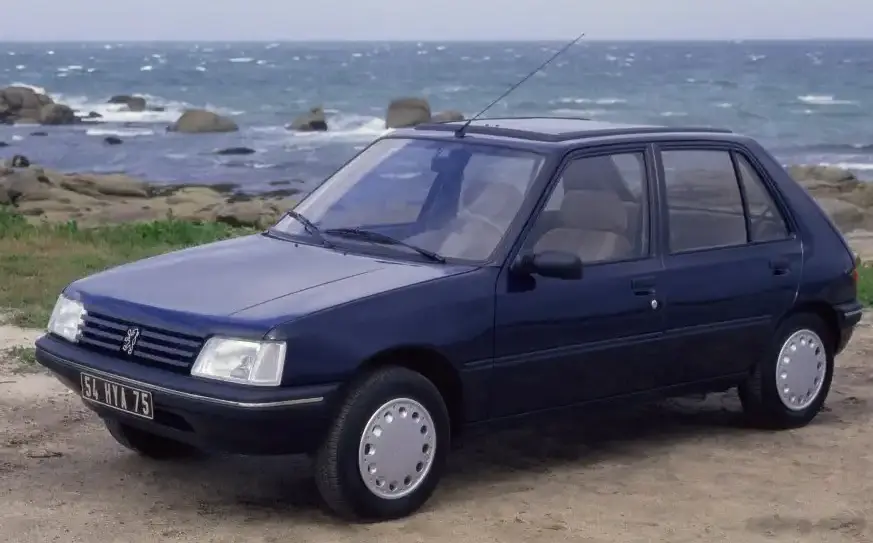
Technical Specifications
| Brand | Peugeot |
| Model | 205 |
| Generation | 205 I (20A/C, facelift 1987) |
| Type (Engine) | 1.0 i (50 Hp) |
| Start of production | 1992 |
| End of production | 1992 |
| Powertrain Architecture | Internal Combustion engine |
| Body type | Hatchback |
| Seats | 5 |
| Doors | 3-5 |
| Fuel consumption (urban) | 7 l/100 km (33.6 US mpg, 40.4 UK mpg, 14.3 km/l) |
| Fuel consumption (extra urban) | 4.8 l/100 km (49 US mpg, 58.9 UK mpg, 20.8 km/l) |
| Fuel consumption (combined) | 6.7 l/100 km (35.1 US mpg, 42.2 UK mpg, 14.9 km/l) |
| Fuel Type | Petrol (Gasoline) |
| Acceleration 0 – 100 km/h | 17.9 sec |
| Acceleration 0 – 62 mph | 17.9 sec |
| Acceleration 0 – 60 mph | 17 sec |
| Maximum speed | 148 km/h (91.96 mph) |
| Weight-to-power ratio | 15.2 kg/Hp, 65.8 Hp/tonne |
| Weight-to-torque ratio | 10.3 kg/Nm, 97.4 Nm/tonne |
| Power | 50 Hp @ 6000 rpm |
| Power per litre | 52.4 Hp/l |
| Torque | 74 Nm @ 3700 rpm (54.58 lb.-ft. @ 3700 rpm) |
| Engine layout | Front, Transverse |
| Engine Model/Code | CDZ TU9M |
| Engine displacement | 954 cm3 (58.22 cu. in.) |
| Number of cylinders | 4 |
| Engine configuration | Inline |
| Cylinder Bore | 70 mm (2.76 in.) |
| Piston Stroke | 62 mm (2.44 in.) |
| Compression ratio | 9.4:1 |
| Number of valves per cylinder | 2 |
| Fuel injection system | Single-point injection |
| Engine aspiration | Naturally aspirated |
| Engine oil capacity | 3.2 l (3.38 US qt | 2.82 UK qt) |
| Coolant capacity | 5.8 l (6.13 US qt | 5.1 UK qt) |
| Kerb Weight | 760 kg (1675.51 lbs.) |
| Max. weight | 1140 kg (2513.27 lbs.) |
| Max load | 380 kg (837.76 lbs.) |
| Trunk (boot) space – minimum | 298 l (10.52 cu. ft.) |
| Trunk (boot) space – maximum | 585 l (20.66 cu. ft.) |
| Fuel tank capacity | 50 l (13.21 US gal | 11 UK gal) |
| Length | 3705 mm (145.87 in.) |
| Width | 1560 mm (61.42 in.) |
| Height | 1375 mm (54.13 in.) |
| Wheelbase | 2420 mm (95.28 in.) |
| Front track | 1350 mm (53.15 in.) |
| Rear track | 1300 mm (51.18 in.) |
| Drivetrain Architecture | Front wheel drive |
| Number of gears | 5 |
| Gearbox type | Manual transmission |
| Front suspension | Coil spring |
| Rear suspension | Torsion |
| Front brakes | Disc |
| Rear brakes | Drum |
| Assisting systems | ABS (Anti-lock braking system) |
| Steering type | Steering rack and pinion |
| Power steering | Hydraulic |
| Tires size | 155/70 R14 |
The Peugeot 205 1.0 i, produced for a limited time in 1992, was a derivative of the highly successful 205 series, which debuted in 1983. The 205, built on the 20A/C platform, quickly became a popular choice in Europe, known for its nimble handling and stylish design. The 1.0 i variant was introduced as a cost-effective option, appealing to buyers prioritizing fuel efficiency and affordability over outright performance. It represented the base level of the 205 range, offering a practical and reliable mode of transportation.
Powertrain & Engine Architecture
At the heart of the 205 1.0 i lies the CDZ engine, a 954cc inline-four cylinder unit belonging to Peugeot’s TU9M family. This engine featured a single-point fuel injection system, a relatively simple setup for the time, contributing to its affordability and ease of maintenance. The engine produced 50 horsepower at 6000 rpm and 74 Nm (54.58 lb-ft) of torque at 3700 rpm. The engine’s valvetrain consisted of two valves per cylinder. The 205 1.0 i was exclusively offered with a five-speed manual transmission, designed to maximize fuel economy and provide adequate acceleration for everyday driving. The transmission’s gear ratios were optimized for low-speed torque and efficient cruising.
Driving Characteristics
The driving experience in the 205 1.0 i was characterized by its light and nimble handling. However, with only 50 horsepower on tap, acceleration was decidedly modest. The 0-60 mph sprint took approximately 17 seconds, and the top speed was around 92 mph. Compared to the more powerful 205 variants, such as the 1.6 or GTI models, the 1.0 i felt significantly slower. The five-speed manual transmission allowed drivers to keep the engine in its optimal power band, but overtaking maneuvers required careful planning. Despite its lack of outright speed, the 205 1.0 i offered a comfortable and predictable driving experience, making it well-suited for urban commuting and shorter journeys.
Equipment & Trim Levels
The 205 1.0 i was typically equipped with basic features, reflecting its position as the entry-level model. Standard equipment generally included cloth upholstery, a basic dashboard layout, and manual windows and door locks. Options were limited but could include features like a radio, upgraded interior trim, and occasionally, power steering. The interior was functional and durable, prioritizing practicality over luxury. The exterior styling was consistent with other 205 models, featuring a distinctive hatchback silhouette and Peugeot’s signature styling cues.
Chassis & Braking
The 205 1.0 i utilized a simple yet effective chassis design. The front suspension consisted of coil springs, while the rear suspension employed a torsion beam setup. This configuration provided a comfortable ride and predictable handling characteristics. The braking system featured disc brakes on the front wheels and drum brakes on the rear. While adequate for the car’s performance capabilities, the braking system lacked the stopping power of the more advanced setups found on higher-spec 205 models. The 205 1.0 i was equipped with a hydraulic steering system, providing reasonable steering feel and maneuverability.
Market Reception & Comparison
The Peugeot 205 1.0 i was generally well-received as an affordable and economical option within the 205 range. Critics acknowledged its practicality and fuel efficiency but noted its lack of performance compared to other variants. Compared to the 1.6-liter models, the 1.0 i offered significantly lower running costs but at the expense of acceleration and overall driving enjoyment. The 1.0 i appealed to a different demographic – those prioritizing affordability and fuel economy over sporty driving dynamics. Its fuel consumption figures of around 35 mpg combined were a significant selling point.
Legacy
The Peugeot 205 1.0 i, while not as celebrated as its GTI counterpart, holds a place in automotive history as a practical and reliable small car. The TU9M engine, while simple in design, proved to be durable and relatively easy to maintain. Today, the 205 1.0 i is a relatively rare sight on the roads, but those that remain are often cherished by enthusiasts for their simplicity and affordability. The 205’s legacy as a fun-to-drive and iconic hatchback continues to endure, and the 1.0 i represents a unique and accessible entry point into the 205 ownership experience. Its simplicity makes it a popular choice for restoration projects and classic car enthusiasts seeking a straightforward and affordable classic.
