Technical Specifications
| Brand | Chevrolet |
| Model | Malibu |
| Generation | Malibu IV Sedan |
| Type (Engine) | 3.3 V6 (95 Hp) CAT Automatic |
| Start of production | 1977 |
| End of production | 1978 |
| Powertrain Architecture | Internal Combustion engine |
| Body type | Sedan |
| Seats | 6 |
| Doors | 4 |
| Fuel Type | Petrol (Gasoline) |
| Weight-to-power ratio | 15 kg/Hp, 66.8 Hp/tonne |
| Weight-to-torque ratio | 6.6 kg/Nm, 152.6 Nm/tonne |
| Power | 95 Hp @ 3800 rpm |
| Power per litre | 28.9 Hp/l |
| Torque | 217 Nm @ 2000 rpm, 160.05 lb.-ft. @ 2000 rpm |
| Engine layout | Front, Longitudinal |
| Engine displacement | 3292 cm3, 200.89 cu. in. |
| Number of cylinders | 6 |
| Engine configuration | V-engine |
| Cylinder Bore | 88.9 mm, 3.5 in. |
| Piston Stroke | 88.4 mm, 3.48 in. |
| Compression ratio | 8.2:1 |
| Number of valves per cylinder | 2 |
| Fuel injection system | Carburettor |
| Engine aspiration | Naturally aspirated engine |
| Valvetrain | OHV |
| Engine oil capacity | 4 l, 4.23 US qt | 3.52 UK qt |
| Kerb Weight | 1422 kg, 3134.97 lbs |
| Trunk (boot) space – maximum | 470 l, 16.6 cu. ft |
| Fuel tank capacity | 68 l, 17.96 US gal | 14.96 UK gal |
| Length | 4895 mm, 192.72 in |
| Width | 1816 mm, 71.5 in |
| Height | 1376 mm, 54.17 in |
| Wheelbase | 2745 mm, 108.07 in |
| Front track | 1486 mm, 58.5 in |
| Rear (Back) track | 1467 mm, 57.76 in |
| Front overhang | 915 mm, 36.02 in |
| Rear overhang | 1235 mm, 48.62 in |
| Ride height (ground clearance) | 137 mm, 5.39 in |
| Drag coefficient (Cd) | 0.45 |
| Minimum turning circle (turning diameter) | 12.2 m, 40.03 ft |
| Approach angle | 20° |
| Departure angle | 15° |
| Ramp-over (brakeover) angle | 14° |
| Drivetrain Architecture | The Internal combustion engine (ICE) drives the rear wheels of the vehicle. |
| Drive wheel | Rear wheel drive |
| Number of gears and type of gearbox | 3 gears, automatic transmission |
| Front suspension | Independent, type McPherson with coil spring and anti-roll bar |
| Rear suspension | dependent spring suspension, Transverse stabilizer, Trailing arm |
| Front brakes | Ventilated discs |
| Rear brakes | Drum |
| Steering type | Steering rack and pinion |
| Tires size | 195/75 R14; 205/75 R14 |
| Wheel rims size | 6.0J x 14 |
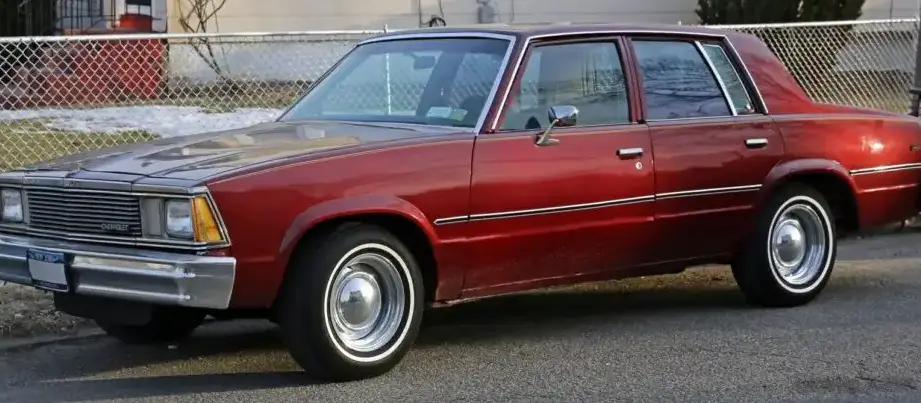
The 1977 and 1978 Chevrolet Malibu IV Sedan marked a significant departure for the Malibu nameplate. After the larger, more muscle-car oriented models of the early 1970s, Chevrolet downsized the Malibu, moving it to the A-body platform. This change was driven by the oil crises of the decade and a growing consumer demand for more fuel-efficient vehicles. The 3.3-liter V6 engine paired with an automatic transmission represented the base engine offering for this generation, aimed at buyers seeking affordability, practicality, and ease of driving. It was a transitional vehicle, bridging the gap between the performance-focused cars of the past and the more sensible, fuel-conscious designs of the future.
Powertrain & Engine Architecture
The core of this Malibu variant was the 3.3-liter (200.89 cubic inch) Chevrolet V6 engine. While various internal codes existed depending on specific emissions control equipment, the engine was fundamentally a simple overhead valve (OHV) design. Fuel delivery was managed by a two-barrel carburetor, a common technology for the era. The engine featured a compression ratio of 8.2:1, balancing performance and fuel economy. A crucial element of this engine was the catalytic converter, indicated by the “CAT” designation, which was essential for meeting the increasingly strict emissions regulations of the time. The three-speed automatic transmission was a standard General Motors (GM) unit, prioritizing smooth operation and ease of use over sporty responsiveness. This transmission choice catered to a wider audience, particularly those who preferred the convenience of automatic gear changes.
Driving Characteristics
The 3.3L V6 automatic Malibu, producing 95 horsepower, wasn’t designed for exhilarating performance. Acceleration was moderate, and overtaking required careful consideration. The automatic transmission, while comfortable, contributed to a somewhat sluggish driving feel. The gear ratios were optimized for fuel efficiency and relaxed highway cruising rather than rapid acceleration. In comparison to the available V8 engine options, or even the later 2.5-liter inline-four, this variant offered a significantly more subdued driving experience. It was best suited for urban commuting and highway travel where outright speed wasn’t a primary concern. The rear-wheel-drive layout provided predictable handling characteristics, but the relatively soft suspension tuning prioritized ride comfort over precise cornering ability.
Equipment & Trim Levels
The base 3.3L automatic Malibu typically came equipped with a fairly standard set of features. Cloth upholstery, a basic AM radio, and manual windows and locks were common. Air conditioning was frequently an optional upgrade, as were power steering and power brakes. The interior trim was generally functional and durable, emphasizing practicality over luxury. The dashboard layout was straightforward and easy to understand, with clearly labeled gauges and controls. Buyers could choose to add options such as a more powerful radio, upgraded interior materials, and various convenience packages to personalize their vehicle.
Chassis & Braking
The Malibu IV Sedan employed a body-on-frame construction, a common practice for American automobiles of that period. The front suspension was independent, utilizing a McPherson strut design with coil springs and an anti-roll bar. The rear suspension was a more conventional dependent spring setup with trailing arms and a transverse stabilizer. Braking was provided by ventilated discs at the front and drum brakes at the rear. While adequate for the car’s weight and performance capabilities, the braking system wasn’t particularly powerful by contemporary standards. The standard tire size was either 195/75 R14 or 205/75 R14, chosen to strike a balance between ride comfort and durability.
Market Reception & Comparison
The 3.3L V6 automatic Malibu was generally perceived as a sensible and affordable transportation option. Automotive critics acknowledged its improved fuel economy compared to larger, V8-powered vehicles, but also noted its lack of dynamic performance. It was often considered a suitable choice for families or individuals who prioritized practicality and reliability over driving excitement. Compared to the higher-output V8 models, the 3.3L offered significantly lower operating costs but at the expense of acceleration and towing capacity. The 3.3L engine also demonstrated greater reliability than some of the more complex V8 engines, requiring less frequent maintenance.
Legacy
The 1977-1978 Chevrolet Malibu IV Sedan with the 3.3L V6 automatic transmission, while not a particularly iconic or memorable vehicle in terms of performance or styling, played a role in the broader shift towards more fuel-efficient American automobiles. The powertrain, while relatively simple in design, proved to be reasonably durable and reliable. Today, these cars are relatively scarce and are often sought after by collectors and enthusiasts interested in classic American cars. Obtaining replacement parts can be challenging, but the fundamental mechanical components are generally straightforward to repair. The 3.3L V6 automatic Malibu represents a specific moment in automotive history, a time when manufacturers were adapting to new emissions regulations and evolving consumer preferences.