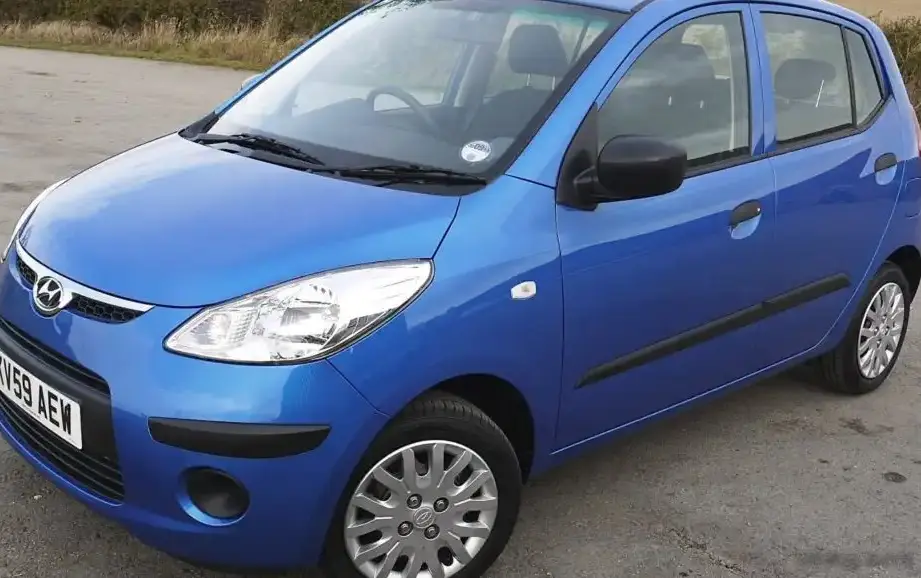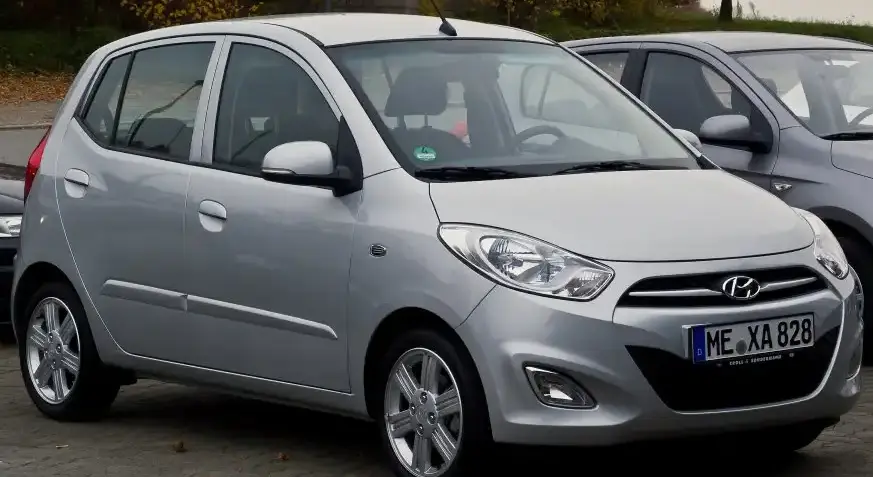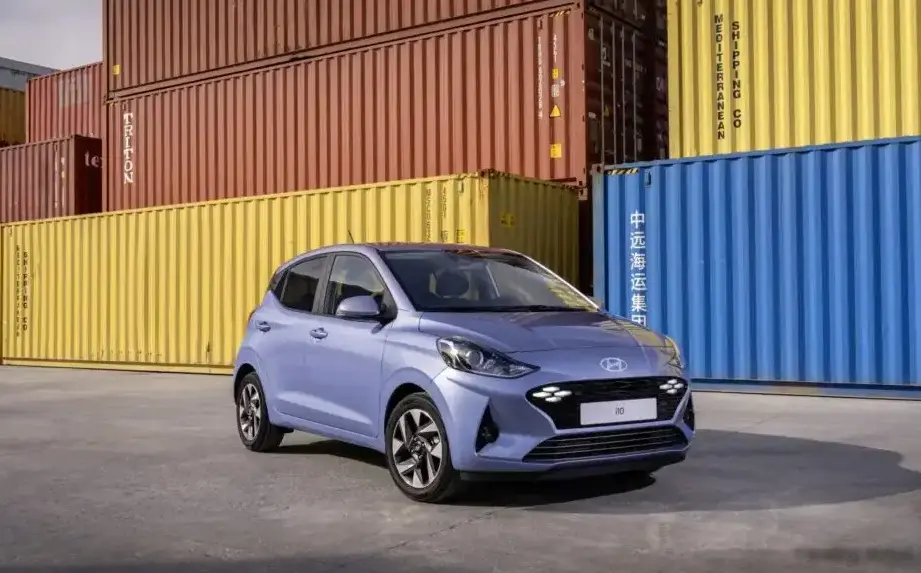
The Hyundai i10 III, specifically the facelifted version introduced in May 2024, represents the third generation of Hyundai’s city car. The 1.0-liter (63 horsepower) variant occupies the entry-level position in the i10 lineup, aimed at buyers prioritizing affordability and fuel efficiency. This model is primarily marketed in Europe and other regions where small, economical hatchbacks are highly popular. The facelift brought subtle styling updates and enhanced standard equipment, building upon the already successful foundation of the i10 III, which is built on the HA3 platform.
Technical Specifications
| Brand | Hyundai |
| Model | i10 |
| Generation | i10 III (facelift 2023) |
| Type (Engine) | 1.0 (63 Hp) |
| Start of production | May, 2024 |
| Powertrain Architecture | Internal Combustion engine |
| Body type | Hatchback |
| Seats | 5 |
| Doors | 5 |
| Combined fuel consumption (WLTP) | 4.9-5.1 l/100 km (48 – 46.1 US mpg, 57.6 – 55.4 UK mpg, 20.4 – 19.6 km/l) |
| CO2 emissions (WLTP) | 110-116 g/km |
| Fuel Type | Petrol (Gasoline) |
| Acceleration 0 – 100 km/h | 15.6 sec |
| Acceleration 0 – 62 mph | 15.6 sec |
| Acceleration 0 – 60 mph | 14.8 sec |
| Maximum speed | 143 km/h (88.86 mph) |
| Emission standard | Euro 6e |
| Weight-to-power ratio | 14.6 kg/Hp, 68.4 Hp/tonne |
| Weight-to-torque ratio | 9.9 kg/Nm, 101 Nm/tonne |
| Power | 63 Hp @ 5500 rpm |
| Power per litre | 63.1 Hp/l |
| Torque | 93 Nm @ 3750 rpm (68.59 lb.-ft. @ 3750 rpm) |
| Engine layout | Front, Transverse |
| Engine Model/Code | G3LD |
| Engine displacement | 998 cm3 (60.9 cu. in.) |
| Number of cylinders | 3 |
| Engine configuration | Inline |
| Cylinder Bore | 71 mm (2.8 in.) |
| Piston Stroke | 84 mm (3.31 in.) |
| Number of valves per cylinder | 4 |
| Fuel injection system | Multi-port manifold injection |
| Engine aspiration | Naturally aspirated engine |
| Engine oil capacity | 3.1 l (3.28 US qt | 2.73 UK qt) |
| Coolant | 4.5 l (4.76 US qt | 3.96 UK qt) |
| Kerb Weight | 921-993 kg (2030.46 – 2189.19 lbs.) |
| Max. weight | 1340 kg (2954.19 lbs.) |
| Max load | 347-419 kg (765 – 923.74 lbs.) |
| Trunk (boot) space – minimum | 252 l (8.9 cu. ft.) |
| Trunk (boot) space – maximum | 1050 l (37.08 cu. ft.) |
| Fuel tank capacity | 36 l (9.51 US gal | 7.92 UK gal) |
| Max. roof load | 60 kg (132.28 lbs.) |
| Permitted trailer load with brakes (12%) | 310 kg (683.43 lbs.) |
| Permitted trailer load without brakes | 310 kg (683.43 lbs.) |
| Permitted towbar download | 75 kg (165.35 lbs.) |
| Length | 3670 mm (144.49 in.) |
| Width | 1680 mm (66.14 in.) |
| Height | 1480 mm (58.27 in.) |
| Wheelbase | 2425 mm (95.47 in.) |
| Front track | 1467-1479 mm (57.76 – 58.23 in.) |
| Rear (Back) track | 1478-1490 mm (58.19 – 58.66 in.) |
| Front overhang | 540 mm (21.26 in.) |
| Rear overhang | 705 mm (27.76 in.) |
| Ride height (ground clearance) | 149 mm (5.87 in.) |
| Drivetrain Architecture | The Internal combustion engine (ICE) drives the front wheels of the vehicle. |
| Drive wheel | Front wheel drive |
| Number of gears and type of gearbox | 5 gears, manual transmission |
| Front suspension | Independent type McPherson |
| Rear suspension | Torsion |
| Front brakes | Ventilated discs |
| Rear brakes | Disc |
| Assisting systems | ABS (Anti-lock braking system) |
| Steering type | Steering rack and pinion |
| Power steering | Electric Steering |
| Tires size | 175/65 R14; 185/55 R15; 195/45 R16 |
| Wheel rims size | 5.5J x 14; 6.0J x 15; 6.5J x 16 |
Powertrain & Engine Architecture
The heart of this i10 variant is the Hyundai G3LD, a 998cc inline-three cylinder petrol engine. This engine utilizes a multi-point fuel injection system and a naturally aspirated design, prioritizing simplicity and fuel economy over outright performance. The G3LD engine produces 63 horsepower at 5,500 rpm and 93 Nm (68.59 lb-ft) of torque at 3,750 rpm. The engine features four valves per cylinder and a relatively high compression ratio, contributing to its efficiency. The engine is paired with a five-speed manual transmission, which is the standard offering for this trim level. The transmission is chosen for its cost-effectiveness and reliability, rather than sporty performance.
Driving Characteristics
The 1.0-liter i10 is not designed for rapid acceleration. Its 0-100 km/h (0-62 mph) time of 15.6 seconds reflects its focus on urban driving. The power delivery is linear, but requires the driver to utilize the full rev range to extract the most performance. The five-speed manual transmission is well-matched to the engine’s characteristics, allowing for reasonable progress in city traffic. Compared to higher-spec i10 models with larger engines, this variant feels noticeably slower, particularly when fully loaded or tackling inclines. However, its light weight and nimble handling make it easy to maneuver in tight spaces.
Equipment & Trim Levels
The 1.0-liter i10 typically serves as the base model, offering a practical and affordable entry point into the i10 range. Standard equipment generally includes air conditioning, central locking, electric front windows, and a basic audio system. Safety features such as ABS, airbags, and stability control are also standard. Higher trim levels add features like alloy wheels, a touchscreen infotainment system, rear parking sensors, and heated seats. The interior upholstery is typically cloth, with a functional and durable design. The facelifted model saw improvements in interior materials and design, offering a more refined feel compared to earlier iterations.
Chassis & Braking
The i10 III utilizes a McPherson strut front suspension and a torsion beam rear suspension. This setup provides a comfortable ride quality, well-suited for city streets. The front brakes are ventilated discs, while the rear brakes are discs, providing adequate stopping power for the vehicle’s weight and performance. The steering is electrically assisted, offering light and precise control. The i10’s relatively small size and tight turning circle make it exceptionally easy to park and maneuver in urban environments.
Market Reception & Comparison
The 1.0-liter i10 has been well-received as an affordable and economical city car. Critics have praised its fuel efficiency, ease of driving, and practicality. However, its limited power and basic interior have been noted as drawbacks. Compared to other city cars in its class, such as the Kia Picanto and Volkswagen up!, the i10 offers a competitive combination of price, features, and warranty. The 1.0-liter engine prioritizes fuel economy, achieving between 4.9 and 5.1 liters per 100 kilometers (48-46.1 US mpg), making it an attractive option for budget-conscious buyers.
Legacy
The Hyundai i10 III 1.0-liter is expected to be a reliable and durable vehicle, benefiting from Hyundai’s reputation for build quality. The G3LD engine is known for its simplicity and longevity, and the five-speed manual transmission is also generally reliable. As a used car, this variant is likely to hold its value reasonably well, particularly among buyers seeking an affordable and economical city car. Its low running costs and ease of maintenance will continue to make it a popular choice in the used car market for years to come.