
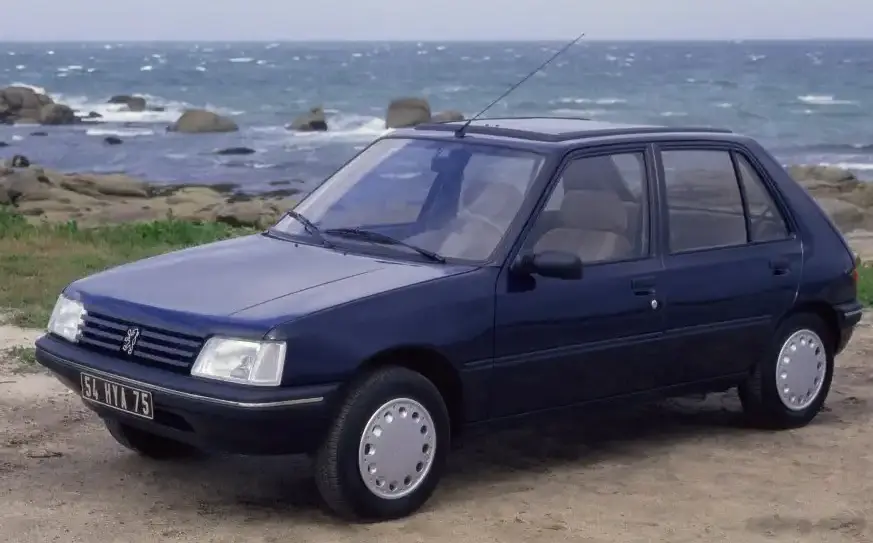
The Peugeot 205 I 1.3 Rallye, produced between 1987 and 1990, was a performance-oriented variant of Peugeot’s hugely successful 205 supermini. Falling within the 20A/C series after the 1987 facelift, the Rallye was designed to offer an accessible entry point into the world of sporty driving, bridging the gap between the standard 205 models and the more potent 205 GTI. It represented a significant step up in performance from the base 205s, appealing to enthusiasts seeking a fun-to-drive, lightweight hatchback. The Rallye was primarily marketed in Europe, where the demand for small, nimble, and affordable performance cars was high.
Technical Specifications
| Brand | Peugeot |
| Model | 205 |
| Generation | 205 I (20A/C, facelift 1987) |
| Type (Engine) | 1.3 Rallye (101 Hp) |
| Start of production | 1987 |
| End of production | 1990 |
| Powertrain Architecture | Internal Combustion engine |
| Body type | Hatchback |
| Seats | 5 |
| Doors | 3 |
| Fuel consumption (urban) | 9.6 l/100 km (24.5 US mpg, 29.4 UK mpg, 10.4 km/l) |
| Fuel consumption (extra urban) | 5.5 l/100 km (42.8 US mpg, 51.4 UK mpg, 18.2 km/l) |
| Fuel consumption (combined) | 7.6 l/100 km (30.9 US mpg, 37.2 UK mpg, 13.2 km/l) |
| Fuel Type | Petrol (Gasoline) |
| Acceleration 0 – 100 km/h | 9.6 sec |
| Acceleration 0 – 62 mph | 9.6 sec |
| Acceleration 0 – 60 mph | 9.1 sec |
| Maximum speed | 190 km/h (118.06 mph) |
| Weight-to-power ratio | 7.8 kg/Hp, 127.8 Hp/tonne |
| Weight-to-torque ratio | 6.7 kg/Nm, 149.4 Nm/tonne |
| Power | 101 Hp @ 6800 rpm |
| Power per litre | 78.1 Hp/l |
| Torque | 118 Nm @ 5000 rpm (87.03 lb.-ft. @ 5000 rpm) |
| Engine layout | Front, Transverse |
| Engine Model/Code | M2A TU24 |
| Engine displacement | 1294 cm3 (78.96 cu. in.) |
| Number of cylinders | 4 |
| Engine configuration | Inline |
| Cylinder Bore | 75 mm (2.95 in.) |
| Piston Stroke | 73.2 mm (2.88 in.) |
| Compression ratio | 9.6:1 |
| Number of valves per cylinder | 2 |
| Fuel injection system | Carburettor |
| Engine aspiration | Naturally aspirated |
| Engine oil capacity | 3.2 l (3.38 US qt, 2.82 UK qt) |
| Coolant capacity | 5.8 l (6.13 US qt, 5.1 UK qt) |
| Kerb Weight | 790 kg (1741.65 lbs.) |
| Max. weight | 1220 kg (2689.64 lbs.) |
| Max load | 430 kg (947.99 lbs.) |
| Trunk (boot) space – minimum | 290 l (10.24 cu. ft.) |
| Trunk (boot) space – maximum | 585 l (20.66 cu. ft.) |
| Fuel tank capacity | 50 l (13.21 US gal, 11 UK gal) |
| Length | 3705 mm (145.87 in.) |
| Width | 1560 mm (61.42 in.) |
| Height | 1375 mm (54.13 in.) |
| Wheelbase | 2420 mm (95.28 in.) |
| Front track | 1350 mm (53.15 in.) |
| Rear track | 1300 mm (51.18 in.) |
| Drivetrain Architecture | Front wheel drive |
| Number of gears | 5 gears, manual transmission |
| Front suspension | Coil spring |
| Rear suspension | Torsion |
| Front brakes | Disc |
| Rear brakes | Drum |
| Assisting systems | ABS (Anti-lock braking system) |
| Steering type | Steering rack and pinion |
| Power steering | Hydraulic |
| Tires size | 165/70 HR13 |
Powertrain & Engine Architecture
The heart of the 205 1.3 Rallye is the Peugeot M2A TU24 engine, a 1.3-liter (1294 cc) inline-four cylinder unit. This engine, while sharing a basic architecture with other TU-series engines used in the 205 range, was specifically tuned for performance. It featured a single overhead camshaft (SOHC) valvetrain with two valves per cylinder. Unlike the fuel-injected engines found in the GTI models, the Rallye utilized a Solex C32 PHH carburetor, a deliberate choice to keep costs down and maintain a certain level of mechanical simplicity. The carburetor, while less precise than fuel injection, provided a responsive throttle feel. The engine produced 101 horsepower at 6800 rpm and 118 Nm (87 lb-ft) of torque at 5000 rpm. The engine was transversely mounted, driving the front wheels through a five-speed manual transmission. This transmission featured relatively short gear ratios, contributing to the Rallye’s lively acceleration.
Driving Characteristics
The 205 1.3 Rallye offered a distinctly engaging driving experience. Its relatively low weight (approximately 790 kg or 1742 lbs) combined with the 101 hp engine resulted in a power-to-weight ratio that was noticeably higher than the standard 205 models. While not as brutally fast as the 205 GTI, the Rallye felt nimble and responsive, particularly on winding roads. The carburetor demanded a bit more driver involvement – requiring a touch of throttle finesse – but rewarded with a direct connection between the accelerator pedal and the engine. The five-speed gearbox allowed the driver to keep the engine in its sweet spot, maximizing performance. Compared to the GTI, the Rallye’s acceleration was slightly slower, but the difference wasn’t dramatic, and many drivers appreciated the Rallye’s more approachable power delivery.
Equipment & Trim Levels
The 205 1.3 Rallye was positioned as a sporty, but relatively basic, trim level. Standard equipment included sports seats, a three-spoke steering wheel, and a rev-counter. The interior trim was typically simple and functional, reflecting the car’s performance focus. Optional extras included a sunroof, central locking, and upgraded audio systems. The exterior was distinguished by subtle styling cues, including a black grille, body-colored bumpers, and a rear spoiler. The Rallye did not receive the same level of luxurious appointments as the GTI, but it offered a focused and driver-oriented environment.
Chassis & Braking
The 205 Rallye utilized a MacPherson strut front suspension and a torsion beam rear suspension. The suspension was tuned to provide a balance between comfort and handling, offering a firm but not overly harsh ride. The front brakes were disc brakes, while the rear brakes were drums. ABS (Anti-lock Braking System) was available as an option, enhancing safety. The steering was a rack-and-pinion system with hydraulic power assistance, providing precise and responsive steering feel. The relatively lightweight construction of the 205 chassis contributed significantly to its agility and handling prowess.
Market Reception & Comparison
The Peugeot 205 1.3 Rallye was well-received by automotive journalists and enthusiasts alike. It was praised for its lively performance, nimble handling, and affordability. Critics noted that it offered a compelling alternative to the more expensive 205 GTI, particularly for drivers who valued a more engaging and direct driving experience. Compared to the base 205 models, the Rallye offered a significant performance upgrade. Compared to the GTI, it was slightly slower in a straight line, but offered a more accessible and forgiving driving experience. Fuel economy was respectable for a performance-oriented hatchback of the era, averaging around 31 mpg in combined driving.
Legacy
The Peugeot 205 1.3 Rallye has become a sought-after classic among enthusiasts. Its combination of performance, affordability, and engaging driving dynamics has ensured its enduring appeal. The TU24 engine, while not known for being particularly complex, is generally considered reliable when properly maintained. However, like any classic car, the Rallye requires regular maintenance and attention to prevent corrosion. Today, well-preserved examples command a premium in the used car market, reflecting their status as a desirable and iconic French hatchback.
