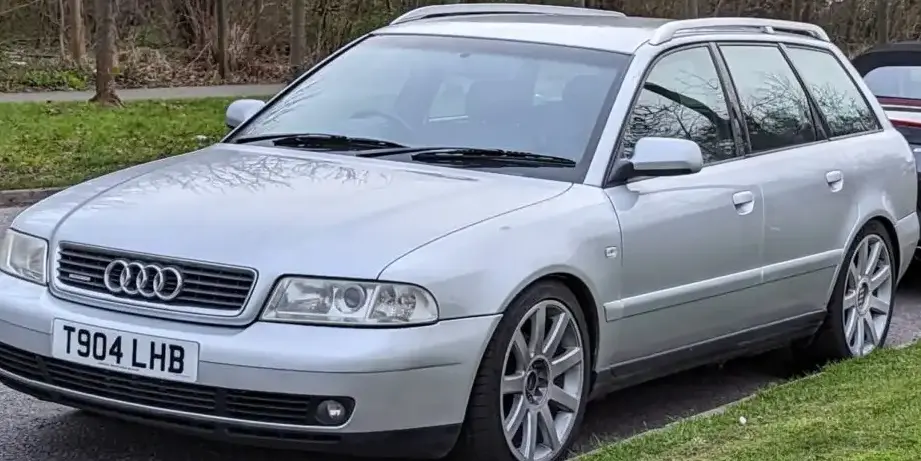
The Audi A4 Avant (B5, Typ 8D) facelift model produced between 1999 and September 2001, equipped with the 2.8-liter V6 30V engine producing 193 horsepower and paired with Audi’s quattro all-wheel drive system, represented a compelling blend of performance, practicality, and luxury within the compact executive wagon segment. This variant occupied a premium position in the B5 A4 lineup, sitting above the four-cylinder models and below the higher-performance S4. It was primarily marketed in Europe and North America, appealing to buyers seeking a refined and capable vehicle for both daily commuting and long-distance travel.
Technical Specifications
| Brand | Audi |
| Model | A4 |
| Generation | A4 Avant (B5, Typ 8D, facelift 1999) |
| Type (Engine) | 2.8 V6 30V (193 Hp) quattro |
| Start of production | 1999 |
| End of production | September, 2001 |
| Powertrain Architecture | Internal Combustion engine |
| Body type | Station wagon (estate) |
| Seats | 5 |
| Doors | 5 |
| Fuel consumption (urban) | 14.9 l/100 km (15.8 US mpg, 19 UK mpg, 6.7 km/l) |
| Fuel consumption (extra urban) | 8 l/100 km (29.4 US mpg, 35.3 UK mpg, 12.5 km/l) |
| Fuel consumption (combined) | 10.5 l/100 km (22.4 US mpg, 26.9 UK mpg, 9.5 km/l) |
| Fuel Type | Petrol (Gasoline) |
| Acceleration 0 – 100 km/h | 7.5 sec |
| Acceleration 0 – 62 mph | 7.5 sec |
| Acceleration 0 – 60 mph | 7.1 sec |
| Maximum speed | 234 km/h (145.4 mph) |
| Weight-to-power ratio | 7.6 kg/Hp, 131.7 Hp/tonne |
| Weight-to-torque ratio | 5.2 kg/Nm, 191.1 Nm/tonne |
| Power | 193 Hp @ 6000 rpm |
| Power per litre | 69.6 Hp/l |
| Torque | 280 Nm @ 3200 rpm (206.52 lb.-ft. @ 3200 rpm) |
| Engine layout | Front, Longitudinal |
| Engine Model/Code | AMX, APR, AQD |
| Engine displacement | 2771 cm3 (169.1 cu. in.) |
| Number of cylinders | 6 |
| Engine configuration | V-engine |
| Cylinder Bore | 82.5 mm (3.25 in.) |
| Piston Stroke | 86.4 mm (3.4 in.) |
| Compression ratio | 10.6:1 |
| Number of valves per cylinder | 5 |
| Fuel injection system | Multi-port manifold injection |
| Engine aspiration | Naturally aspirated engine |
| Valvetrain | DOHC |
| Engine oil capacity | 5.7 l (6.02 US qt, 5.02 UK qt) |
| Coolant | 8 l (8.45 US qt, 7.04 UK qt) |
| Kerb Weight | 1465 kg (3229.77 lbs.) |
| Max. weight | 2015 kg (4442.31 lbs.) |
| Max load | 550 kg (1212.54 lbs.) |
| Trunk (boot) space – minimum | 390 l (13.77 cu. ft.) |
| Trunk (boot) space – maximum | 1250 l (44.14 cu. ft.) |
| Fuel tank capacity | 60 l (15.85 US gal, 13.2 UK gal) |
| Length | 4479 mm (176.34 in.) |
| Width | 1733 mm (68.23 in.) |
| Height | 1417 mm (55.79 in.) |
| Wheelbase | 2607 mm (102.64 in.) |
| Front track | 1498 mm (58.98 in.) |
| Rear (Back) track | 1475 mm (58.07 in.) |
| Drag coefficient (Cd) | 0.32 |
| Minimum turning circle | 11.1 m (36.42 ft.) |
| Drivetrain Architecture | ICE drives all four wheels permanently |
| Drive wheel | All wheel drive (4×4) |
| Number of gears | 5 |
| Type of gearbox | Manual transmission |
| Front suspension | Double wishbone |
| Rear suspension | Suspension with traction connecting levers |
| Front brakes | Ventilated discs |
| Rear brakes | Ventilated discs |
| Assisting systems | ABS (Anti-lock braking system) |
| Steering type | Steering rack and pinion |
| Power steering | Hydraulic Steering |
| Tires size | 205/60 R15 |
| Wheel rims size | 15 |
Powertrain & Engine Architecture
The heart of this A4 Avant variant is the 2.8-liter V6 engine, identifiable by engine codes AMX, APR, or AQD depending on the specific market and production date. This engine is a naturally aspirated, 30-valve (5 valves per cylinder) V6, utilizing a double overhead camshaft (DOHC) design. Fuel delivery is managed by a multi-port fuel injection system, providing precise fuel metering for optimal combustion. The engine’s architecture is longitudinally mounted in the front of the vehicle, driving all four wheels through Audi’s renowned quattro all-wheel drive system. The 5-speed manual transmission was standard, offering a direct connection between the engine and the wheels. The engine’s design prioritized smooth power delivery and refinement over outright peak horsepower, making it well-suited for comfortable cruising and everyday driving.
Driving Characteristics
The 193 hp and 280 Nm (206 lb-ft) of torque provided by the 2.8 V6 engine, coupled with the quattro all-wheel drive, resulted in a capable and confident driving experience. Acceleration from 0-60 mph took approximately 7.1 seconds, making it noticeably quicker than the base four-cylinder models. The quattro system provided excellent traction in all weather conditions, enhancing stability and control. The 5-speed manual transmission offered precise shifts, allowing drivers to fully utilize the engine’s powerband. Compared to the 1.8T models, the V6 offered a more linear power delivery and a richer exhaust note. While not as fuel-efficient as the smaller displacement engines, the V6 provided a more refined and engaging driving experience.
Equipment & Trim Levels
The 2.8 V6 quattro Avant typically came well-equipped, reflecting its position as a premium trim level. Standard features often included automatic climate control, power windows and locks, a driver and passenger airbag, and an upgraded audio system. Interior upholstery was typically cloth, with leather options available as an upgrade. Optional extras included sunroof, heated front seats, premium audio systems, and alloy wheels. The dashboard layout was typical of the B5 A4, characterized by a functional and ergonomic design. The Avant’s spacious interior and large cargo area made it a practical choice for families and those needing to transport larger items.
Chassis & Braking
The A4 Avant’s chassis featured a double wishbone front suspension and a semi-independent suspension with traction connecting levers at the rear. This setup provided a good balance between ride comfort and handling precision. Brakes consisted of ventilated discs on all four wheels, providing ample stopping power. Anti-lock Braking System (ABS) was standard, enhancing safety and control during emergency braking situations. The suspension was tuned to provide a comfortable ride without sacrificing handling capabilities, making it suitable for both city driving and highway cruising.
Market Reception & Comparison
The 2.8 V6 quattro Avant was generally well-received by automotive critics. It was praised for its refined engine, capable handling, and practical wagon body style. Compared to the 1.8T models, the V6 was often seen as offering a more premium and sophisticated driving experience, albeit at a higher price point. Fuel economy was a common criticism, as the V6 consumed more fuel than the turbocharged four-cylinder engines. However, the V6’s reliability was generally considered good, with proper maintenance.
Legacy
The 2.8 V6 engine in the B5 A4 Avant has proven to be a relatively durable and reliable powertrain. While age and mileage can lead to common issues such as oil leaks and sensor failures, the engine is generally well-regarded by enthusiasts. Today, these vehicles are increasingly sought after by collectors and enthusiasts who appreciate their classic Audi styling, engaging driving dynamics, and relative simplicity compared to modern vehicles. The 2.8 V6 quattro Avant remains a compelling option for those seeking a practical and enjoyable classic wagon.