Technical Specifications
| Brand | Hyundai |
| Model | i10 |
| Generation | i10 III (facelift 2023) |
| Type (Engine) | 1.0 (63 Hp) AMT |
| Start of production | May, 2024 |
| Powertrain Architecture | Internal Combustion engine |
| Body type | Hatchback |
| Seats | 5 |
| Doors | 5 |
| Combined fuel consumption (WLTP) | 5.3 l/100 km (44.4 US mpg, 53.3 UK mpg, 18.9 km/l) |
| CO2 emissions (WLTP) | 121 g/km |
| Fuel Type | Petrol (Gasoline) |
| Acceleration 0 – 100 km/h | 18.4 sec |
| Acceleration 0 – 62 mph | 18.4 sec |
| Acceleration 0 – 60 mph | 17.5 sec |
| Maximum speed | 143 km/h (88.86 mph) |
| Emission standard | Euro 6e |
| Weight-to-power ratio | 14.7 kg/Hp, 68.2 Hp/tonne |
| Weight-to-torque ratio | 9.9 kg/Nm, 100.6 Nm/tonne |
| Power | 63 Hp @ 5500 rpm |
| Power per litre | 63.1 Hp/l |
| Torque | 93 Nm @ 3750 rpm (68.59 lb.-ft. @ 3750 rpm) |
| Engine layout | Front, Transverse |
| Engine Model/Code | G3LD |
| Engine displacement | 998 cm3 (60.9 cu. in.) |
| Number of cylinders | 3 |
| Engine configuration | Inline |
| Cylinder Bore | 71 mm (2.8 in.) |
| Piston Stroke | 84 mm (3.31 in.) |
| Number of valves per cylinder | 4 |
| Fuel injection system | Multi-port manifold injection |
| Engine aspiration | Naturally aspirated engine |
| Engine oil capacity | 3.1 l (3.28 US qt | 2.73 UK qt) |
| Coolant | 4.5 l (4.76 US qt | 3.96 UK qt) |
| Kerb Weight | 924-995 kg (2037.07 – 2193.6 lbs.) |
| Max. weight | 1410 kg (3108.52 lbs.) |
| Max load | 415-486 kg (914.92 – 1071.45 lbs.) |
| Trunk (boot) space – minimum | 252 l (8.9 cu. ft.) |
| Trunk (boot) space – maximum | 1050 l (37.08 cu. ft.) |
| Fuel tank capacity | 36 l (9.51 US gal | 7.92 UK gal) |
| Max. roof load | 60 kg (132.28 lbs.) |
| Permitted trailer load with brakes (12%) | 310 kg (683.43 lbs.) |
| Permitted trailer load without brakes | 310 kg (683.43 lbs.) |
| Permitted towbar download | 75 kg (165.35 lbs.) |
| Length | 3670 mm (144.49 in.) |
| Width | 1680 mm (66.14 in.) |
| Height | 1480 mm (58.27 in.) |
| Wheelbase | 2425 mm (95.47 in.) |
| Front track | 1467 mm (57.76 in.) |
| Rear (Back) track | 1478 mm (58.19 in.) |
| Front overhang | 540 mm (21.26 in.) |
| Rear overhang | 705 mm (27.76 in.) |
| Ride height (ground clearance) | 149 mm (5.87 in.) |
| Drivetrain Architecture | The Internal combustion engine (ICE) drives the front wheels of the vehicle. |
| Drive wheel | Front wheel drive |
| Number of gears and type of gearbox | 5 gears, automatic transmission AMT |
| Front suspension | Independent type McPherson |
| Rear suspension | Torsion |
| Front brakes | Ventilated discs |
| Rear brakes | Disc |
| Assisting systems | ABS (Anti-lock braking system) |
| Steering type | Steering rack and pinion |
| Power steering | Electric Steering |
| Tires size | 185/55 R15; 195/45 R16 |
| Wheel rims size | 6.0J x 15; 6.5J x 16 |
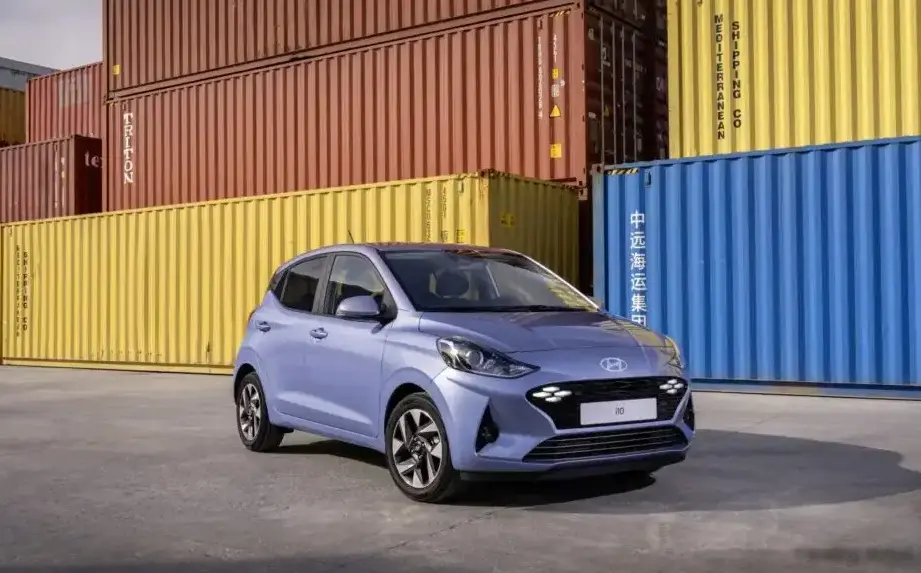
The Hyundai i10 III (facelift, introduced in May 2024) 1.0 (63 Hp) AMT represents the entry point into the third generation of Hyundai’s city car. Positioned as an affordable and practical option within the i10 range, this variant caters to buyers prioritizing fuel efficiency and ease of use over outright performance. It builds upon the foundation of the PA3 platform, offering a refreshed design and updated technology compared to the pre-facelift models. This specific configuration – the 1.0-liter engine paired with an automated manual transmission (AMT) – is primarily aimed at urban drivers seeking a comfortable and economical driving experience.
Powertrain & Engine Architecture
The heart of this i10 variant is the Hyundai G3LD, a 998cc inline-three cylinder petrol engine. This engine utilizes a multi-point fuel injection system and is naturally aspirated, meaning it doesn’t employ a turbocharger or supercharger. The G3LD engine is known for its simplicity and relatively low maintenance requirements. The engine produces 63 horsepower at 5,500 rpm and 93 Nm (68.59 lb-ft) of torque at 3,750 rpm. Paired with this engine is a 5-speed Automated Manual Transmission (AMT). Unlike a traditional automatic transmission with a torque converter, an AMT uses actuators to shift gears automatically, essentially automating a manual gearbox. This results in a more fuel-efficient, but sometimes less smooth, shifting experience compared to conventional automatics.
Driving Characteristics
The 1.0-liter AMT i10 prioritizes fuel economy over spirited performance. Acceleration is modest, taking approximately 18.4 seconds to reach 62 mph (100 km/h). In real-world driving, the AMT can exhibit noticeable pauses during gear changes, particularly during quick acceleration. The gear ratios are tuned for efficiency, meaning the engine operates at lower revolutions per minute during cruising speeds. Compared to the more powerful 1.2-liter engine option, this variant feels noticeably slower, especially when fully loaded or tackling inclines. However, for purely urban commutes, the 1.0-liter provides adequate power and a comfortable driving experience.
Equipment & Trim Levels
The 1.0 AMT i10 typically comes with a base level of equipment, focusing on essential features. Standard amenities generally include air conditioning, power steering, central locking, and an integrated audio system with USB connectivity. Safety features such as ABS (Anti-lock Braking System) and multiple airbags are also standard. Higher trim levels offer upgrades like alloy wheels, a touchscreen infotainment system with smartphone integration (Apple CarPlay and Android Auto), and additional safety features like lane departure warning. Interior upholstery is typically cloth, with a functional and durable design.
Chassis & Braking
The i10 III utilizes a McPherson strut front suspension and a torsion beam rear suspension. This setup provides a comfortable ride quality, particularly on smooth urban roads. The front brakes are ventilated discs, offering adequate stopping power, while the rear brakes are discs. The steering is electrically assisted, providing light and easy maneuverability. The relatively lightweight nature of the i10 contributes to its nimble handling characteristics.
Market Reception & Comparison
The 1.0-liter AMT i10 is often praised for its affordability and fuel efficiency. Critics generally acknowledge its suitability for city driving, but point out its lack of performance for highway journeys. Compared to the 1.2-liter variants, the 1.0 AMT offers significantly better fuel economy but sacrifices acceleration and overall driving enjoyment. Reliability is generally good, with the G3LD engine proving to be a durable unit. However, the AMT transmission can be prone to occasional jerky shifts, and some owners have reported issues with the actuators over time.
Legacy
The Hyundai i10 III 1.0 AMT has established itself as a popular choice in the budget city car segment. Its combination of low running costs, practicality, and a reasonable level of equipment makes it an attractive option for first-time car buyers and those seeking an economical urban runabout. On the used car market, these models are generally well-regarded for their reliability and affordability, though potential buyers should be aware of the potential for issues with the AMT transmission and ensure regular maintenance has been performed.