
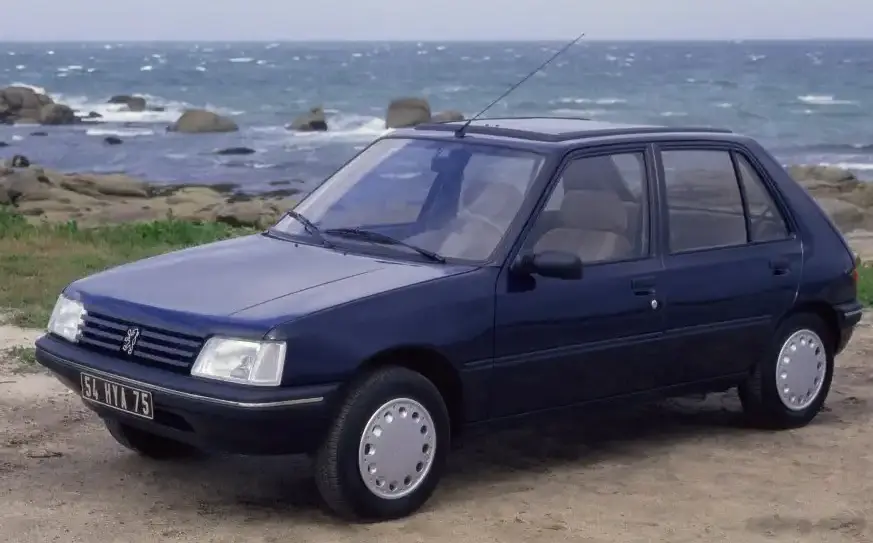
The Peugeot 205, launched in 1983, quickly became a cornerstone of the French automotive landscape and a popular choice across Europe. The 205 I, specifically the facelifted version introduced in 1987 (designated 20A/C), represented a refinement of the original design, offering improved features and a slightly updated aesthetic. Within the 205 range, the 1.4-liter (67 horsepower) variant occupied an entry-level position, aimed at buyers prioritizing affordability and fuel economy. Produced from 1987 to 1990, this model served as a practical and accessible option in a market increasingly demanding compact, efficient vehicles. It was a key component in Peugeot’s strategy to offer a broad range of choices within the 205 lineup, catering to diverse customer needs.
Technical Specifications
| Brand | Peugeot |
| Model | 205 |
| Generation | 205 I (20A/C, facelift 1987) |
| Type (Engine) | 1.4 (67 Hp) |
| Start of production | 1987 |
| End of production | 1990 |
| Powertrain Architecture | Internal Combustion engine |
| Body type | Hatchback |
| Fuel Type | Petrol (Gasoline) |
| Power | 67 Hp |
| Engine Model/Code | K1D TU3A |
| Engine aspiration | Naturally aspirated engine |
| Engine oil capacity | 3.2 l (3.38 US qt | 2.82 UK qt) |
| Coolant capacity | 5.8 l (6.13 US qt | 5.1 UK qt) |
Powertrain & Engine Architecture
The heart of the 205 1.4 was the K1D engine, a member of Peugeot’s TU3 family of inline-four cylinder petrol engines. This 1360cc unit was a relatively simple design, featuring a single overhead camshaft (SOHC) operating two valves per cylinder. The engine utilized a Bosch L-Jetronic fuel injection system, a common setup for the era, providing a balance between efficiency and performance. While not particularly powerful, the TU3A engine was known for its reliability and relatively low maintenance costs. The engine’s architecture prioritized durability over outright performance, making it well-suited for everyday driving. The 67 horsepower output was achieved at 6000 rpm, with peak torque of approximately 84 lb-ft (114 Nm) at 3000 rpm. The engine was transversely mounted at the front of the vehicle, driving the front wheels.
Driving Characteristics
The 1.4-liter 205 offered a decidedly unhurried driving experience. With 67 horsepower propelling a relatively lightweight hatchback, acceleration was modest. Zero to sixty mph times were typically in the 13-14 second range. The four-speed manual transmission, the most common pairing, was geared to prioritize fuel economy rather than spirited performance. The gear ratios were relatively tall, requiring frequent downshifts when overtaking or climbing hills. While the engine lacked the punch of the higher-spec 1.6 or 1.9-liter versions, it was perfectly adequate for urban driving and shorter journeys. The steering was light and precise, a hallmark of the 205, making it easy to maneuver in tight spaces. The suspension, while basic, provided a comfortable ride, absorbing bumps and imperfections in the road surface reasonably well.
Equipment & Trim Levels
The 1.4-liter 205 typically represented the base trim level. Standard equipment was fairly minimal, reflecting its position as an affordable option. Features generally included cloth upholstery, a basic dashboard with analog gauges, and manual windows and door locks. A simple two-speaker AM/FM radio was often included, though higher-end audio systems were available as options. Interior trim was typically a durable, though somewhat utilitarian, plastic. Optional extras included a sunroof, upgraded upholstery, and central locking. The exterior featured steel wheels with hubcaps, and body-colored bumpers were often an optional upgrade. The focus was on providing a functional and reliable vehicle at a competitive price point.
Chassis & Braking
The 205 I utilized a relatively simple chassis design. The front suspension consisted of independent MacPherson struts, while the rear employed a torsion beam axle. This setup provided a good balance between ride comfort and handling. Braking was typically accomplished with disc brakes on the front wheels and drum brakes on the rear. The braking system was adequate for the vehicle’s performance, but lacked the stopping power of the larger-engined models with optional front discs. Steering was rack and pinion, providing precise and responsive control. The relatively lightweight construction of the 205 contributed to its nimble handling characteristics. Stabilizer bars were not typically fitted to the base 1.4-liter model, further emphasizing its focus on affordability.
Market Reception & Comparison
The 1.4-liter 205 was generally well-received as a practical and economical city car. Critics praised its fuel efficiency and ease of driving, but noted its lack of outright performance. Compared to the 1.6-liter and 1.9-liter versions, the 1.4 offered significantly less power and a slower driving experience. However, it also benefited from lower running costs and insurance premiums. The 1.9-liter diesel variant offered superior fuel economy but lacked the refinement of the petrol engine. The 1.4’s main appeal lay in its affordability and suitability for drivers who prioritized practicality over performance. It was a popular choice for first-time car buyers and those seeking a reliable and economical runabout.
Legacy
The Peugeot 205 1.4, while not the most powerful or glamorous version of the 205, remains a fondly remembered car. The TU3 engine proved to be exceptionally durable, and many examples are still on the road today. The 205’s simple design and readily available parts make it relatively easy to maintain. In the used car market, the 1.4-liter models are typically the most affordable 205s, making them an attractive option for enthusiasts on a budget. While not highly sought after by collectors, they represent a reliable and charming piece of automotive history. The 205, in all its variants, established Peugeot as a major player in the small car segment and paved the way for future generations of successful compact vehicles.
