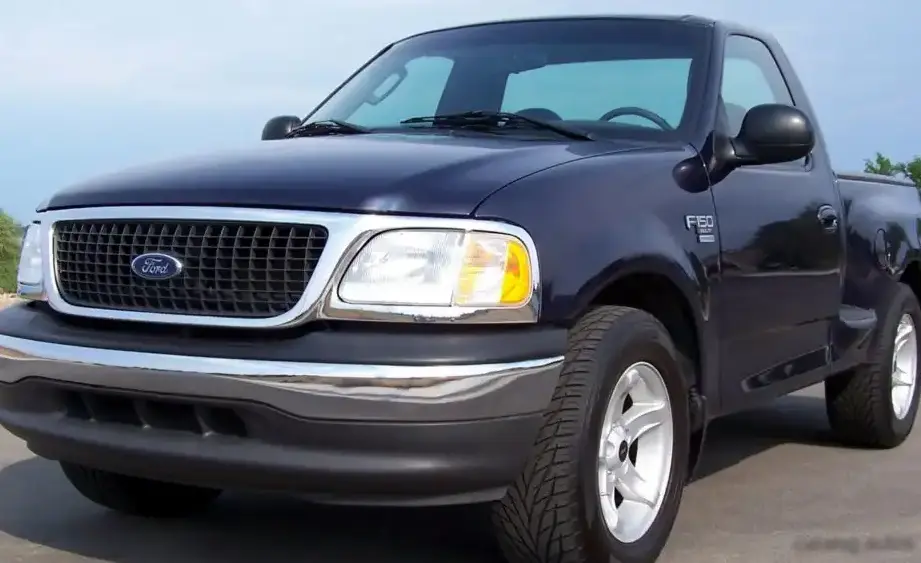
The Ford F-Series F-150 X Regular Cab, equipped with the 4.6-liter V8 Triton engine and a four-speed automatic transmission, represents a significant iteration of America’s best-selling vehicle. Produced for the 1997 and 1998 model years, this configuration occupied a middle ground within the F-150 lineup, offering a balance between capability, affordability, and convenience. It was part of the tenth generation of the F-Series (1997-2003), known for its substantial redesign and focus on enhanced comfort and interior space compared to its predecessors. This particular variant catered to buyers needing a robust work truck with the ease of an automatic transmission and the added security of four-wheel drive.
Technical Specifications
| Brand | Ford |
| Model | F-Series F-150 X Regular Cab |
| Generation | F-Series F-150 X Regular Cab |
| Type (Engine) | 4.6 V8 Triton (220 Hp) 4×4 Automatic |
| Start of production | 1997 |
| End of production | 1998 |
| Powertrain Architecture | Internal Combustion engine |
| Body type | Pick-up |
| Seats | 3 |
| Doors | 2 |
| Fuel Type | Petrol (Gasoline) |
| Power | 220 Hp @ 4500 rpm |
| Power per litre | 47.8 Hp/l |
| Torque | 393 Nm @ 3250 rpm / 289.86 lb.-ft. @ 3250 rpm |
| Engine layout | Front, Longitudinal |
| Engine displacement | 4605 cm3 / 281.01 cu. in. |
| Number of cylinders | 8 |
| Engine configuration | V-engine |
| Compression ratio | 9:1 |
| Number of valves per cylinder | 2 |
| Fuel injection system | Multi-port manifold injection |
| Engine aspiration | Naturally aspirated engine |
| Valvetrain | SOHC |
| Engine oil capacity | 5.7 l / 6.02 US qt | 5.02 UK qt |
| Coolant | 19.5 l / 20.61 US qt | 17.16 UK qt |
| Max. weight | 2722 kg / 6000.98 lbs |
| Trunk (boot) space – minimum | 1659 l / 58.59 cu. ft |
| Trunk (boot) space – maximum | 2056 l / 72.61 cu. ft |
| Fuel tank capacity | 93-114 l / 24.57 – 30.12 US gal | 20.46 – 25.08 UK gal |
| Permitted trailer load with brakes (12%) | 3084 kg / 6799.06 lbs |
| Length | 5174-5646 mm / 203.7 – 222.28 in |
| Wheelbase | 3048-3531 mm / 120 – 139.02 in |
| Ride height (ground clearance) | 185 mm / 7.28 in |
| Wading depth | 886-889 mm / 34.88 – 35 in |
| Drivetrain Architecture | The Internal combustion engine (ICE) drives the rear wheels permanently, and the front wheels are driven through an electrically or mechanically operated clutch if necessary. |
| Drive wheel | All wheel drive (4×4) |
| Number of gears and type of gearbox | 4 gears, automatic transmission |
| Front suspension | Torsion |
| Front brakes | Ventilated discs |
| Rear brakes | Ventilated discs |
| Power steering | Electric Steering |
| Tires size | 235/70 R16 |
| Wheel rims size | 7.0J x 16 |
Powertrain & Engine Architecture
The heart of this F-150 X was the 4.6-liter Triton V8 engine. This engine, part of Ford’s modular engine family, featured a single overhead camshaft (SOHC) design with two valves per cylinder. The multi-port fuel injection system delivered fuel directly to each intake port, optimizing combustion efficiency. The 9:1 compression ratio was a compromise between performance and the ability to run on readily available gasoline grades. The engine produced 220 horsepower at 4500 rpm and 393 Nm (289.86 lb-ft) of torque at 3250 rpm. The four-speed automatic transmission (likely the 4R70W) was chosen for its durability and ease of use, making it a popular choice for drivers who preferred not to deal with a manual clutch. This transmission featured electronic control for smoother shifting and improved fuel economy.
Driving Characteristics
The 4.6L V8 with the four-speed automatic provided adequate, though not exhilarating, performance. Acceleration was reasonable for a full-size pickup, but it wasn’t designed for rapid sprints. The automatic transmission’s gear ratios were tuned for towing and hauling, prioritizing low-end torque over high-revving performance. Compared to the optional 5.4-liter Triton V8, this engine offered less power and quicker acceleration. The 4.6L was also noticeably more fuel-efficient than the larger engine. Against the diesel options available at the time, the 4.6L lacked the substantial low-end torque favored for heavy-duty work, but it offered a quieter and smoother driving experience.
Equipment & Trim Levels
The F-150 X Regular Cab with the 4.6L engine and automatic transmission typically came standard with features like air conditioning, a basic AM/FM radio, and cloth upholstery. Power steering and power brakes were also standard. The “X” trim level represented a step up from the base model, often including features like upgraded interior trim, color-matched exterior components, and potentially a tilt steering wheel. Optional extras included a cassette or CD player, upgraded sound systems, power windows and locks, and a sliding rear window. The regular cab configuration meant seating for three passengers and a focus on practicality over passenger comfort.
Chassis & Braking
The F-150 X utilized a body-on-frame construction, providing a robust and durable platform. The front suspension employed torsion bars, while the rear suspension featured leaf springs. This setup was designed to handle heavy loads and provide a comfortable ride. Braking duties were handled by ventilated discs on all four wheels, offering adequate stopping power for the vehicle’s weight. The four-wheel drive system, engaged via an electronically controlled transfer case, provided enhanced traction in challenging conditions. The 235/70 R16 tires offered a good balance between on-road comfort and off-road capability.
Market Reception & Comparison
The 1997-1998 F-150 X with the 4.6L V8 and automatic transmission was generally well-received by consumers and automotive critics. It was praised for its comfortable ride, spacious interior, and improved build quality compared to previous generations. However, some critics noted that the 4.6L engine could feel underpowered when towing heavy loads or driving in hilly terrain. Fuel economy was considered average for a full-size pickup truck. Compared to the 5.4L V8, the 4.6L offered a lower price point and better fuel efficiency, making it an attractive option for buyers who didn’t require maximum power. The diesel options, while more expensive, provided superior towing capacity and fuel economy for those engaged in demanding work applications.
Legacy
The 4.6-liter Triton V8 engine proved to be a reliable and durable powerplant, and many examples are still on the road today. While early versions of the engine were known for potential spark plug issues, these were largely addressed in later years. The four-speed automatic transmission also proved to be relatively reliable, although regular maintenance is crucial for long-term durability. In the used car market, these F-150s are often sought after for their affordability and practicality. They represent a solid choice for buyers looking for a capable and dependable work truck that won’t break the bank. The tenth-generation F-150, including this specific variant, helped solidify the F-Series’ position as the best-selling truck in America for decades.